A team of researchers led by Rensselaer Polytechnic Institute’s Trevor David Rhone, assistant professor in the Department of Physics, Applied Physics, and Astronomy, has identified novel van der Waals (vdW) magnets using cutting-edge tools in artificial intelligence (AI). In particular, the team identified transition metal halide vdW materials with large magnetic moments that are predicted to be chemically stable using semi-supervised learning. These two-dimensional (2D) vdW magnets have potential applications in data storage, spintronics, and even quantum computing.
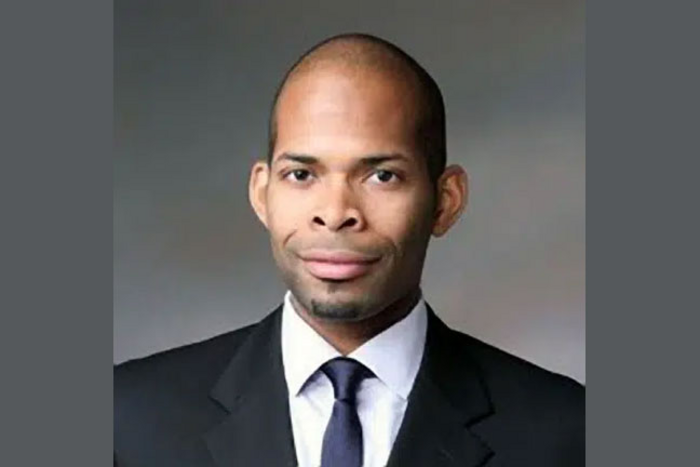
Credit: Rensselaer Polytechnic Institute
A team of researchers led by Rensselaer Polytechnic Institute’s Trevor David Rhone, assistant professor in the Department of Physics, Applied Physics, and Astronomy, has identified novel van der Waals (vdW) magnets using cutting-edge tools in artificial intelligence (AI). In particular, the team identified transition metal halide vdW materials with large magnetic moments that are predicted to be chemically stable using semi-supervised learning. These two-dimensional (2D) vdW magnets have potential applications in data storage, spintronics, and even quantum computing.
Rhone specializes in harnessing materials informatics to discover new materials with unexpected properties that advance science and technology. Materials informatics is an emerging field of study at the intersection of AI and materials science. His team’s latest research was recently featured on the cover of Advanced Theory and Simulations.
2D materials, which can be as thin as a single atom, were only discovered in 2004 and have been the subject of great scientific curiosity because of their unexpected properties. 2D magnets are significant because their long-range magnetic ordering persists when they are thinned down to one or a few layers. This is due to magnetic anisotropy. The interplay with this magnetic anisotropy and low dimensionality could give rise to exotic spin degrees of freedom, such as spin textures that can be used in the development of quantum computing architectures. 2D magnets also span the full range of electronic properties and can be used in high-performance and energy-efficient devices.
Rhone and team combined high-throughput density functional theory (DFT) calculations, to determine the vdW materials’ properties, with AI to implement a form of machine learning called semi-supervised learning. Semi-supervised learning uses a combination of labeled and unlabeled data to identify patterns in data and make predictions. Semi-supervised learning mitigates a major challenge in machine learning – the scarcity of labeled data.
“Using AI saves time and money,” said Rhone. “The typical materials discovery process requires expensive simulations on a supercomputer that can take months. Lab experiments can take even longer and can be more expensive. An AI approach has the potential to speed up the materials discovery process.”
Using an initial subset of 700 DFT calculations on a supercomputer, an AI model was trained that could predict the properties of many thousands of materials candidates in milliseconds on a laptop. The team then identified promising candidate vdW materials with large magnetic moments and low formation energy. Low formation energy is an indicator of chemical stability, which is an important requirement for synthesizing the material in a laboratory and subsequent industrial applications.
“Our framework can easily be applied to explore materials with different crystal structures, as well,” said Rhone. “Mixed crystal structure prototypes, such as a data set of both transition metal halides and transition metal trichalcogenides, can also be explored with this framework.”
“Dr. Rhone’s application of AI to the field of materials science continues to produce exciting results,” said Curt Breneman, dean of Rensselaer’s School of Science. “He has not only accelerated our understanding of 2D materials that have novel properties, but his findings and methods are likely to contribute to new quantum computing technologies.”
Rhone was joined in research by Romakanta Bhattarai and Haralambos Gavras of Renselaer; Bethany Lusch and Misha Salim of Argonne National Laboratory; Marios Mattheakis, Daniel T. Larson, and Efthimios Kaxiras of Harvard University; and Yoshiharu Krockenberger of NTT Basic Research Laboratories.
About Rensselaer Polytechnic Institute:
Founded in 1824, Rensselaer Polytechnic Institute is America’s first technological research university. Rensselaer encompasses five schools, over 30 research centers, more than 140 academic programs including 25 new programs, and a dynamic community made up of over 6,800 students and 104,000 living alumni. Rensselaer faculty and alumni include upwards of 155 National Academy members, six members of the National Inventors Hall of Fame, six National Medal of Technology winners, five National Medal of Science winners, and a Nobel Prize winner in Physics. With nearly 200 years of experience advancing scientific and technological knowledge, Rensselaer remains focused on addressing global challenges with a spirit of ingenuity and collaboration. To learn more, please visit www.rpi.edu.
Contact:
Katie Malatino
Sr. Communications Specialist
[email protected]
838-240-5691
For general inquiries: [email protected]
Visit the Rensselaer research and discovery blog: https://everydaymatters.rpi.edu/
Follow us on Twitter: @RPINews
Journal
Advanced Theory and Simulations
DOI
10.1002/adts.202300019
Method of Research
Computational simulation/modeling
Subject of Research
Not applicable
Article Title
Artificial Intelligence Guided Studies of van der Waals Magnets
Article Publication Date
16-Apr-2023