— JOINT PRESS RELEASE OF FORSCHUNGSZENTRUM JÜLICH AND JOHANNES GUTENBERG UNIVERSITY MAINZ —
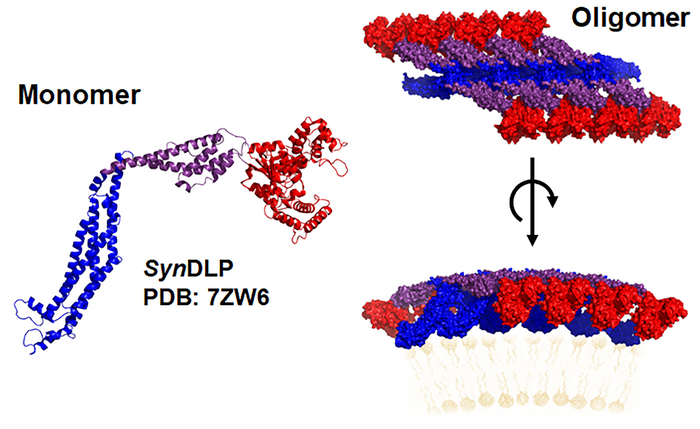
Credit: ill./©: Lucas Gewehr, Dirk Schneider
— JOINT PRESS RELEASE OF FORSCHUNGSZENTRUM JÜLICH AND JOHANNES GUTENBERG UNIVERSITY MAINZ —
SynDLP could be a bacterial ancestor of eukaryotic membrane proteins
The cells of living organisms are equipped with proteins that are involved in the shaping and remodeling of cellular membranes, thereby performing important tasks. The cell membrane encloses the cell interior, but is constantly remodeled, for example, due to membrane budding, invagination, or fusion processes. This also involves various proteins that were long assumed to be present exclusively or predominantly in higher organisms. In the past 10 to 20 years, however, proteins have been identified or predicted to be present also in simple organisms that do not possess a nucleus. In a research collaboration, a protein involved in membrane remodeling in cyanobacteria has now been described for the first time. The existence of such a bacterial protein was suspected, but proof was still pending. The studied protein is likely a bacterial representative of a similar protein found in higher organisms such as animals and plants.
Membrane proteins also discovered in prokaryotes
Membrane proteins are involved in a variety of membrane remodeling as well as repair processes to cope with membrane damage and thus ensure cell survival. In the past decade, such proteins have also been discovered in prokaryotes, i.e., simple organisms that do not have a cell nucleus. Many of these have similarities to proteins previously thought to be found solely in more complex organisms that contain a cell nucleus, i.e., the eukaryotes, such as animals and plants.
So-called dynamins and dynamin-like proteins were also originally thought to be eukaryotic inventions until a bioinformatics study in 1999 predicted the existence of bacterial dynamin-like proteins or DLPs. These DLPs belong to the dynamin protein superfamily and are involved in various membrane remodeling processes in eukaryotes.
Recently, a specific DLP, namely SynDLP, has been identified in the genome of a cyanobacterium. This protein was studied by research teams from Johannes Gutenberg University Mainz (JGU) and Forschungszentrum Jülich with participation from Heinrich Heine University Düsseldorf (HHU). “We previously assumed that we would only find this type of protein in eukaryotic cells,” said Professor Dirk Schneider, head of the Membrane Proteins group at JGU. “SynDLP has a structure that we previously thought only exists in higher organisms,” added Professor Carsten Sachse, a scientist at Forschungszentrum Jülich and professor at HHU. “The structural properties of SynDLP suggest that it is the closest known bacterial ancestor of eukaryotic dynamin,” Sachse described the results. “We assume that this protein was already present in a primordial cell before they further developed into cells with and without a nucleus,” added Schneider.
Cyanobacteria use an internal membrane system for photosynthesis
Cyanobacteria are among the oldest organisms on earth. They are also called blue-green bacteria because of their color. Unlike other bacteria, they possess a second internal membrane system in which the light reactions of photosynthesis take place. However, precisely because of the light reaction, the membrane is very vulnerable and is subject to constant repair and remodeling. Therefore, membrane-remodeling proteins are particularly important for the reconstruction or repair of the membrane.
“We do not yet know exactly what function SynDLP has in membrane dynamics,” said Professor Dirk Schneider. It does not appear to be vital under laboratory conditions. “However, if it were not essential, it would not have been conserved over billions of years,” surmised the chemist from Mainz University. In the future, the scientists want to pursue this question and investigate exactly what function the protein performs in bacterial cells.
Long-term research cooperation bears fruit
Three young scientists played a key role in the eight years of research now published: Dr. Ruven Jilly and Lucas Gewehr from JGU and Dr. Benedikt Junglas from Forschungszentrum Jülich, formerly a doctoral student at the Max Planck Graduate Center with Johannes Gutenberg University Mainz (MPGC). Other collaborators are from the Max Planck Institute for Polymer Research in Mainz and Aarhus University in Denmark. The work has just been published in Nature Communications.
Publications:
L. Gewehr et al., SynDLP is a dynamin-like protein of Synechocystis sp. PCC 6803 with eukaryotic features, Nature Communications 14: 2156, 14 April 2023,
DOI: 10.1038/s41467-023-37746-9
https://www.nature.com/articles/s41467-023-37746-9
C. Siebenaller, D. Schneider, Cyanobacterial membrane dynamics in the light of eukaryotic principles, Bioscience Reports 43: 2, 23 February 2023,
DOI: 10.1042/BSR20221269
https://portlandpress.com/bioscirep/article/43/2/BSR20221269/232406/Cyanobacterial-membrane-dynamics-in-the-light-of
Related links:
- https://www.blogs.uni-mainz.de/fb09-schneider/ – Membrane Proteins group of Professor Dirk Schneider at the JGU Department of Chemistry
- https://www.mpip-mainz.mpg.de/en/home – Max Planck Institute for Polymer Research
- https://www.fz-juelich.de – Forschungszentrum Jülich
- http://www.fz-juelich.de/er-c/er-c-3 – Structural Biology research division at the Ernst-Ruska Center for Microscopy and Spectroscopy with Electrons at Forschungszentrum Jülich
Read more:
- https://press.uni-mainz.de/membrane-proteins-of-bacteria-and-humans-show-surprising-similarities/ – press release “Membrane proteins of bacteria and humans show surprising similarities” (24 June 2021)
- https://press.uni-mainz.de/protective-shield-a-membrane-attached-protein-protects-bacteria-and-chloroplasts-from-stress/ – press release “Protective shield: A membrane-attached protein protects bacteria and chloroplasts from stress” (23 Oct. 2020)
- https://press.uni-mainz.de/fusion-protein-controls-design-of-photosynthesis-platform/ – press release “Fusion protein controls design of photosynthesis platform” (13 May 2015)
Journal
Nature Communications
DOI
10.1038/s41467-023-37746-9
Article Title
SynDLP is a dynamin-like protein of Synechocystis sp. PCC 6803 with eukaryotic features
Article Publication Date
14-Apr-2023