Doctors often use tongue depressors when peering in a patient’s mouth and throat. But what if that flat wooden spatula could actively evaluate the patient’s health? That’s the premise of an ecofriendly disposable sensor, reported in ACS’ Analytical Chemistry, that can check levels of glucose and other biomarkers in saliva. Researchers say the easy-to-produce device could someday help doctors assess a range of conditions.
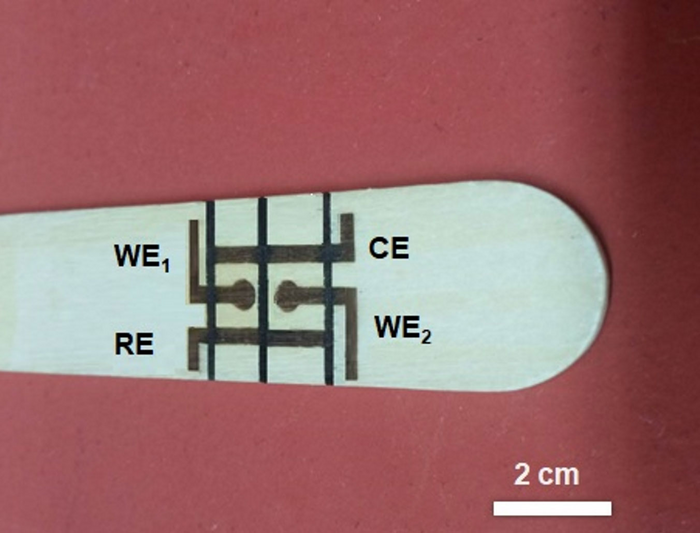
Credit: Adapted from Analytical Chemistry, 2023, DOI: 10.1021/acs.analchem.3c01211
Doctors often use tongue depressors when peering in a patient’s mouth and throat. But what if that flat wooden spatula could actively evaluate the patient’s health? That’s the premise of an ecofriendly disposable sensor, reported in ACS’ Analytical Chemistry, that can check levels of glucose and other biomarkers in saliva. Researchers say the easy-to-produce device could someday help doctors assess a range of conditions.
Wood is a renewable, biodegradable, natural material that is widely available at low cost, which makes it attractive for researchers who design electronics and sensors. However, this is challenging because the material isn’t good at conducting electricity. One solution is to use wood as a passive substrate and then coat it with metals and carbon-based inks. Alternatively, high-power lasers can char specific regions on the wood, turning those spots into conductive graphite. But this complicated technique requires sophisticated and expensive instrumentation, an oxygen-free atmosphere and fire retardants. To develop a cheaper and easier process, Christos Kokkinos and colleagues turned to low-power diode lasers, which have already been successfully used to make polyimide-based sensors but haven’t previously been applied to wooden electronics and electrochemical sensors.
The team used a portable, low-cost laser engraver to create a pattern of conductive graphite electrodes on a wooden tongue depressor, without the need for special conditions. Those electrodes formed two electrochemical cells separated by lines drawn with a water-repellent permanent marker. The biosensor was then used to rapidly and simultaneously measure concentrations of nitrite and glucose in artificial saliva. Nitrite can reveal oral diseases, such as periodontitis, while glucose can serve as a diagnostic for diabetes. The researchers say these low-cost devices could be adapted to detect other saliva biomarkers and would be quick and easy to produce on-site at medical facilities.
The researchers did not receive outside funding for the study.
The American Chemical Society (ACS) is a nonprofit organization chartered by the U.S. Congress. ACS’ mission is to advance the broader chemistry enterprise and its practitioners for the benefit of Earth and all its people. The Society is a global leader in promoting excellence in science education and providing access to chemistry-related information and research through its multiple research solutions, peer-reviewed journals, scientific conferences, eBooks and weekly news periodical Chemical & Engineering News. ACS journals are among the most cited, most trusted and most read within the scientific literature; however, ACS itself does not conduct chemical research. As a leader in scientific information solutions, its CAS division partners with global innovators to accelerate breakthroughs by curating, connecting and analyzing the world’s scientific knowledge. ACS’ main offices are in Washington, D.C., and Columbus, Ohio.
To automatically receive news releases from the American Chemical Society, contact [email protected].
Follow us: Twitter | Facebook | LinkedIn | Instagram
Journal
Analytical Chemistry
DOI
10.1021/acs.analchem.3c01211
Article Title
“Wooden Tongue Depressor Multiplex Saliva Biosensor Fabricated via Diode Laser Engraving”
Article Publication Date
20-Apr-2023