• HOME
  • NEWS
  • EXPLORE
    • CAREER
      • Companies
      • Jobs
    • EVENTS
    • iGEM
      • News
      • Team
    • PHOTOS
    • VIDEO
    • WIKI
  • BLOG
  • COMMUNITY
    • FACEBOOK
    • INSTAGRAM
    • TWITTER
Friday, July 10, 2026
BIOENGINEER.ORG
No Result
View All Result
  • Login
  • HOME
  • NEWS
  • EXPLORE
    • CAREER
      • Companies
      • Jobs
        • Lecturer
        • PhD Studentship
        • Postdoc
        • Research Assistant
    • EVENTS
    • iGEM
      • News
      • Team
    • PHOTOS
    • VIDEO
    • WIKI
  • BLOG
  • COMMUNITY
    • FACEBOOK
    • INSTAGRAM
    • TWITTER
  • HOME
  • NEWS
  • EXPLORE
    • CAREER
      • Companies
      • Jobs
        • Lecturer
        • PhD Studentship
        • Postdoc
        • Research Assistant
    • EVENTS
    • iGEM
      • News
      • Team
    • PHOTOS
    • VIDEO
    • WIKI
  • BLOG
  • COMMUNITY
    • FACEBOOK
    • INSTAGRAM
    • TWITTER
No Result
View All Result
Bioengineer.org
No Result
View All Result
Home NEWS Science News Chemistry

New approach allows faster test of urea in body fluids

Bioengineer by Bioengineer
February 22, 2023
in Chemistry
Reading Time: 2 mins read
0
New Approach Allows Faster Test of Urea in Body Fluids
Share on FacebookShare on TwitterShare on LinkedinShare on RedditShare on Telegram

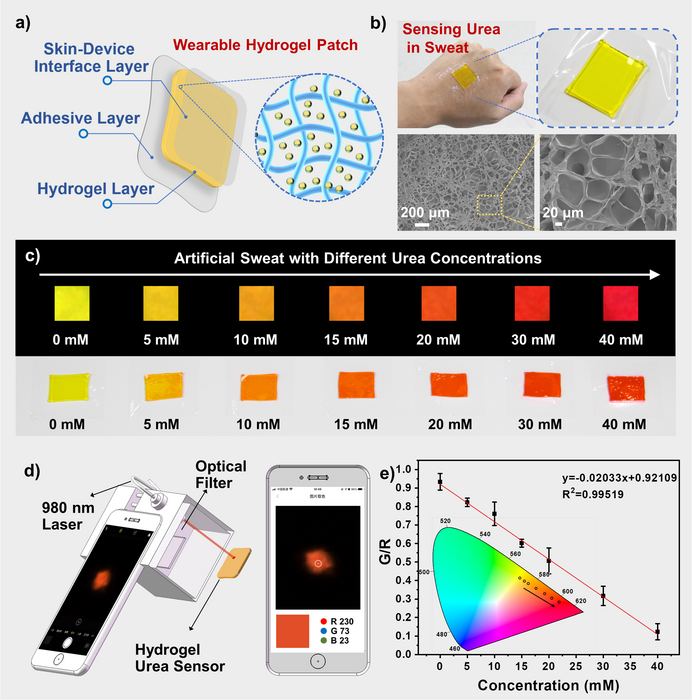
Recently, a research team from the Institute of Solid State Physics, Hefei Institutes of Physical Science (HFIPS) of Chinese Academy of Sciences developed a wearable sensing patch and realized rapid quantitative analysis of urea.
New Approach Allows Faster Test of Urea in Body Fluids

Credit: KANG Xiaohui

Recently, a research team from the Institute of Solid State Physics, Hefei Institutes of Physical Science (HFIPS) of Chinese Academy of Sciences developed a wearable sensing patch and realized rapid quantitative analysis of urea.

The related results have been published in prestigious international journal Analytical Chemistry.

Urea, which is excreted through sweat, urine, saliva and blood, is considered an important indicator of renal function in clinical diagnosis. Effective detection of urea level is crucial for early detection of disease. Wearable fluorescence-based sensors have attracted much attention of users, but traditional fluorescent hydrogels are excited by short wavelength. It is easy to be interfered by spontaneous and background fluorescence in the detection of biological samples. Upconversion nanoparticles (UCNPs), which can eliminate the self-fluorescence and background interference of biological samples, are therefore an effective strategy to detect human biomarkers with high sensitivity.

“We embedded an upconversion optical probe into a three-dimensional porous polyacrylamide (PAM) hydrogel, and combined the patch with a smart phone color reader,” said Prof. JIANG Changlong, who led the team.

The PAM hydrogel sensor was based on an upconversion optical probe, which was composed of UCNPs and p-dimethylamino-cinnamaldehyde (p-DMAC). Due to the internal filtration effect (IFE), the red product produced by the reaction of urea and p-DMAC quenched the green fluorescence of UCNPs and made the upconversion fluorescence change from yellow to red, thus realizing the fluorescence detection of urea.

On this basis, a flexible wearable sensor was made by combining PAM hydrogel, and a portable sensor platform was constructed by 3D printing technology.

The detection limits (LODs) of the self-designed upconversion fluorescent probe and hydrogel sensor were just 1.4μM and 30μM, respectively. They were much lower than the urea content in sweat and means higher sensitivity.

The designed sensing patch provides a convenient and accurate sensing strategy for detecting biomarkers in body fluids, and has the potential to be developed into a device for providing disease warning and clinical diagnosis, according to the team.


Journal

Analytical Chemistry

DOI

10.1021/acs.analchem.2c03806

Article Title

Multiplex chroma response wearable hydrogel patch: Visual monitoring of urea in body fluids for health prognosis

Article Publication Date

8-Feb-2023

Share12Tweet8Share2ShareShareShare2

Related Posts

IBEC Joins Major European Grant on Living Matter Physics

IBEC Joins Major European Grant on Living Matter Physics

July 10, 2026
Innovative Ligand Design Enhances Nanocluster Catalyst Activity

Innovative Ligand Design Enhances Nanocluster Catalyst Activity

July 10, 2026

New Fluorescent Sensor Quickly Detects Pesticide Phoxim Visually

July 10, 2026

Advances in NASICON Cathodes: Structure, Electrochemistry, and Stability Explored

July 10, 2026

POPULAR NEWS

  • Detection of EDCs in Breast Milk and Infant Urine Up to Six Months Highlights Early Exposure Risks

    77 shares
    Share 31 Tweet 19
  • New Drug Candidate Developed at McMaster Shows Potential for Treating Brain Cancer

    58 shares
    Share 23 Tweet 15
  • KTU Researchers Explore Ultrasound’s Role in Enhancing Blood Flow Beyond Diagnostics

    53 shares
    Share 21 Tweet 13
  • 高齢者の骨粗鬆症治療の持続性比較

    51 shares
    Share 20 Tweet 13

About

We bring you the latest biotechnology news from best research centers and universities around the world. Check our website.

Follow us

Recent News

Uremic Toxins Drive Kidney Fat Synthesis and Fibrosis Through AhR Activation

Durable CNT@Ag-MXene Sensor Resists Corrosion Under High Strain

IBEC Joins Major European Grant on Living Matter Physics

Subscribe to Blog via Email

Enter your email address to subscribe to this blog and receive notifications of new posts by email.

Join 84 other subscribers
  • Contact Us

Bioengineer.org © Copyright 2023 All Rights Reserved.

Welcome Back!

Login to your account below

Forgotten Password?

Retrieve your password

Please enter your username or email address to reset your password.

Log In
No Result
View All Result
  • Homepages
    • Home Page 1
    • Home Page 2
  • News
  • National
  • Business
  • Health
  • Lifestyle
  • Science

Bioengineer.org © Copyright 2023 All Rights Reserved.