

• HOME
  • NEWS
  • EXPLORE
    • CAREER
      • Companies
      • Jobs
    • EVENTS
    • iGEM
      • News
      • Team
    • PHOTOS
    • VIDEO
    • WIKI
  • BLOG
  • COMMUNITY
    • FACEBOOK
    • INSTAGRAM
    • TWITTER
Saturday, February 7, 2026
BIOENGINEER.ORG
No Result
View All Result
  • Login
  • HOME
  • NEWS
  • EXPLORE
    • CAREER
      • Companies
      • Jobs
        • Lecturer
        • PhD Studentship
        • Postdoc
        • Research Assistant
    • EVENTS
    • iGEM
      • News
      • Team
    • PHOTOS
    • VIDEO
    • WIKI
  • BLOG
  • COMMUNITY
    • FACEBOOK
    • INSTAGRAM
    • TWITTER
  • HOME
  • NEWS
  • EXPLORE
    • CAREER
      • Companies
      • Jobs
        • Lecturer
        • PhD Studentship
        • Postdoc
        • Research Assistant
    • EVENTS
    • iGEM
      • News
      • Team
    • PHOTOS
    • VIDEO
    • WIKI
  • BLOG
  • COMMUNITY
    • FACEBOOK
    • INSTAGRAM
    • TWITTER
No Result
View All Result
Bioengineer.org
No Result
View All Result
Home NEWS Science News Health

Mushrooms magnify memory by boosting nerve growth

Bioengineer by Bioengineer
February 10, 2023
in Health
Reading Time: 2 mins read
0
Lion's mane mushroom
Share on FacebookShare on TwitterShare on LinkedinShare on RedditShare on Telegram

Researchers from The University of Queensland have discovered the active compound from an edible mushroom that boosts nerve growth and enhances memory.

Professor Frederic Meunier from the Queensland Brain Institute said the team had identified new active compounds from the mushroom, Hericium erinaceus.
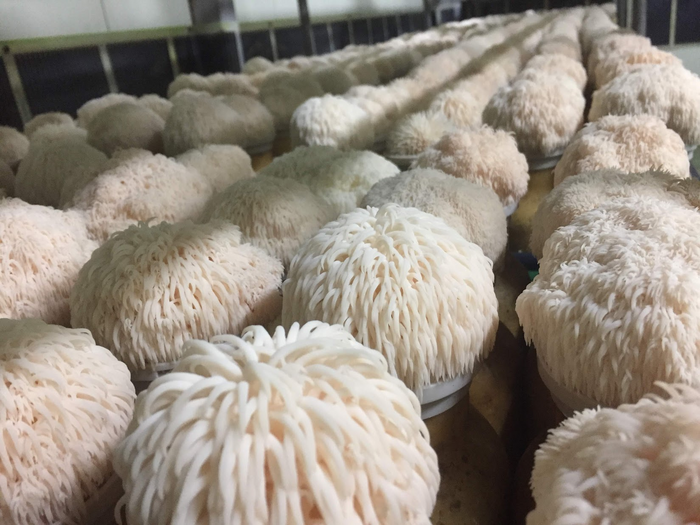
Lion's mane mushroom

Credit: UQ

Researchers from The University of Queensland have discovered the active compound from an edible mushroom that boosts nerve growth and enhances memory.

Professor Frederic Meunier from the Queensland Brain Institute said the team had identified new active compounds from the mushroom, Hericium erinaceus.

Researchers have discovered lion’s mane mushrooms improve brain cell growth and memory in pre-clinical trials. Image UQ. 

“Extracts from these so-called ‘lion’s mane’ mushrooms have been used in traditional medicine in Asian countries for centuries, but we wanted to scientifically determine their potential effect on brain cells,” Professor Meunier said.

“Pre-clinical testing found the lion’s mane mushroom had a significant impact on the growth of brain cells and improving memory.

“Laboratory tests measured the neurotrophic effects of compounds isolated from Hericium erinaceus on cultured brain cells, and surprisingly we found that the active compounds promote neuron projections, extending and connecting to other neurons.

“Using super-resolution microscopy, we found the mushroom extract and its active components largely increase the size of growth cones, which are particularly important for brain cells to sense their environment and establish new connections with other neurons in the brain.”

Co-author, UQ’s Dr Ramon Martinez-Marmol said the discovery had applications that could treat and protect against neurodegenerative cognitive disorders such as Alzheimer’s disease.

“Our idea was to identify bioactive compounds from natural sources that could reach the brain and regulate the growth of neurons, resulting in improved memory formation,” Dr Martinez-Marmol said.

Dr Dae Hee Lee from CNGBio Co, which has supported and collaborated on the research project, said the properties of lion’s mane mushrooms had been used to treat ailments and maintain health in traditional Chinese medicine since antiquity.

“This important research is unravelling the molecular mechanism of lion’s mane mushroom compounds and their effects on brain function, particularly memory,” Dr Lee said.

The study was published in the Journal of Neurochemistry.

UQ acknowledges the collaborative efforts of researchers from the Republic of Korea’s Gachon University and Chungbuk National University.


Journal

Journal of Neurochemistry

DOI

10.1111/jnc.15767

Method of Research

Experimental study

Subject of Research

Animals

Article Title

Hericerin derivatives activates a pan-neurotrophic pathway in central hippocampal neurons converging to ERK1/2 signaling enhancing spatial memory

Article Publication Date

20-Jan-2023

COI Statement

This work was supported by the company CNG-Bio inc. Frédéric A. Meunier is a former editor of the Journal of Neurochemistry.


Share12Tweet8Share2ShareShareShare2

Related Posts

Decoding Prostate Cancer Origins via snFLARE-seq, mxFRIZNGRND

February 7, 2026

Digital Health Perspectives from Baltic Sea Experts

February 7, 2026

Exploring Decision-Making in Dementia Caregivers’ Mobility

February 7, 2026

Succinate Receptor 1 Limits Blood Cell Formation, Leukemia

February 7, 2026

POPULAR NEWS

  • Robotic Ureteral Reconstruction: A Novel Approach

    Robotic Ureteral Reconstruction: A Novel Approach

    82 shares
    Share 33 Tweet 21
  • Digital Privacy: Health Data Control in Incarceration

    63 shares
    Share 25 Tweet 16
  • Study Reveals Lipid Accumulation in ME/CFS Cells

    57 shares
    Share 23 Tweet 14
  • Breakthrough in RNA Research Accelerates Medical Innovations Timeline

    53 shares
    Share 21 Tweet 13

About

We bring you the latest biotechnology news from best research centers and universities around the world. Check our website.

Follow us

Recent News

Decoding Prostate Cancer Origins via snFLARE-seq, mxFRIZNGRND

Digital Health Perspectives from Baltic Sea Experts

Florida Cane Toad: Complex Spread and Selective Evolution

Subscribe to Blog via Email

Enter your email address to subscribe to this blog and receive notifications of new posts by email.

Join 73 other subscribers
  • Contact Us

Bioengineer.org © Copyright 2023 All Rights Reserved.

Welcome Back!

Login to your account below

Forgotten Password?

Retrieve your password

Please enter your username or email address to reset your password.

Log In
No Result
View All Result
  • Homepages
    • Home Page 1
    • Home Page 2
  • News
  • National
  • Business
  • Health
  • Lifestyle
  • Science

Bioengineer.org © Copyright 2023 All Rights Reserved.
