• HOME
  • NEWS
  • EXPLORE
    • CAREER
      • Companies
      • Jobs
    • EVENTS
    • iGEM
      • News
      • Team
    • PHOTOS
    • VIDEO
    • WIKI
  • BLOG
  • COMMUNITY
    • FACEBOOK
    • INSTAGRAM
    • TWITTER
Sunday, May 3, 2026
BIOENGINEER.ORG
No Result
View All Result
  • Login
  • HOME
  • NEWS
  • EXPLORE
    • CAREER
      • Companies
      • Jobs
        • Lecturer
        • PhD Studentship
        • Postdoc
        • Research Assistant
    • EVENTS
    • iGEM
      • News
      • Team
    • PHOTOS
    • VIDEO
    • WIKI
  • BLOG
  • COMMUNITY
    • FACEBOOK
    • INSTAGRAM
    • TWITTER
  • HOME
  • NEWS
  • EXPLORE
    • CAREER
      • Companies
      • Jobs
        • Lecturer
        • PhD Studentship
        • Postdoc
        • Research Assistant
    • EVENTS
    • iGEM
      • News
      • Team
    • PHOTOS
    • VIDEO
    • WIKI
  • BLOG
  • COMMUNITY
    • FACEBOOK
    • INSTAGRAM
    • TWITTER
No Result
View All Result
Bioengineer.org
No Result
View All Result
Home NEWS Science News Biology

Fossil discovery reveals complex ecosystems existed on Earth much earlier than previously thought

Bioengineer by Bioengineer
February 9, 2023
in Biology
Reading Time: 2 mins read
0
Watsonulus fish
Share on FacebookShare on TwitterShare on LinkedinShare on RedditShare on Telegram

About 250 million years ago, the Permian-Triassic mass extinction killed over 80 per cent of the planet’s species. In the aftermath, scientists believe that life on earth was dominated by simple species for up to 10 million years before more complex ecosystems could evolve. Now this longstanding theory is being challenged by a team of international researchers – including scientists from McGill University and Université du Québec à Montréal.
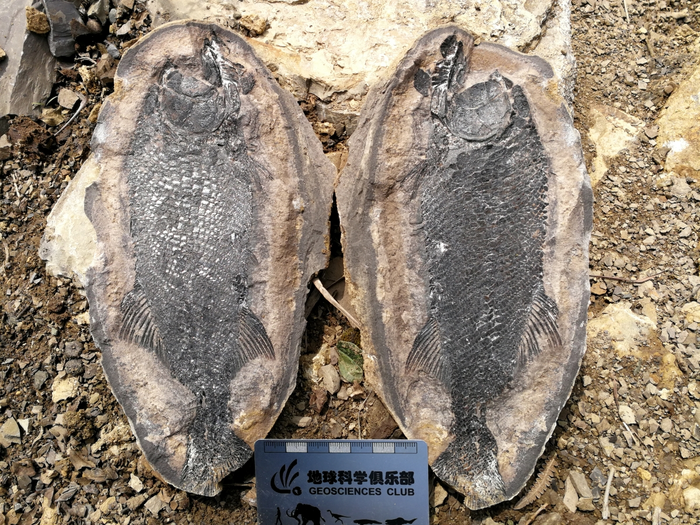
Watsonulus fish

Credit: Xu Dai

About 250 million years ago, the Permian-Triassic mass extinction killed over 80 per cent of the planet’s species. In the aftermath, scientists believe that life on earth was dominated by simple species for up to 10 million years before more complex ecosystems could evolve. Now this longstanding theory is being challenged by a team of international researchers – including scientists from McGill University and Université du Québec à Montréal.

A fossilized ocean ecosystem

Until now, scientists have long theorized that scorching hot ocean conditions resulting from catastrophic climate change prevented the development of complex life after the mass extinction. This idea is based on geochemical evidence of ocean conditions at the time. Now the discovery of fossils dating back 250.8 million years near the Guizhou region of China suggests that complex ecosystems were present on Earth just one million years after the Permian-Triassic mass extinction, which is much earlier than previously thought.

“The fossils of the Guizhou region reveal an ocean ecosystem with diverse species making up a complex food chain that includes plant life, boney fish, ray-finned fish, crabs, lobsters, shrimp, and molluscs. In all, our team discovered 12 classes of organisms and even found fossilised faeces, revealing clues about the diets of these ancient animals,” says Morgann Perrot, a former postdoctoral researcher at McGill University, now at Université du Québec à Montréal.

Challenging an age-old theory

Previously, it was thought that complex ecosystem would need five to ten million years to evolve after an extinction. However, the researchers found that the specimens in the Guizhou region evolved much quicker than that by using radiometric dating to date the rocks where the fossils were discovered.

“All of this has implications for our understanding of how quickly life can respond to extreme crises. It also necessitates a re-evaluation of early Triassic ocean conditions,” says Perrot, whose research focuses on earth sciences and geochronology.

About the study

“A Mesozoic fossil lagerstätte from 250.8 million years ago shows a modern-type marine ecosystem” by Xu Dai, Joshua Davies, Zhiwei Yuan, Arnaud Brayard, Maria Ovtcharova, Guanghui Xu, Xiaokang Liu, Christopher Smith, Carrie Schweitzer, Mingtao Li, Morgann Perrot, Shouyi Jiang, Luyi Miao, Yiran Cao, Jia Yan, Ruoyu Bai, Fengyu Wang, Wei Guo, Huyue Song, Li Tian, Jacopo Dal Corso, Yuting Liu, Daoliang Chu, and Haijun Song was published in Science.


Journal

Science

DOI

10.1126/science.adf1622

Method of Research

Observational study

Subject of Research

Animals

Article Title

A Mesozoic fossil lagerstätte from 250.8 million years ago shows a modern-type marine ecosystem

Article Publication Date

9-Feb-2023

Share12Tweet8Share2ShareShareShare2

Related Posts

Successful Birth Following Uterus Transplant Marks Medical Breakthrough — Biology

Successful Birth Following Uterus Transplant Marks Medical Breakthrough

May 1, 2026
Cockatoos Mimic Peers to Sharpen Adaptation Skills, Study Finds — Biology

Cockatoos Mimic Peers to Sharpen Adaptation Skills, Study Finds

May 1, 2026

Gut Microbe’s Sulfated Bile Acid Eases Pediatric Sepsis

May 1, 2026

AI Breakthrough Solves One of Science’s Most Challenging Math Problems

May 1, 2026

POPULAR NEWS

  • Research Indicates Potential Connection Between Prenatal Medication Exposure and Elevated Autism Risk

    832 shares
    Share 333 Tweet 208
  • New Study Reveals Plants Can Detect the Sound of Rain

    714 shares
    Share 285 Tweet 178
  • Scientists Investigate Possible Connection Between COVID-19 and Increased Lung Cancer Risk

    67 shares
    Share 27 Tweet 17
  • Salmonella Haem Blocks Macrophages, Boosts Infection

    61 shares
    Share 24 Tweet 15

About

We bring you the latest biotechnology news from best research centers and universities around the world. Check our website.

Follow us

Recent News

Family Health Needs of Disabled Elders Explored

Mcu Controls Bone Growth Through Mitochondrial Calcium

Physical Disorders, ADLs, Cognition, Depression in Nursing Homes

Subscribe to Blog via Email

Success! An email was just sent to confirm your subscription. Please find the email now and click 'Confirm' to start subscribing.

Join 82 other subscribers
  • Contact Us

Bioengineer.org © Copyright 2023 All Rights Reserved.

Welcome Back!

Login to your account below

Forgotten Password?

Retrieve your password

Please enter your username or email address to reset your password.

Log In
No Result
View All Result
  • Homepages
    • Home Page 1
    • Home Page 2
  • News
  • National
  • Business
  • Health
  • Lifestyle
  • Science

Bioengineer.org © Copyright 2023 All Rights Reserved.