Shining light on a water droplet creates effects analogous to what happens in an atom. This can help us understand how atoms work, write researchers from the University of Gothenburg in a new journal article.
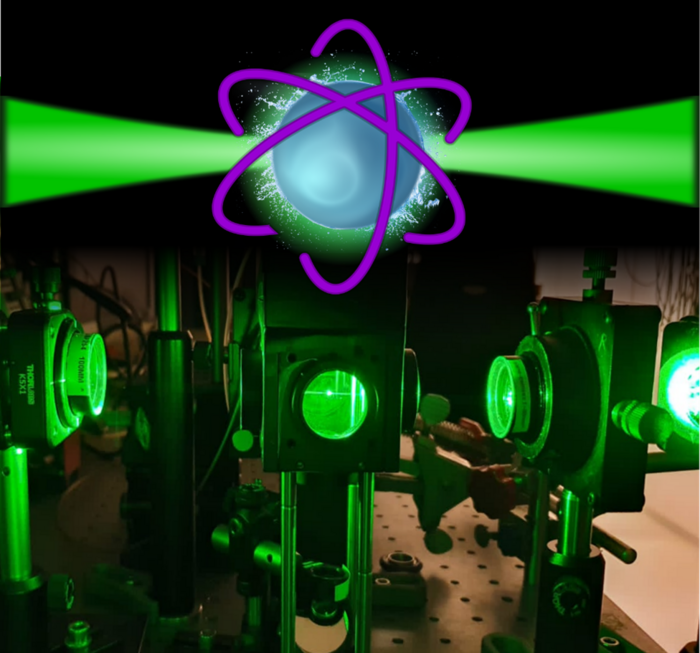
Credit: Javier Tello Marmolejo
Shining light on a water droplet creates effects analogous to what happens in an atom. This can help us understand how atoms work, write researchers from the University of Gothenburg in a new journal article.
If you whisper by the wall in the dome of St Paul’s Cathedral in London, you’ll discover that the sound bounces off the dome’s walls all the way around and is audible on the opposite side. Which is why the Cathedral’s dome has been dubbed ‘the whispering gallery’.
The same effect is achieved when a beam of light is shone into a water droplet. Rays of light bounce off the inner wall of the water droplet over and over again, going around and around inside the droplet. When its circumference is a multiple of the light’s wavelength, a resonance phenomenon occurs, just like the sound inside the Cathedral’s dome, making the droplet shine brighter.
The droplet flashes
“In our experiments with laser light, we could see that the light is trapped inside the water droplet. When the droplet shrinks due to evaporation, it appears to flash every time its size is right to create the resonance phenomenon,” says Javier Marmolejo, doctoral student in physics at the University of Gothenburg, who is the main author of a new study published in Physical Review Letters.
Thanks to a Nobel prize-winning optical tweezers technique, the researchers can trap a water droplet using laser beams that target it from two directions. The laser beam is refracted in the water droplet and scatters, trapping the light inside.
You cannot change the size of the dome in St. Paul’s Cathedral, but a water droplet changes size as it evaporates. The researchers then discovered how the droplet flashed in a way similar to what occurs when an electron is emitted from an atom when illuminated by light of varying wavelengths. They were also able to use a quantum mechanics analogy to explain how the resonances – the size of the droplet when the scattering was greatest – correspond to the energy levels of an atom. This makes the droplet a model of an atom with the added bonus that its size can be varied. It provides deeper insights into how light scatters while being a model for understanding how atoms work.
Useful in medication research
“Since a water droplet is about 100,000 times larger than an atom, we get a model of an atom that is visible to the naked eye, an ‘optical atom’,” says Javier Marmolejo.
Laser spectroscopy generates data on energy levels, bonds and structures in atoms and molecules. Similarly, the spectrum of scattered light from the water droplets generates data about the actual droplets. This can be used to measure the evaporation rates of microscopic droplets with high precision, the researchers say. This discovery can be applied to liquids other than water and may be useful when studying aerosol droplets in inhalers used for medication, for example. The researchers also note that this technology offers a new way to analyse water quality.
“Small amounts of pollutants in the water change the way the droplets flash, which opens up the possibility of quick and easy measurements of chemical or biological pollutants in water droplets,” says Javier Marmolejo.
Journal
Physical Review Letters
DOI
10.1103/PhysRevLett.130.043804
Method of Research
Experimental study
Subject of Research
Not applicable
Article Title
Fano Combs in the Directional Mie Scattering of a Water Droplet
Article Publication Date
24-Jan-2023