In a new study using a rat model of Crohn’s disease, a biodegradable hydrogel composite loaded with stem cells, developed by Johns Hopkins Medicine researchers, in a collaborative effort with the Whiting School of Engineering, has shown significant success in treating perianal fistulas (PAF) — one of the many complications of Crohn’s disease.
Credit: Photo courtesy of Florin Selaru
In a new study using a rat model of Crohn’s disease, a biodegradable hydrogel composite loaded with stem cells, developed by Johns Hopkins Medicine researchers, in a collaborative effort with the Whiting School of Engineering, has shown significant success in treating perianal fistulas (PAF) — one of the many complications of Crohn’s disease.
Crohn’s disease, a subtype of inflammatory bowel disease, is a disorder estimated by the U.S. Centers for Disease Control and Prevention to afflict more than three million adult Americans. About 30 percent to40 percent of patients with Crohn’s disease develop perianal fistulas — an inflamed tunnel between the skin and the inside of the anus. Fistulas can lead to pain, swelling, discomfort and leakage of blood or pus. Surgery is usually needed to treat the condition. However, more than half of patients do not benefit from current available treatments.
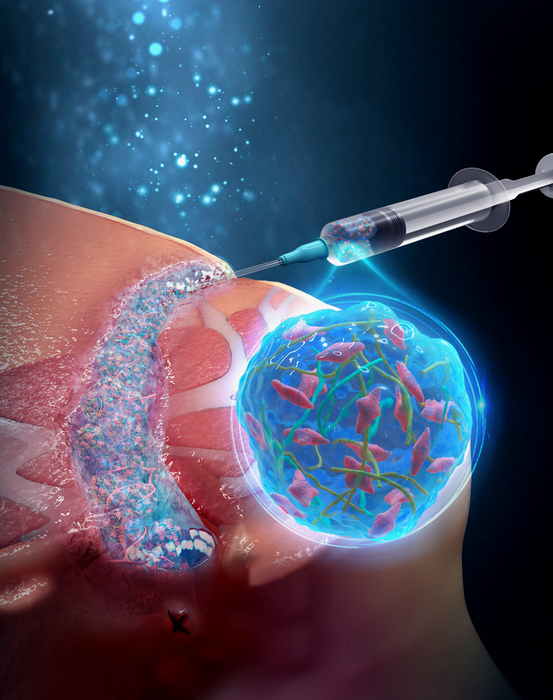
The injectable, biodegradable, mechanically fragmented nanofiber-hydrogel composite (mfNHC), loaded with stem cells that the Johns Hopkins team designed, can be injected inside the fistula tract, and showed a higher degree of healing, reducing the size of fistulas six-fold, in comparison to surgery.
The results were published on Jan. 4, in Science Advances.
“A large number of patients are diagnosed with Crohn’s disease in their late teens to early 20s, and they are contemplating a lifetime of suffering from perianal fistulas,” says Florin M. Selaru, M.D., associate professor of medicine and oncology; director of the IBD Center at Hopkins and the Atran Professor in IBD Research at Johns Hopkins Medicine and one of the senior authors of the study. “This condition in Crohn’s patients is notoriously difficult to treat. We hope these results offer a potential new treatment paradigm to be translated and to improve the quality of life for these patients.”
Selaru says previous studies and current clinical trials have shown stem cell injection around fistula tracts have helped with local healing. However, the stem cells are unlikely to be retained around the fistula track for any meaningful duration of time that may allow for any significant healing. The hydrogel created by the team can be injected directly into the fistula tract. It is infused with nanofiber fragments that give the substance enough stiffness to anchor the stem cells in place at the site of the fistula, so they don’t migrate away. This will assist with tissue regeneration and promote healthy healing.
“Think of it as a local delivery of a tissue regeneration nanogel-nanofiber composite that also keeps the stem cells at the site of the injury and enables the healing to occur,” says Selaru. The gel built a scaffold that retained the stem cells at the site of the fistulas and promoted regenerative healing. Results showed the gel had an overall reduction in volume of the fistula track by six times, compared to surgery.
“These results are very exciting for the future of bio-stimulation tissue repair for chronic injuries — even beyond PAF,” says Hai-Quan Mao, Ph.D., professor in Whiting School of Engineering’s Department of Materials Science and Engineering and Department of Biomedical Engineering, and another senior author of this study. Mao is also director of Johns Hopkins Institute for NanoBioTechnology.
Selaru cautions, however, that these very encouraging results need to be verified in human trials. The experiments conducted thus far have laid the foundation of such translational future studies. The team plans to continue this work and to improve the gel, including exploring the idea of a foam version.
Other researchers include Ling Li, Zhi-Cheng Yao, Alyssa Parian, Yueh-Hsun Yang, Jeffrey Chao, Jason Yin, Kevan Salimian, Sashank Reddy, Atif Zaheer and Susan Gearhart.
Funding for this work was supported by The Leona M. and Harry B. Helmsley Charitable Trust, the National Institutes of Health and the Atran Foundation.
Mao and Reddy are inventors on one issued patent and two pending patent applications related to the hydrogel composite filed by Johns Hopkins Technology Ventures. No other authors declare conflicts of interest.
Journal
Science Advances