• HOME
  • NEWS
  • EXPLORE
    • CAREER
      • Companies
      • Jobs
    • EVENTS
    • iGEM
      • News
      • Team
    • PHOTOS
    • VIDEO
    • WIKI
  • BLOG
  • COMMUNITY
    • FACEBOOK
    • INSTAGRAM
    • TWITTER
Thursday, July 9, 2026
BIOENGINEER.ORG
No Result
View All Result
  • Login
  • HOME
  • NEWS
  • EXPLORE
    • CAREER
      • Companies
      • Jobs
        • Lecturer
        • PhD Studentship
        • Postdoc
        • Research Assistant
    • EVENTS
    • iGEM
      • News
      • Team
    • PHOTOS
    • VIDEO
    • WIKI
  • BLOG
  • COMMUNITY
    • FACEBOOK
    • INSTAGRAM
    • TWITTER
  • HOME
  • NEWS
  • EXPLORE
    • CAREER
      • Companies
      • Jobs
        • Lecturer
        • PhD Studentship
        • Postdoc
        • Research Assistant
    • EVENTS
    • iGEM
      • News
      • Team
    • PHOTOS
    • VIDEO
    • WIKI
  • BLOG
  • COMMUNITY
    • FACEBOOK
    • INSTAGRAM
    • TWITTER
No Result
View All Result
Bioengineer.org
No Result
View All Result
Home NEWS Science News Chemistry

Better hydrogen transfer brings better hydrogen evolution reaction performance

Bioengineer by Bioengineer
January 18, 2023
in Chemistry
Reading Time: 2 mins read
0
Schematic illustration of hydrogen transfer
Share on FacebookShare on TwitterShare on LinkedinShare on RedditShare on Telegram

The electrocatalytic hydrogen evolution reaction (HER) is one of the most efficient methods for producing green hydrogen. However, the inefficient mass transfer of hydrogen has greatly impeded HER efficiency.
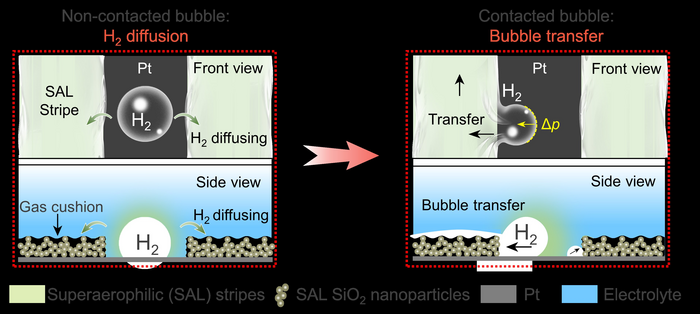
Schematic illustration of hydrogen transfer

Credit: YU Cunming et al.

The electrocatalytic hydrogen evolution reaction (HER) is one of the most efficient methods for producing green hydrogen. However, the inefficient mass transfer of hydrogen has greatly impeded HER efficiency.

The mass transfer of hydrogen has two main types: gaseous bubble transfer and dissolved hydrogen diffusion. Inefficient bubble transfer will cause bubble adhesion and dispersion problems, while inefficient hydrogen diffusion will cause oversaturated dissolved hydrogen and result in high concentration overpotential.

In a new study, a joint research team led by Prof. YU Cunming from Beihang University and Prof. JIANG Lei from the Technical Institute of Physics and Chemistry of the Chinese Academy of Sciences (CAS) has reported a superaerophilic/superaerophobic cooperative electrode that can promote bubble removal and dissolved hydrogen diffusion to achieve efficient HER.

Results were published in Science Advances on Jan. 18.

In this study, the researchers introduced superaerophilic stripes on a Pt electrode; these stripes are covered with gas cushions and act as gas channels to transport hydrogen out.

For non-contacted bubbles, the diffusion distance of dissolved hydrogen is greatly decreased owing to the existence of gas cushions on the superaerophilic stripes, thus accelerating dissolved hydrogen diffusion. For contacted bubbles, the bubbles can be quickly transferred by asymmetric Laplace pressure between the exposed Pt surface and the superaerophilic stripes.

Prof. YU said that HER is like a production line, with hydrogen ions as the raw material, the catalyst as the production machinery and hydrogen as the product. However, if the catalyst is excellent but the hydrogen product cannot be removed from the surface of a catalyst in a timely way, the production line will be blocked.

“Here, we designed a transport line, superaerophilic stripes, specialized for hydrogen delivery, which greatly avoids blocking the production line and improves efficiency,” said Prof. YU.

Based on more efficient hydrogen transfer, including through gaseous bubbles and dissolved hydrogen, the superaerophilic/superaerophobic cooperative Pt electrode can achieve much better HER. Its overpotential at -10 mA cm-2 is -19 mV, compared with -61 mV on a traditional flat Pt electrode.

Prof. YU also noted that the superaerophilic/superaerophobic cooperative strategy can be applied not only to HER but also to other gas evolution reactions.


Journal

Science Advances

DOI

10.1126/sciadv.add6978

Method of Research

Meta-analysis

Subject of Research

Not applicable

Article Title

Superaerophilic/superaerophobic cooperative electrode for efficient hydrogen evolution reaction via enhanced mass transfer

Article Publication Date

18-Jan-2023

Share12Tweet8Share2ShareShareShare2

Related Posts

Scientists Decode Glass-Like Properties of Epithelial Tissues

Scientists Decode Glass-Like Properties of Epithelial Tissues

July 9, 2026

New high-throughput method accelerates catalyst and reaction discovery

July 9, 2026

New Method Enables Electrical Control of Helimagnetic Structures

July 9, 2026

Honey’s Anti-Aging Effects Revealed in Human Skin Cells Study

July 9, 2026

POPULAR NEWS

  • Detection of EDCs in Breast Milk and Infant Urine Up to Six Months Highlights Early Exposure Risks

    77 shares
    Share 31 Tweet 19
  • New Drug Candidate Developed at McMaster Shows Potential for Treating Brain Cancer

    58 shares
    Share 23 Tweet 15
  • KTU Researchers Explore Ultrasound’s Role in Enhancing Blood Flow Beyond Diagnostics

    53 shares
    Share 21 Tweet 13
  • 高齢者の骨粗鬆症治療の持続性比較

    51 shares
    Share 20 Tweet 13

About

We bring you the latest biotechnology news from best research centers and universities around the world. Check our website.

Follow us

Recent News

Unified Vision-Language Model Advances Neuroblastoma Precision Oncology and Biomarker Prediction

Portable Cd-109/CZT KXRF System Measures Bone Lead Exposure in Field

Preterm Infant Physiology Affects Morbidity and Two-Year Neurodevelopment Outcomes

Subscribe to Blog via Email

Enter your email address to subscribe to this blog and receive notifications of new posts by email.

Join 84 other subscribers
  • Contact Us

Bioengineer.org © Copyright 2023 All Rights Reserved.

Welcome Back!

Login to your account below

Forgotten Password?

Retrieve your password

Please enter your username or email address to reset your password.

Log In
No Result
View All Result
  • Homepages
    • Home Page 1
    • Home Page 2
  • News
  • National
  • Business
  • Health
  • Lifestyle
  • Science

Bioengineer.org © Copyright 2023 All Rights Reserved.