The X-rays used to examine a broken leg in hospital are easy to produce. In industry, however, X-ray radiation of a completely different kind is needed – namely, X-ray laser pulses that are as short and high-energy as possible. They are used, for example, in the production of nanostructures and electronic components, but also to monitor chemical reactions in real time.
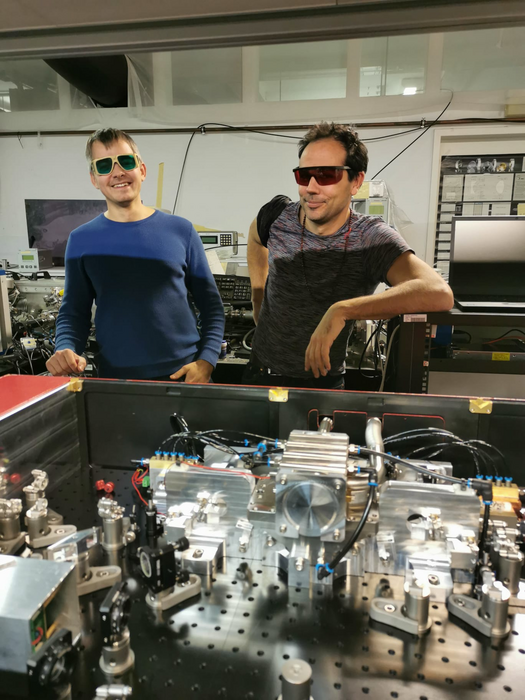
Credit: TU Wien
The X-rays used to examine a broken leg in hospital are easy to produce. In industry, however, X-ray radiation of a completely different kind is needed – namely, X-ray laser pulses that are as short and high-energy as possible. They are used, for example, in the production of nanostructures and electronic components, but also to monitor chemical reactions in real time.
Intense, extremely short-wave X-ray pulses in the nanometre wavelength range are difficult to produce, but now a new, simpler method has been developed at TU Wien (Vienna): the starting point is not a titanium-sapphire laser, which had mostly been used for this purpose, but an ytterbium laser. The crucial trick is that the light is then sent through a gas in order to change its properties.
Long wavelengths lead to short wavelengths
The wavelength of a laser beam depends on the material in which it is generated: In the atoms or molecules involved, electrons change from one state to another state with lower energy. This causes a photon to be emitted – its wavelength (and thus its colour) depends on how much energy the electron lost during its change of state. In this way, different laser colours can be produced – from red to violet.
However, for creating laser beams with even much smaller wavelengths, special tricks have to be employed: First, laser beams with a long wavelength are created and shot at atoms. An electron is ripped away from the atom and accelerated in the electric field of the laser. It then turns back and collides again with the atom from which it came – and thereby it can produce short-wave X-rays. This technique is called “high harmonic generation”.
“At first glance, the situation seems somewhat counter-intuitive,” says Paolo Carpeggiani from the Institute of Photonics at TU Wien. “It turns out, in fact, that the larger the wavelength of the original laser beam, the smaller the wavelengths you can achieve in the end.” However, the efficiency of X-ray radiation production also decreases in the process: if you want to produce very short-wave radiation, its intensity becomes very low.
Ytterbium instead of titanium sapphire, gas instead of crystal
Until now, this technique was almost always employed by using titanium-sapphire lasers and then increasing the wavelength of their radiation with special crystals in order to generate the shortest possible X-ray radiation through High Harmonic Generation. However, the team at TU Wien has now developed a simpler and at the same time more powerful method: they used an ytterbium laser. Ytterbium lasers are simpler, cheaper and more powerful than titanium-sapphire lasers, but until now, their performance in x-ray production was much lower.
At TU Wien, the wavelength of the ytterbium laser’s radiation was first increased – not by sending this radiation through a crystal as usual, but by sending it through a molecular gas. “This increases the efficiency quite dramatically,” says Paolo Carpeggiani. “Instead of the 20% we used to get, we get around 80%.”
Journal
ACS Photonics
DOI
10.1021/acsphotonics.2c01021
Article Title
HHG at the Carbon K-Edge Directly Driven by SRS Red-Shifted Pulses from an Ytterbium Amplifier
Article Publication Date
29-Dec-2022