Plasma is matter that is so hot that the electrons are separated from atoms. The electrons float freely and the atoms become ions. This creates an ionized gas—plasma—that makes up nearly all of the visible universe. Recent research shows that magnetic fields can spontaneously emerge in a plasma. This can happen if the plasma has a temperature anisotropy—temperature that is different along different spatial directions. This mechanism is known as the Weibel instability. It was predicted by plasma theorist Eric Weibel more than six decades ago but only now has been unambiguously observed in the laboratory. The new research finds that this process can convert a significant fraction of the energy stored in the temperature anisotropy into magnetic field energy. It also finds that the Weibel instability could be a source of magnetic fields that permeate throughout the cosmos.
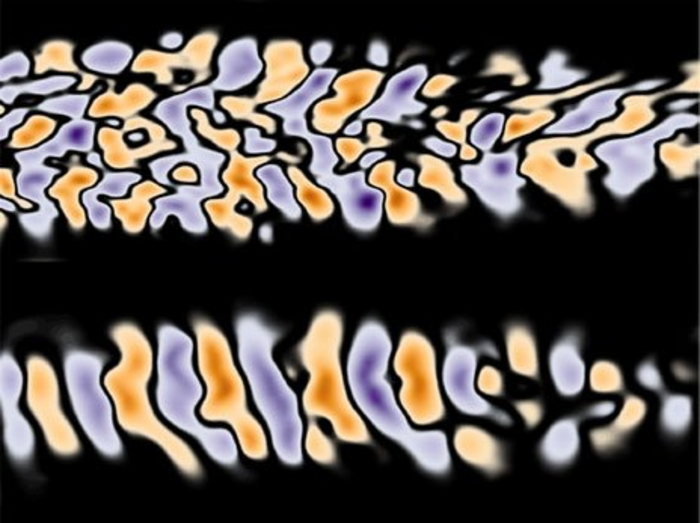
Credit: Image courtesy of Chaojie Zhang, University of California Los Angeles
The Science
Plasma is matter that is so hot that the electrons are separated from atoms. The electrons float freely and the atoms become ions. This creates an ionized gas—plasma—that makes up nearly all of the visible universe. Recent research shows that magnetic fields can spontaneously emerge in a plasma. This can happen if the plasma has a temperature anisotropy—temperature that is different along different spatial directions. This mechanism is known as the Weibel instability. It was predicted by plasma theorist Eric Weibel more than six decades ago but only now has been unambiguously observed in the laboratory. The new research finds that this process can convert a significant fraction of the energy stored in the temperature anisotropy into magnetic field energy. It also finds that the Weibel instability could be a source of magnetic fields that permeate throughout the cosmos.
The Impact
The matter in our observable universe is plasma state and it is magnetized. Magnetic fields at the micro-gauss level (about a millionth of the Earth’s magnetic fields) permeate the galaxies. These magnetic fields are thought to be amplified from weak seed fields by the spiral motion of the galaxies, known as the galactic dynamo. How the seed magnetic fields are created is a longstanding question in astrophysics. This new work offers a possible solution to this vexing problem of the origin of the microgauss level seed magnetic fields. The research used a novel platform that has great potential for studying the ultrafast dynamics of magnetic fields in the laboratory plasmas that are relevant to astro- and high-energy density physics.
Summary
First theorized six decades ago, the Weibel instability driven by temperature anisotropy is thought to be an important mechanism for self-magnetization of many laboratory and astrophysical plasmas. However, scientists have faced two challenges in unambiguously demonstrating the Weibel instability. First, until recently, researchers were not able to generate a plasma with a known temperature anisotropy as initially envisioned by Weibel. Second, researchers had no suitable technique to measure the complex and rapidly evolving topology of the magnetic fields subsequently generated in the plasma.
This work, enabled by the unique capability of the Accelerator Test Facility, a Department of Energy (DOE) user facility at Brookhaven National Laboratory, employed a novel experimental platform that allowed the researchers to create a hydrogen plasma with a known highly anisotropic electron velocity distributions on a tens of trillionth of a second timescale by using an ultrashort but intense carbon dioxide laser pulse. The subsequent thermalization of the plasma occurs via self-organization of plasma currents that produces magnetic fields driven by Weibel instability. These fields are large enough to deflect relativistic electrons to reveal an image of the magnetic fields a certain distance from the plasma. The researchers obtained a movie of the evolution of these magnetic fields with exquisite spatiotemporal resolution by using an one picosecond relativistic electron beam to probe these fields.
Funding
This work was supported by the Department of Energy (DOE) Office of Science, the National Science Foundation, and NSF Graduate Research Fellowships Program. The Accelerator Test Facility is supported by the DOE Office of Science. The principal investigator’s work at UCLA is supported by the National Science Foundation (NSF), DOE Office of Science High Energy Physics program, and the NSF Graduate Research Fellowships Program.
Journal
Proceedings of the National Academy of Sciences
DOI
10.1073/pnas.221171311
Method of Research
Experimental study
Subject of Research
Not applicable
Article Title
Mapping the self-generated magnetic fields due to thermal Weibel instability
Article Publication Date
5-Dec-2022