Kyoto, Japan — Nutrition, as an impactful part of an organism’s physiological state, seems to extend to all stages of life. Neural development, including the growth of dendrites and axons, is known to be metabolically demanding, but little is known about how specific nutrients affect neuronal development.
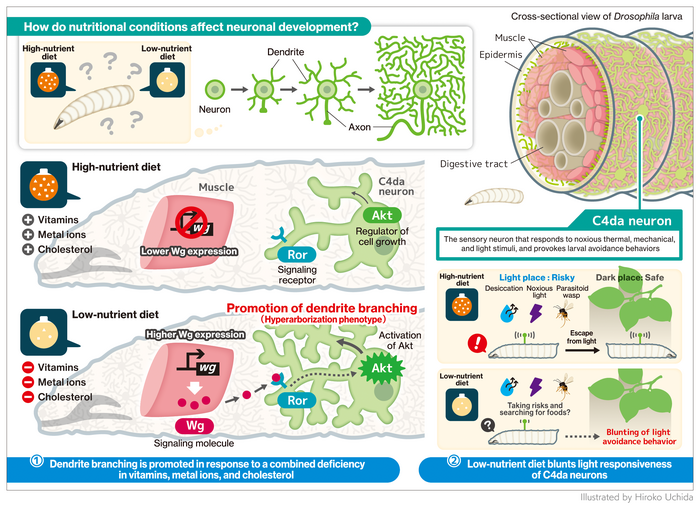
Credit: KyotoU/Biostudies/Uemura Lab
Kyoto, Japan — Nutrition, as an impactful part of an organism’s physiological state, seems to extend to all stages of life. Neural development, including the growth of dendrites and axons, is known to be metabolically demanding, but little is known about how specific nutrients affect neuronal development.
A team of researchers at Kyoto University’s Graduate School of Biostudies has now found that regulatory mechanisms of nutrient-dependent neuronal development can be explored at the molecular level with appropriate models.
“One such model is the Drosophila C4da — or class IV dendritic arborization — neuron located in the fruit flies’ larvae,” says lead author Yukako Hattori.
The dendrites of C4da neurons — located between the epidermis and body wall muscles — sense noxious thermal, mechanical, and light stimuli, subsequently transmitting information to the central nervous system to trigger avoidance behaviors.
“The growth of these dendrites is controlled by the environment in unexpected ways and becomes more complex. That is, a poor, low-yeast diet causes hyperarborization of dendrites,” adds first author Yasutetsu Kanaoka.
After a systematic search for key nutrients, the team found that the hyperarborization phenotype was not caused by low concentrations of amino acids — typical yeast nutrients — but rather by a simultaneous deficiency in vitamins, metal ions, and cholesterol.
This deficiency increases the production of Wingless signaling molecules from body wall muscle. After Wingless is received by C4da neurons, it activates a protein called Akt, which promotes the complex branching of dendrites.
“While this excess growth of C4da neurons despite a nutrient-poor environment is counterintuitive, we were further intrigued by those neurons becoming less responsive to the noxious light stimuli,” reflects Tadashi Uemura.
“Our study raises the possibility that nutrient-dependent development of somatosensory neurons plays a role in optimizing a trade-off between searching for high-nutrient foods and escaping from noxious environmental threats.”
Using cell type-specific knockdown systems — an established method to inhibit specific gene functions in a cell-specific manner — the team identified the inter-organ signaling that regulates the hyperarborization phenotype.
“By focusing on the mechanism by which nutritional information is transmitted from the intestine to the muscle, we may unravel the molecular mystery linking food and health.”
###
The paper “Inter-organ Wingless/Ror/Akt signaling regulates nutrient-dependent hyperarborization of somatosensory neurons” will appear on 17 January 2023 in eLife, with doi: 10.7554/eLife.79461
About Kyoto University
Kyoto University is one of Japan and Asia’s premier research institutions, founded in 1897 and responsible for producing numerous Nobel laureates and winners of other prestigious international prizes. A broad curriculum across the arts and sciences at both undergraduate and graduate levels is complemented by numerous research centers, as well as facilities and offices around Japan and the world. For more information please see: http://www.kyoto-u.ac.jp/en
Journal
eLife
DOI
10.7554/eLife.79461
Method of Research
Experimental study
Subject of Research
Animals
Article Title
eLife
Article Publication Date
17-Jan-2023
COI Statement
The authors have declared no competing interest.