“Food allergy or hypersensitivity is estimated to affect about 520 million people worldwide. These reactions occur mainly through the consumption of foods containing trace allergens. Therefore, identifying and quantifying them before the food is consumed is essential, and this is what the test we have developed allows,” says Sergi Morais, professor in the Department of Chemistry at the Universitat Politècnica de València and researcher at the Inter-University Institute of Molecular Recognition and Technological Development (IDM).
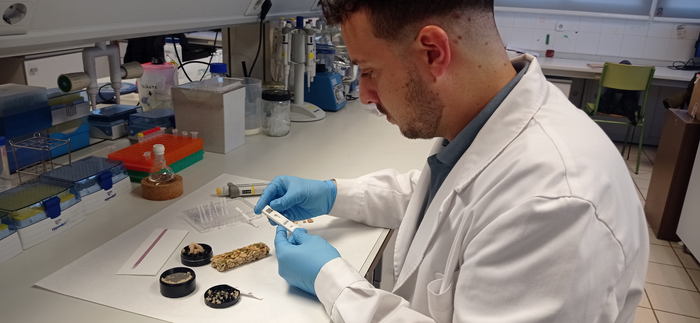
Credit: UPV
“Food allergy or hypersensitivity is estimated to affect about 520 million people worldwide. These reactions occur mainly through the consumption of foods containing trace allergens. Therefore, identifying and quantifying them before the food is consumed is essential, and this is what the test we have developed allows,” says Sergi Morais, professor in the Department of Chemistry at the Universitat Politècnica de València and researcher at the Inter-University Institute of Molecular Recognition and Technological Development (IDM).
The prototype has been developed as a proof of concept for simultaneously detecting almond and peanut allergens and has been validated with everyday commercial foods such as biscuits and energy bars.
Among its advantages, the researchers highlight the reliability of the test, which contains multiple internal controls and calibrators integrated into a miniaturised 36-point array. “With microarray technology, we perform 36 assays in a single step. The derived information allows us to identify whether the result is a true positive or negative. In addition, with the internal calibrators and the smartphone, we can quantify with high precision traces of allergen in the food,” says Ángel Maquieira, full professor in the Department of Chemistry at the Universitat Politècnica de València.
Regarding the extraction method, the UPV, UV, and CIBERER team stresses its simplicity, which means anyone can carry it out at any time.
“Current extraction methods consist of multiple steps and require sophisticated equipment for grinding, degreasing, extraction, and purification of allergens. Therefore, the analysis is carried out in qualified laboratories. The aim is to decentralise the analysis, as has been done with the COVID-19 test. We want anyone to be able to analyse a food just before consuming it,” adds Sergi Morais.
The extraction method developed is based on the use of a portable grinder, which is used to grind and filter the sample in a single step; 5 mL of a solution is then added to extract the allergen, and, once the sample is prepared, the test strip is immersed in the solution. And in just 5 minutes, the result is obtained, which can be read with a mobile phone.
“At an estimated cost of €1 per strip, the developed test has great commercial potential, for example, in the food sector for rapid identification of allergens in situ and in the pharmaceutical sector to quantify the potency of allergenic extracts used in allergy testing,” says Amadeo Sena, a postdoctoral researcher at the Inter-University Institute for Molecular Recognition and Technological Development (IDM).
Future development
Looking to the future, the UPV, UV, and CIBERER team points out that, given the characteristics of the test strip, it could easily be adapted for other allergens, as the group has specific antibodies for a wide range of allergens and biomarkers. “Our challenge is to develop a test for the simultaneous quantification of the 14 allergens that must be declared according to Royal Decree 126/2015. ” concludes Patricia Casino, a researcher at Instituto Universitario de Biotecnología i Biomedicina (BIOTECMED) -Universitat de València and the CIBERER.
Journal
Biosensors
DOI
10.3390/bios12110980
Method of Research
Meta-analysis
Subject of Research
Not applicable
Article Title
Lateral Flow Microimmunoassay (LFµIA) for the Reliable Quantification of Allergen Traces in Food Consumables
Article Publication Date
7-Nov-2022