Osaka, Japan – Protein detection based on antigen–antibody reaction is vital in early diagnosis of a wide range of diseases. How to effectively detect proteins, however, has frequently bedeviled researchers. Osaka Metropolitan University scientists have discovered a new principle underlying light-induced acceleration of antigen–antibody reaction, allowing for simple, ultrafast, and highly sensitive detection of proteins. Their findings were published in Communications Biology.
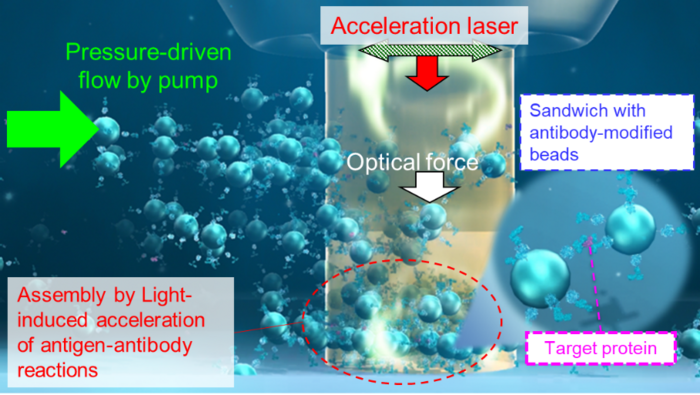
Credit: Takuya Iida, OMU
Osaka, Japan – Protein detection based on antigen–antibody reaction is vital in early diagnosis of a wide range of diseases. How to effectively detect proteins, however, has frequently bedeviled researchers. Osaka Metropolitan University scientists have discovered a new principle underlying light-induced acceleration of antigen–antibody reaction, allowing for simple, ultrafast, and highly sensitive detection of proteins. Their findings were published in Communications Biology.
“The antigen–antibody reaction is a biochemical reaction that plays a crucial role in immunity, the body’s defense function,” explained lead researcher Professor Takuya Iida, Director of the Research Institute for Light-induced Acceleration System at Osaka Metropolitan University. Methods to analyze trace amounts of proteins based on antigen–antibody reaction enable diagnosis at an early stage of many diseases, including cancer, dementia, and microbial infections. However, such methods either have limited sensitivity or require complex and time-consuming processing to allow antigen–antibody reactions to occur.
Aiming to accelerate antigen–antibody reactions, the researchers introduced target proteins and probe particles, with modified antibodies that selectively bind to the target proteins, into a channel that is as narrow as a human hair or artery and then applied irradiation with infrared laser light for 3 minutes, making it possible to carry out detection at a sensitivity approximately 100 times higher than that of conventional protein testing.
The researchers achieved, for the first time, the rapid measurement of trace amounts of target proteins on the order of tens of attograms (ag = 10−18 g; one quintillionth of a gram) after only 3 minutes of laser irradiation.
The study results demonstrate that rapid and highly sensitive detection can be achieved by condensing proteins through the simple operation of confining them in a small space and irradiating them with a laser to accelerate the reaction. These findings will facilitate the detection of disease-related substances from a small amount of body fluids, such as a single drop of blood, and will assist in the discovery of novel disease markers, potentially leading to breakthroughs in the development of systems for ultra-early diagnosis of various diseases.
“In an interdisciplinary collaboration beyond physics, chemistry, and biology, we uncovered a new principle underlying the control of antigen–antibody reaction by optical force, or light-induced force,” concluded Professor Iida. “I hope that the advantage of being able to measure trace markers with high sensitivity and speed by simple laser irradiation will aid in ultra-early diagnosis.”
###
About OMU
Osaka Metropolitan University is a new public university established by a merger between Osaka City University and Osaka Prefecture University in April 2022. For more science news, see https://www.omu.ac.jp/en/info/research-news/, and follow @OsakaMetUniv_en, or search #OMUScience.
Journal
Communications Biology
DOI
10.1038/s42003-022-03946-0
Method of Research
Experimental study
Article Title
Attogram-level light-induced antigen-antibody binding confined in microflow
Article Publication Date
6-Oct-2022