Osaka, Japan – Can’t sleep when your partner is on his or her smartphone? This may not be oversensitivity on your part; your eyelids probably deserve some of the blame. A scientist from Osaka Metropolitan University shows that eyelids transmit much more light than previously thought. The findings were published in Color Research and Application.
Credit: Hideki Sakai, Osaka Metropolitan University
Osaka, Japan – Can’t sleep when your partner is on his or her smartphone? This may not be oversensitivity on your part; your eyelids probably deserve some of the blame. A scientist from Osaka Metropolitan University shows that eyelids transmit much more light than previously thought. The findings were published in Color Research and Application.
Sleep deprivation and sleep disorders are detrimental to health and interfere with daily life. Studies have been conducted to elucidate the mechanisms underlying various factors that affect sleep. One major factor is the lighting environment. Changes in light exposure during the daytime and nighttime or during sleep have been reported to influence circadian rhythms and sleep quality.
Currently, indices to describe the lighting environment, such as illuminance and color temperature, are based on visual characteristics under well-lit conditions when the eyes are open. However, given that the eyes are closed while sleeping, understanding the light transmittance of the eyelids and perceived closed-eye brightness is essential to properly describe the lighting environment during sleep. Although several studies have been carried out to measure eyelid transmittance, experimental conditions differed significantly from lighting environments in daily life: evaluations were conducted under extremely low illuminance, for example, or with only one eye.
Professor Hideki Sakai, from the Graduate School of Human Life and Ecology at Osaka Metropolitan University, applied a new method to measure the light transmittance of the eyelids when the eyes are shut. His results indicate that closed-eye perception of brightness is remarkably stronger than previously reported.
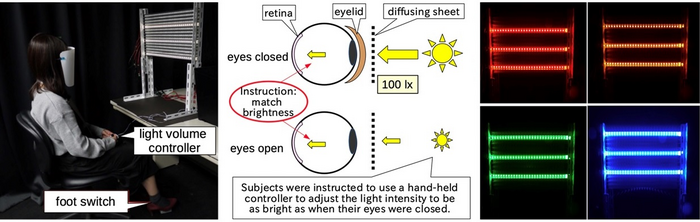
Professor Sakai conducted experiments on a total of 33 participants under relatively bright conditions (illuminance of 100 lux) in which each participant’s entire face was illuminated. A lighting device was used to increase or decrease facial illuminance, and closed-eye light transmittance was measured by having the participants make adjustments to match the levels of brightness they perceived with their eyes closed and with their eyes open. Monochromatic red, yellow, green, and blue LEDs and a white LED were used as light sources.
The experiment results show that eyelid transmittance values were up to 10 times higher than those (i.e., 0.3%–14.5%) reported in the past. The color of the light also made a difference, with red light perceived as brighter and blue light perceived as darker. Additionally, Professor Sakai noted significant differences between individual participants; for some, their perception of brightness remained almost unchanged between the open- and closed-eye conditions.
“By properly understanding and utilizing the lighting environment when the eyes are closed, I hope to advance research on appropriate lighting not only during normal sleep but also in various other situations, such as during naps or riding late-night transportation,” stated Professor Sakai. “Since light colors with low transmittance are perceived as dark only when people close their eyes, I think that this finding could be useful for designing lighting in spaces with both awake and sleeping people, such as evacuation centers.”
###
Osaka Metropolitan University is a new public university established by a merger between Osaka City University and Osaka Prefecture University in April 2022. For more science news, see https://www.omu.ac.jp/en/, and follow @OsakaMetUniv_en, or search #OMUScience.
Journal
Color Research & Application
DOI
10.1002/col.22832
Method of Research
Experimental study
Subject of Research
People
Article Title
Perception of brightness when the eyes are closed
Article Publication Date
21-Nov-2022