Myocardial infarction is an ischemic disease in which a coronary artery supplying blood to the heart muscle is stenotic or obstructed, resulting in cardiac tissue necrosis. Due to the irreversible loss of cardiomyocytes, damaged heart tissue cannot be naturally regenerated. The most recent effort to regenerate the damaged heart tissue is to transplant stem cells to the damaged area. However, this approach has low engraftment rates stemming from the highly curved surface of the heart and its dynamic nature – hindering the cells from settling on the heart to allow time for cell regeneration.
Credit: POSTECH
Myocardial infarction is an ischemic disease in which a coronary artery supplying blood to the heart muscle is stenotic or obstructed, resulting in cardiac tissue necrosis. Due to the irreversible loss of cardiomyocytes, damaged heart tissue cannot be naturally regenerated. The most recent effort to regenerate the damaged heart tissue is to transplant stem cells to the damaged area. However, this approach has low engraftment rates stemming from the highly curved surface of the heart and its dynamic nature – hindering the cells from settling on the heart to allow time for cell regeneration.
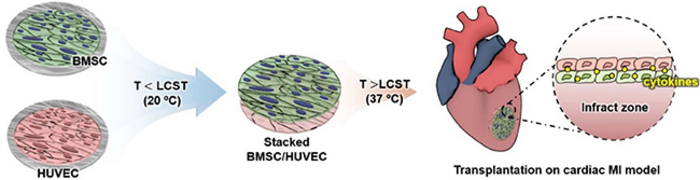
A joint team of Professor Dong Sung Kim and Dr. Andrew Choi (Department of Mechanical Engineering) from POSTECH, professors Hun-Jun Park and Dr. Hyeok Kim (College of Medicine) from Catholic University of Korea, and Professor Kiwon Ban of the City University of Hong Kong announced the successful transplantation of a highly integrable in vivo priming bone marrow mesenchymal stem cell (BMSC) sheet based on the utilization of a thermos-responsive nanofiber membrane. Their work has attracted attention from academic circles for developing a human umbilical vein endothelial cell (HUVEC) sheet specially designed for enhancement of an angiogenesis (formation of new blood vessels from pre-existing vessels), which promoted cardiac repair when transplanted together with the BMSC sheet.
Stem cells are pluripotent when they have yet to be differentiated and are able to self-renew by dividing and developing into all cell types. When transplanted, they promote new tissue regeneration, which can be applied to treat incurable diseases. From here, cell sheet engineering takes a further step by enabling the transplant of cell sheet made only of stem cells to damaged areas for promoting tissue regeneration.
Attempts to treat myocardial infarction with various types of patches were stymied as the heart’s curved shape and constant pulsing prevent such a patch from staying in place. The joint team of researchers decided to use a BMSC sheet on a thermos-responsive nanofiber membrane. This stem cell sheet, rich in the extracellular matrix, has strong adhesion and the advantage of being able to anchor many cells to the required location. Along with this sheet, the researchers transplanted another sheet made of HUVECs.
After the transplantation, the team found that a prolonged secretion of multiple angiogenic cytokines, such as vascular endothelial growth factor, angiopoietin-1, and insulin-like growth factor-1 promoted angiogenesis, leading to a significant improvement in the cardiac function, including intrinsic contractibility and remodeling.
This technique is assessed to have proposed a new-concept heart patch by improving the heart function for the treatment of myocardial infarction as well as increasing integration and engraftment rates, which have been some of the challenges of utilizing patches.
This research, published in Biofabrication – one of the prestigious journals in biomaterials – was supported by the National Research Foundation of Korea and the Tung Biomedical Sciences Center in Hong Kong.
Journal
Biofabrication
DOI
10.1088/1758-5090/ac8dc9
Article Title
Sutureless transplantation of in vivo priming human mesenchymal stem cell sheet promotes the therapeutic potential for cardiac repair
Article Publication Date
27-Oct-2022