AMHERST, Mass. – While the world focuses on limiting the rise in global temperature to 1.5 or 2 degrees Celsius over the preindustrial average, increasing meltwater from ice sheets presents an existential threat to the viability of island and coastal nations throughout the world. Now, research from the University of Massachusetts Amherst, recently published in the journal Earth’s Future, shows that even the most optimistic temperature targets can lead to catastrophic sea-level rise, which has already begun and will affect low-lying nations for generations to come.
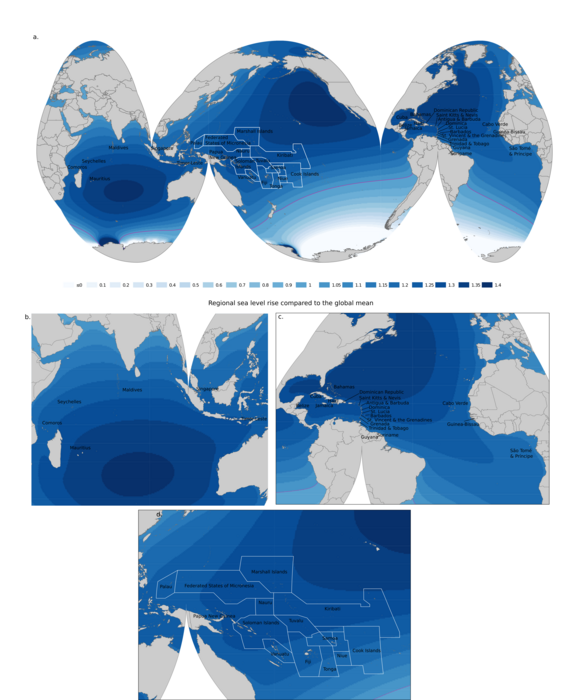
Credit: Sadai et al., 10.1029/2022EF002940
AMHERST, Mass. – While the world focuses on limiting the rise in global temperature to 1.5 or 2 degrees Celsius over the preindustrial average, increasing meltwater from ice sheets presents an existential threat to the viability of island and coastal nations throughout the world. Now, research from the University of Massachusetts Amherst, recently published in the journal Earth’s Future, shows that even the most optimistic temperature targets can lead to catastrophic sea-level rise, which has already begun and will affect low-lying nations for generations to come.
While rising temperatures are having many deleterious effects on global ecosystems, economies and human wellbeing, an interdisciplinary team of researchers at the University of Massachusetts emphasize that temperature alone is not a sufficient basis for climate policy. The team focused on the Antarctic Ice Sheet, which holds the world’s largest store of freshwater—enough to raise the oceans by 58 meters, and which is melting at an accelerating pace. But the physics of the ice sheet itself also contribute to its liquification, which will continue for millennia, even if global carbon emissions are reigned in. And because melting ice can slow rising temperatures in the atmosphere, it is conceivable that the melting ice sheet could help maintain what is commonly considered a “safe” level of warming, 1.5 degrees, say, while actually allowing for devastating sea-level rise. Furthermore, all that Antarctic meltwater won’t cause the same amount of sea-level rise everywhere in the world. Some areas in the Caribbean Sea as well as the Indian and Pacific Oceans will experience a disproportionate share of the sea-level rise from Antarctic ice—up to 33% greater than the global average.
This gap between temperature and sea level has immediate repercussions for many places throughout the world, and especially for the Alliance of Small Island States (AOSIS), an organization of 39 island and coastal nations across the globe. Indeed, the paper’s authors show that, though AOSIS countries have emitted a negligible portion of the planet’s anthropogenic greenhouse gasses, they are bearing the brunt of the world’s rising waters.
“Temperature is not the only way to track global climate change,” says Shaina Sadai, the paper’s lead author, who completed this research as part of her doctoral studies in geosciences at UMass Amherst, “but it became the iconic metric in the Paris Agreement. Knowing that Antarctic melt can delay temperature rise while increasing sea levels, I wondered what it meant for climate justice. But climate science alone can’t answer that question of justice.”
Enter Regine Spector, professor of political science at UMass Amherst and one of the paper’s senior authors. Spector brought expertise in political power dynamics and the history of global inequality to the team’s work to demonstrate how politically powerful countries influence global climate negotiations and continue historic patterns of colonial exploitation experienced by AOSIS nations. “Focusing on temperature misses other real consequences of climate change, such as sea-level rise, that are being felt all over the world today,” says Spector.
The team demonstrates that an interdisciplinary approach to research, which centers the experiences of AOSIS countries, can be used to better understand climate justice impacts of international negotiations and the relationships between science, policy and political power. “We need to listen to the voices of the people facing the vanguard of climate change,” say Sadai and Spector. They hope this research can serve as a model for future studies.
This research was funded by the National Science Foundation and NASA.
Contacts: Shaina Sadai, [email protected]
Regine Spector, [email protected]
Daegan Miller, [email protected]
Journal
Earth s Future
DOI
10.1029/2022EF002940
Article Title
The Paris Agreement and Climate Justice: Inequitable Impacts of Sea Level Rise Associated With Temperature Targets