The combination of global atmospheric warming and westerly winds shifting toward the poles will likely speed up the recession of mountain glaciers in both hemispheres, according to a UMaine study.
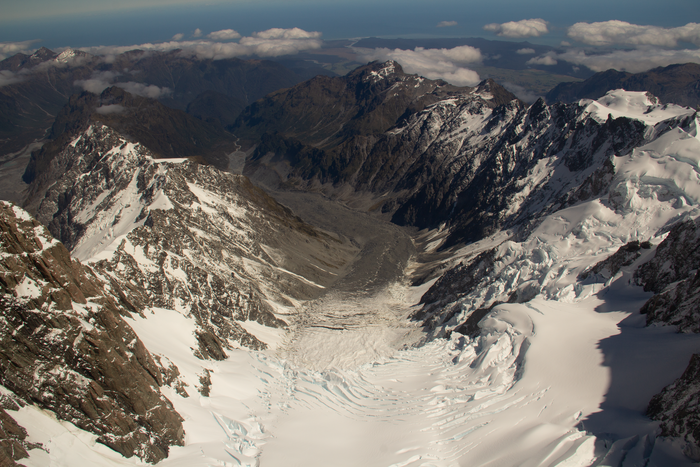
Credit: Photo by Aaron Putnam
The combination of global atmospheric warming and westerly winds shifting toward the poles will likely speed up the recession of mountain glaciers in both hemispheres, according to a UMaine study.
Mountain glaciers freeze and gain mass when the climate cools, and melt and lose mass when the climate warms. The extent to which the fluctuations in mountain glaciers are reflective of local, regional and even hemispheric climate variations, however, is less clear, which has made it more difficult for scientists to use glacial data to interpret past climate dynamics and make predictions for the future.
A team of researchers from the University of Maine conducted a National Science Foundation-funded study evaluating how atmospheric conditions are reflected in the mass fluctuations of mid-latitude glaciers on opposite sides of the Earth, comparing global temperature and wind changes with glacier snowline elevations (also called “equilibrium-line altitudes”) in the Southern Alps of New Zealand and in the European Alps observed over the course of nearly four decades. Glacier extent is dependent on the height of the snowline in the atmosphere, below which ice melts, which in turn is determined by the temperature of the atmosphere.
The data showed that the fluctuations in glacial snowlines reflected temperature changes over large regions of the atmosphere for the two mountain systems studied — even on hemispheric scales. Moreover, the latitudes of westerly wind belts were found to be important for regulating the proportion of cold versus warm air masses that influence glacier melting and freezing.
“This study really shows how intertwined Earth’s climate system is. At first subtle shifts in the state of the climate system can create waves throughout the system that have far reaching consequences,” says Alexander Audet, principal author of the study, who completed the research as a master’s student at the University of Maine. He is now pursuing a Ph.D. at the University of Nevada, Reno.
The results show that under global warming, the poleward contraction of the westerly winds belts may accelerate warming — and glacier melting — in the mid latitudes of both hemispheres.
“These results highlight the sensitivity of Earth’s mountain glaciers to broad-scale atmospheric dynamics. They are incredibly sensitive, physical thermometers, monitoring atmospheric conditions from the sea surface to the top of the troposphere. Reconstructions of past glacier change from glacial landforms may therefore help to provide quantitative insights into how large portions of the atmosphere behaved during past episodes of abrupt climate change, and in turn may offer clues into the climate dynamics of a warming world,” says Aaron Putnam, co-author of the study and associate professor at the UMaine School of Earth and Climate Sciences. George Denton, UMaine professor at the School of Earth and Climate Sciences and the Climate Change Institute, also co-authored the report.
Other co-authors of the study included Joellen Russell of the University of Arizona; Andrew Lorrey, who received his master’s at UMaine and is now principal scientist of climate and environmental applications at the National Institute of Water and Atmospheric Research (NIWA) in New Zealand; Andrew Mackintosh of Monash University, Australia; and Brian Anderson at the Victoria University of Wellington, New Zealand.
The study will be published in the Dec. 16, 2022 issue of Geophysical Research Letters, and was first published online Nov. 14, 2022.
Journal
Geophysical Research Letters
DOI
10.1029/2022GL099897
Article Title
Correspondence Among Mid-Latitude Glacier Equilibrium Line Altitudes, Atmospheric Temperatures, and Westerly Wind Fields