

• HOME
  • NEWS
  • EXPLORE
    • CAREER
      • Companies
      • Jobs
    • EVENTS
    • iGEM
      • News
      • Team
    • PHOTOS
    • VIDEO
    • WIKI
  • BLOG
  • COMMUNITY
    • FACEBOOK
    • INSTAGRAM
    • TWITTER
Wednesday, July 8, 2026
BIOENGINEER.ORG
No Result
View All Result
  • Login
  • HOME
  • NEWS
  • EXPLORE
    • CAREER
      • Companies
      • Jobs
        • Lecturer
        • PhD Studentship
        • Postdoc
        • Research Assistant
    • EVENTS
    • iGEM
      • News
      • Team
    • PHOTOS
    • VIDEO
    • WIKI
  • BLOG
  • COMMUNITY
    • FACEBOOK
    • INSTAGRAM
    • TWITTER
  • HOME
  • NEWS
  • EXPLORE
    • CAREER
      • Companies
      • Jobs
        • Lecturer
        • PhD Studentship
        • Postdoc
        • Research Assistant
    • EVENTS
    • iGEM
      • News
      • Team
    • PHOTOS
    • VIDEO
    • WIKI
  • BLOG
  • COMMUNITY
    • FACEBOOK
    • INSTAGRAM
    • TWITTER
No Result
View All Result
Bioengineer.org
No Result
View All Result
Home NEWS Science News Biology

Ultra-high-resolution photon-counting detector CT: Reconstruction kernel, slice thickness guide protocol

Bioengineer by Bioengineer
December 8, 2022
in Biology
Reading Time: 3 mins read
0
61-year-old male, post lung transplant, who underwent photon-counting detector CT of chest in ultra-high-resolution mode
Share on FacebookShare on TwitterShare on LinkedinShare on RedditShare on Telegram

Leesburg, VA, December 8, 2022—An accepted manuscript published in ARRS’ American Journal of Roentgenology (AJR) guides optimization of clinical protocols when implementing ultra-high-resolution photon-counting detector (UHR PCD) CT of the lungs, providing insights on the association of reconstruction kernel and slice thickness with image quality.
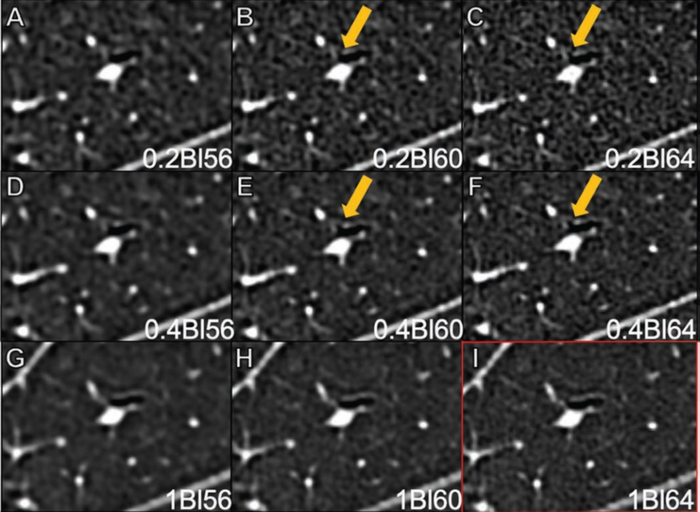
61-year-old male, post lung transplant, who underwent photon-counting detector CT of chest in ultra-high-resolution mode

Credit: ARRS and AJR

Leesburg, VA, December 8, 2022—An accepted manuscript published in ARRS’ American Journal of Roentgenology (AJR) guides optimization of clinical protocols when implementing ultra-high-resolution photon-counting detector (UHR PCD) CT of the lungs, providing insights on the association of reconstruction kernel and slice thickness with image quality.

Evaluating the impact of kernel and slice thickness on image quality of UHR PCD CT of the lungs using a 1024×1024 matrix, “the sharpest evaluated kernel, BI64, was the optimal kernel, consistent with the current clinical-reference technique,” wrote corresponding author Helmut Prosch from the department of biomedical imaging and image-guided therapy at the Medical University of Vienna in Austria.

In this AJR accepted manuscript, 29 patients (17 women, 12 men; median age, 56 years) underwent noncontrast chest CT using a first-generation PCD scanner (NAEOTOM Alpha, Siemens Healthineers, Forchheim, Germany) from February 15 to March 15, 2022. All acquisitions used UHR mode. Nine image sets were reconstructed for all combinations of three sharp kernels (BI56, BI60, BI64) and three slice thicknesses (0.2, 0.4, 1.0 mm). Three radiologists independently reviewed reconstructions for measures of visualization of pulmonary anatomic structures and pathologies using clinical-reference: BI641.0-mm

Ultimately, when performing PCD CT of the lungs in UHR mode, reconstruction using BI64 kernel and 0.4-mm slice thickness was the only assessed reconstruction to yield improved bronchial division identification and bronchial wall and pulmonary fissure sharpness, without loss in pulmonary vessel sharpness or conspicuity of nodules or other pathologies.

In comparison, a 0.2-mm slice thickness—the thinnest reconstruction possible—was “associated with decreased visualization of various anatomic and pathologic findings,” the authors of this AJR accepted manuscript added.

An electronic supplement to this AJR accepted manuscript is available here.


North America’s first radiological society, the American Roentgen Ray Society (ARRS) remains dedicated to the advancement of medicine through the profession of medical imaging and its allied sciences. An international forum for progress in radiology since the discovery of the x-ray, ARRS maintains its mission of improving health through a community committed to advancing knowledge and skills with the world’s longest continuously published radiology journal—American Journal of Roentgenology—the ARRS Annual Meeting, InPractice magazine, topical symposia, myriad multimedia educational materials, as well as awarding scholarships via The Roentgen Fund®.


MEDIA CONTACT:

Logan K. Young, PIO

44211 Slatestone Court

Leesburg, VA 20176

703-858-4332

[email protected]


Journal

American Journal of Roentgenology

DOI

10.2214/AJR.22.28515

Method of Research

Imaging analysis

Subject of Research

People

Article Title

Ultra-High-Resolution Photon-Counting Detector CT of the Lungs: Association of Reconstruction Kernel and Slice Thickness With Image Quality

Article Publication Date

8-Dec-2022

Share12Tweet8Share2ShareShareShare2

Related Posts

Rice and Neal Cancer Center award seed grants for translational cancer research

Rice and Neal Cancer Center award seed grants for translational cancer research

July 8, 2026

Here are a few rewritten headlines for a science magazine post, each with a slightly different tone: Intriguing & poetic: How do organs sculpt themselves? Sea stars hold the secret Direct & research-focused: Sea stars reveal the hidden rules of organ formation Metaphorical & inviting: Tiny architects beneath the waves: What sea stars teach us about building organs Short & punchy: Star-shaped clues to how our organs take shape Question-led: Could a sea star show us how organs form? Elegant & feature-style: The body’s blueprint, glimpsed in a sea star’s arm

July 6, 2026

Bacteria evolve faster with unconventional gene copies

July 6, 2026

Neighbours rewire soil feedback via root microbiome shifts

July 6, 2026

POPULAR NEWS

  • Detection of EDCs in Breast Milk and Infant Urine Up to Six Months Highlights Early Exposure Risks

    77 shares
    Share 31 Tweet 19
  • New Drug Candidate Developed at McMaster Shows Potential for Treating Brain Cancer

    58 shares
    Share 23 Tweet 15
  • KTU Researchers Explore Ultrasound’s Role in Enhancing Blood Flow Beyond Diagnostics

    53 shares
    Share 21 Tweet 13
  • 高齢者の骨粗鬆症治療の持続性比較

    51 shares
    Share 20 Tweet 13

About

We bring you the latest biotechnology news from best research centers and universities around the world. Check our website.

Follow us

Recent News

No-till weed control innovations showcased at Milan Field Day

Immune checkpoint control of inflammation mechanisms unveiled

Architecture of the 8 MDa Hdr–Vhu–Fwd super-assembly in class I methanogens

Subscribe to Blog via Email

Enter your email address to subscribe to this blog and receive notifications of new posts by email.

Join 83 other subscribers
  • Contact Us

Bioengineer.org © Copyright 2023 All Rights Reserved.

Welcome Back!

Login to your account below

Forgotten Password?

Retrieve your password

Please enter your username or email address to reset your password.

Log In
No Result
View All Result
  • Homepages
    • Home Page 1
    • Home Page 2
  • News
  • National
  • Business
  • Health
  • Lifestyle
  • Science

Bioengineer.org © Copyright 2023 All Rights Reserved.
