Scientists from the Institute of Vertebrate Paleontology and Paleoanthropology of the Chinese Academy of Sciences (IVPP) in Beijing and the Field Museum of Natural History in Chicago have revealed that birds retained key dinosaurian traits far into their evolution many millions of years after the split between dinosaurs and birds.
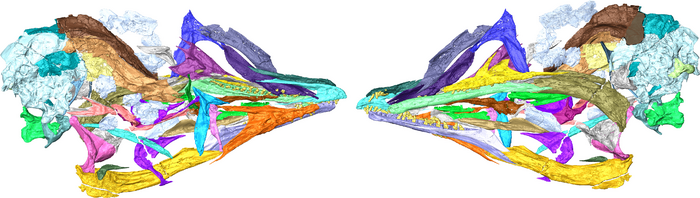
Credit: WANG Min
Scientists from the Institute of Vertebrate Paleontology and Paleoanthropology of the Chinese Academy of Sciences (IVPP) in Beijing and the Field Museum of Natural History in Chicago have revealed that birds retained key dinosaurian traits far into their evolution many millions of years after the split between dinosaurs and birds.
This discovery is based on detailed analysis and three-dimensional reconstruction of the flattened fossilized skull of a 120-million-year-old bird fossil called Yuanchuavis kompsosoura from Early Cretaceous deposits in Liaoning Province, northeastern China. Importantly, this fossil also provides clues about the origin of cranial kinesis, a fundamental feature of modern bird skulls.
The study was published in eLife on Dec. 5.
Most living birds have what is termed a kinetic skull. This means that upper beak movement is independent of the braincase. This mobility is accomplished by two chains of skull bones aligned from the back of the skull to the front, with one chain along the cheek and the other along the palate (roof of the mouth). These chains of interconnected bones help to transfer forces from the back of the skull to the beak, allowing for its movement.
“We still don’t know which chain of bones was completed and freed first in bird evolution, or even if it was all completed together,” said Prof. WANG Min from IVPP, lead and corresponding author of the study. “What we see in dinosaurs and the earliest birds like the enantiornithine Yuanchuavis is that these chains are missing connections or are locked in place because they connected to more bones that would stop most movements.”
“This fossil actually helps to narrow the time when, and where on the bird family tree, components of that moveable beak or kinesis evolved. We can show that it definitely was not present any earlier in bird evolution,” said Prof. Thomas Stidham from IVPP, coauthor of the study.
Yuanchuavis is a member of a group of extinct birds called enantiornithines or “opposite birds”—so named because of key differences in their skeleton from living birds. The enantiornithines became extinct at the end of the Cretaceous during the global mass extinction marking the end of the Age of Dinosaurs.
By using high-resolution CT-scanning, the research team was able to digitally identify, isolate, and assemble all skull bones into a detailed three-dimensional reconstruction. This work revealed many anatomical details not known for early birds. Yuanchuavis shows a mosaic of dinosaurian and bird traits such as a feathered bird body with wings, a toothed mouth, and an immovable dinosaurian palate and snout.
Among the primitive dinosaurian features of Yuanchuavis is the presence of bar-forming contacts among the bones of the temporal region of the skull behind the eye that are found in dinosaurs, crocodiles, lizards, and snakes (known as the diapsid condition). These interconnections essentially “lock up” one of the chains of bones in Yuanchuavis that is otherwise free in living birds, a requirement for kinesis.
The researchers’ detailed study of the shape of the pterygoid, a palate bone, shows that it had no direct contact with another bone called the quadrate, which is also needed to complete the palatal chain of bones in kinesis. That absence of contact is seen in most dinosaurs, including Triceratops and Tyrannosaurus, but the bones connect with one another in living birds.
In addition, the research team was able to confirm that the pterygoid of enantiornithines retained a unique shape. It had a two-pronged projection behind the eye like Velociraptor and other close dinosaurian relatives of birds.
Although these features ruled out any kinesis in the skull of early birds, the paleontological team was able to uncover a secret hidden in the fossil skull regarding the origin of kinesis. Detailed analysis and comparison of the palatine, another bone in the palate of Yuanchuavis, shows that the palatine lacks a key contact with the jugal bone, a part of the cheekbone. Dinosaurs and the oldest bird Archaeopteryx have that contact, which helps stabilize the palate bones and restricts movement. In contrast, the palatine of living birds, like Yuanchuavis, does not have that contact, thus facilitating back and forth sliding during bird skull kinesis.
According to Prof. WANG, the change in palatine bone shape from having contact with four to just three other skull bones in enantiornithines may be where skull kinesis began.
“New features evolve from old ones, and kinesis must have evolved in birds from an ancestor lacking it,” said Prof. WANG.
Prof. Stidham observed that most people would expect early birds to have bird skulls that matched their feathered wings and bodies. “However, these early birds hadn’t completely moved beyond their dinosaurian ancestry, and the evolutionary path from a small feathered dinosaur to a living bird was not a straight line,” he said, noting that bird evolution had its “detours and dead-ends.”
Journal
eLife
DOI
10.7554/eLife.81337
Article Title
Insight into the evolutionary assemblage of cranial kinesis from a Cretaceous bird
Article Publication Date
5-Dec-2022