• HOME
  • NEWS
  • EXPLORE
    • CAREER
      • Companies
      • Jobs
    • EVENTS
    • iGEM
      • News
      • Team
    • PHOTOS
    • VIDEO
    • WIKI
  • BLOG
  • COMMUNITY
    • FACEBOOK
    • INSTAGRAM
    • TWITTER
Saturday, February 7, 2026
BIOENGINEER.ORG
No Result
View All Result
  • Login
  • HOME
  • NEWS
  • EXPLORE
    • CAREER
      • Companies
      • Jobs
        • Lecturer
        • PhD Studentship
        • Postdoc
        • Research Assistant
    • EVENTS
    • iGEM
      • News
      • Team
    • PHOTOS
    • VIDEO
    • WIKI
  • BLOG
  • COMMUNITY
    • FACEBOOK
    • INSTAGRAM
    • TWITTER
  • HOME
  • NEWS
  • EXPLORE
    • CAREER
      • Companies
      • Jobs
        • Lecturer
        • PhD Studentship
        • Postdoc
        • Research Assistant
    • EVENTS
    • iGEM
      • News
      • Team
    • PHOTOS
    • VIDEO
    • WIKI
  • BLOG
  • COMMUNITY
    • FACEBOOK
    • INSTAGRAM
    • TWITTER
No Result
View All Result
Bioengineer.org
No Result
View All Result
Home NEWS Science News Chemistry

New study sheds light on how neurons respond to aged-related iron accumulation

Bioengineer by Bioengineer
December 6, 2022
in Chemistry
Reading Time: 2 mins read
0
Professor Hyung Joon Cho and his research team
Share on FacebookShare on TwitterShare on LinkedinShare on RedditShare on Telegram

Iron (Fe) accumulates in the brain cortex with aging. A plethora of studies indicate that progressive iron accumulation in the substantia nigra (SN) in the aged human brain is a major risk factor for Parkinson’s disease (PD) and other neurodegenerative diseases, but not everyone. This is because our body has plans to respond specifically to iron overloading.
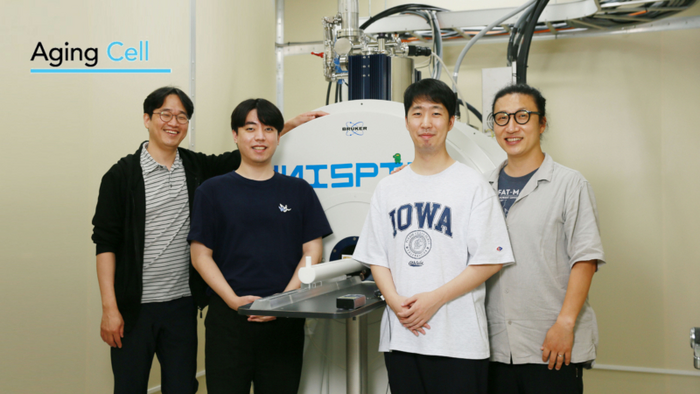
Professor Hyung Joon Cho and his research team

Credit: UNIST

Iron (Fe) accumulates in the brain cortex with aging. A plethora of studies indicate that progressive iron accumulation in the substantia nigra (SN) in the aged human brain is a major risk factor for Parkinson’s disease (PD) and other neurodegenerative diseases, but not everyone. This is because our body has plans to respond specifically to iron overloading.

A recent study, jointly led by Professor Taejoon Kwon and Professor Hyung Joon Cho in the Department of Biomedical Engineering at UNIST details the neuronal response to excessive iron accumulation, which is associated with age-related neurodegenerative diseases.

By investigating the response of neurons in the SN against age-related iron accumulation, the research team identified a transcriptome profile of aging-related iron accumulation using rats of different ages and confirmed their iron accumulation using the magnetic resonance images. With the additional animal experiments and cell line experiments, they found that two genes (CLU and HERPUD1) responded to age-related iron accumulation, and the knockdown of these genes severely impaired the cellular tolerance for iron toxicity.

“We conjecture that the understanding of the gene expression landscape during age-related iron accumulation can help us to elucidate molecular pathways and putative preventative strategies against neurodegenerative diseases,” noted the research team.

Their findings have been published in the September 2022 issue of Aging Cell, an open-access journal published by John Wiley & Sons. This study has been supported by the Global Ph.D. Fellowship and the University Key Research Institute (UKRI) programs through the National Research Foundation of Korea (NRF). It has also been supported through the grants by the Korea Health Industry Development Institute (KHIDI) and UNIST.

Journal Reference
Kujin Kwon,Hwapyeong Cho,Soyeon Lee, et al., “Adaptive cellular response of the substantia nigra dopaminergic neurons upon age-dependent iron accumulation,” Aging Cell, (2022).


Journal

Aging Cell

Article Publication Date

13-Dec-2022

Share12Tweet8Share2ShareShareShare2

Related Posts

blank

Breakthrough in Environmental Cleanup: Scientists Develop Solar-Activated Biochar for Faster Remediation

February 7, 2026
blank

Cutting Costs: Making Hydrogen Fuel Cells More Affordable

February 6, 2026

Scientists Develop Hand-Held “Levitating” Time Crystals

February 6, 2026

Observing a Key Green-Energy Catalyst Dissolve Atom by Atom

February 6, 2026

POPULAR NEWS

  • Robotic Ureteral Reconstruction: A Novel Approach

    Robotic Ureteral Reconstruction: A Novel Approach

    82 shares
    Share 33 Tweet 21
  • Digital Privacy: Health Data Control in Incarceration

    63 shares
    Share 25 Tweet 16
  • Study Reveals Lipid Accumulation in ME/CFS Cells

    57 shares
    Share 23 Tweet 14
  • Breakthrough in RNA Research Accelerates Medical Innovations Timeline

    53 shares
    Share 21 Tweet 13

About

We bring you the latest biotechnology news from best research centers and universities around the world. Check our website.

Follow us

Recent News

Evaluating Pediatric Emergency Care Quality in Ethiopia

TPMT Expression Predictions Linked to Azathioprine Side Effects

Improving Dementia Care with Enhanced Activity Kits

Subscribe to Blog via Email

Enter your email address to subscribe to this blog and receive notifications of new posts by email.

Join 73 other subscribers
  • Contact Us

Bioengineer.org © Copyright 2023 All Rights Reserved.

Welcome Back!

Login to your account below

Forgotten Password?

Retrieve your password

Please enter your username or email address to reset your password.

Log In
No Result
View All Result
  • Homepages
    • Home Page 1
    • Home Page 2
  • News
  • National
  • Business
  • Health
  • Lifestyle
  • Science

Bioengineer.org © Copyright 2023 All Rights Reserved.