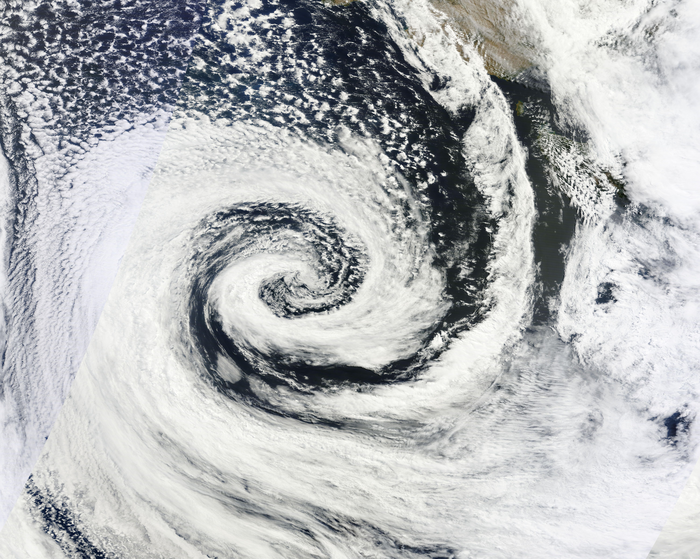
For centuries, sailors who had been all over the world knew where the most fearsome storms of all lay in wait: the Southern Hemisphere. “The waves ran mountain-high and threatened to overwhelm [the ship] at every roll,” wrote one passenger on an 1849 voyage rounding the tip of South America.
Credit: NASA
For centuries, sailors who had been all over the world knew where the most fearsome storms of all lay in wait: the Southern Hemisphere. “The waves ran mountain-high and threatened to overwhelm [the ship] at every roll,” wrote one passenger on an 1849 voyage rounding the tip of South America.
Many years later, scientists poring over satellite data could finally put numbers behind sailors’ intuition: The Southern Hemisphere is indeed stormier than the Northern, by about 24%, in fact. But no one knew why.
A new study led by University of Chicago climate scientist Tiffany Shaw lays out the first concrete explanation for this phenomenon. Shaw and her colleagues found two major culprits: ocean circulation and the large mountain ranges in the Northern Hemisphere.
The study also found that this storminess asymmetry has increased since the beginning of the satellite era in the 1980s. They found the increase was qualitatively consistent with climate change forecasts from physics-based models.
‘A tale of two hemispheres’
For a long time, we didn’t know very much about the weather in the Southern Hemisphere: most of the ways we observe weather are land-based, and the Southern Hemisphere has much more ocean than the Northern Hemisphere does.
But with the advent of satellite-based global observing in the 1980s, we could quantify just how extreme the difference was. The Southern Hemisphere has a stronger jet stream and more intense weather events.
Ideas had been circulated, but no one had established a definitive explanation for this asymmetry. Shaw—along with Osamu Miyawaki (PhD’22, now at the National Center for Atmospheric Research) and the University of Washington’s Aaron Donohoe—had hypotheses from their own and other previous studies, but they wanted to take the next step. This meant bringing together multiple lines of evidence, from observations, theory, and physics-based simulations of Earth’s climate.
“You can’t put the Earth in a jar,” Shaw explained, “so instead we use climate models built on the laws of physics and run experiments to test our hypotheses.”
They used a numerical model of Earth’s climate built on the laws of physics that reproduced the observations. Then they removed different variables one at a time, and quantified each one’s impact on storminess.
The first variable they tested was topography. Large mountain ranges disrupt air flow in a way that reduces storms, and there are more mountain ranges in the Northern Hemisphere.
Indeed, when the scientists flattened every mountain on Earth, about half the difference in storminess between the two hemispheres disappeared.
The other half had to do with ocean circulation. Water moves around the globe like a very slow but powerful conveyor belt: it sinks in the Arctic, travels along the bottom of the ocean, rises near Antarctica and then flows up near the surface, carrying energy with it. This creates an energy difference between the two hemispheres. When the scientists tried eliminating this conveyor belt, they saw the other half of the difference in storminess disappear.
Getting even stormier
Having answered the fundamental question regarding why the southern hemisphere is stormier, the researchers moved on to examine how storminess has changed since we’ve been able to track it.
Looking over past decades of observations, they found that the storminess asymmetry has increased over the satellite era beginning in the 1980s. That is, the Southern Hemisphere is getting even stormier, whereas the change on average in the Northern Hemisphere has been negligible.
The Southern Hemisphere storminess changes were connected to changes in the ocean. They found a similar ocean influence is occurring in the Northern Hemisphere, but its effect is canceled out by the absorption of sunlight in the Northern Hemisphere due to the loss of sea ice and snow.
The scientists checked and found that models used to forecast climate change as part of the Intergovernmental Panel on Climate Change assessment report were showing the same signals—increasing storminess in the Southern Hemisphere and negligible changes in the Northern—which serves as an important independent check on the accuracy of these models.
It may be surprising that such a deceptively simple question—why one hemisphere is stormier than another—went unanswered for so long, but Shaw explained that the field of weather and climate physics is relatively young compared to many other fields.
It was only after World War II that scientists began to build models of the physics driving large-scale weather and climate (of which key contributions were made at the University of Chicago by Prof. Carl-Gustaf Rossby).
But having a deep understanding of the physical mechanisms behind the climate and its response to human-caused changes, such as those laid out in this study, are crucial for predicting and understanding what will happen as climate change accelerates.
“By laying this foundation of understanding, we increase confidence in climate change projections and thereby help society better prepare for the impacts of climate change,” Shaw said. “One of the major threads in my research is to understand if models are giving us good information now so that we can trust what they say about the future. The stakes are high and it’s important to get the right answer for the right reason.”
Journal
Proceedings of the National Academy of Sciences
DOI
10.1073/pnas.2123512119
Article Title
Stormier Southern Hemisphere induced by topography and ocean circulation