• HOME
  • NEWS
  • EXPLORE
    • CAREER
      • Companies
      • Jobs
    • EVENTS
    • iGEM
      • News
      • Team
    • PHOTOS
    • VIDEO
    • WIKI
  • BLOG
  • COMMUNITY
    • FACEBOOK
    • INSTAGRAM
    • TWITTER
Wednesday, July 8, 2026
BIOENGINEER.ORG
No Result
View All Result
  • Login
  • HOME
  • NEWS
  • EXPLORE
    • CAREER
      • Companies
      • Jobs
        • Lecturer
        • PhD Studentship
        • Postdoc
        • Research Assistant
    • EVENTS
    • iGEM
      • News
      • Team
    • PHOTOS
    • VIDEO
    • WIKI
  • BLOG
  • COMMUNITY
    • FACEBOOK
    • INSTAGRAM
    • TWITTER
  • HOME
  • NEWS
  • EXPLORE
    • CAREER
      • Companies
      • Jobs
        • Lecturer
        • PhD Studentship
        • Postdoc
        • Research Assistant
    • EVENTS
    • iGEM
      • News
      • Team
    • PHOTOS
    • VIDEO
    • WIKI
  • BLOG
  • COMMUNITY
    • FACEBOOK
    • INSTAGRAM
    • TWITTER
No Result
View All Result
Bioengineer.org
No Result
View All Result
Home NEWS Science News Biology

Transcranial magnetic stimulation design goes deeper into brain

Bioengineer by Bioengineer
November 29, 2022
in Biology
Reading Time: 3 mins read
0
A new transcranial magnetic stimulation array with a special geometrical-shaped magnet structure reaches deeper brain tissue than conventional methods.
Share on FacebookShare on TwitterShare on LinkedinShare on RedditShare on Telegram

WASHINGTON, Nov. 29, 2022 – As a noninvasive neuromodulation method, transcranial magnetic stimulation (TMS) shows great potential to treat a range of mental and psychiatric diseases, including major depression.
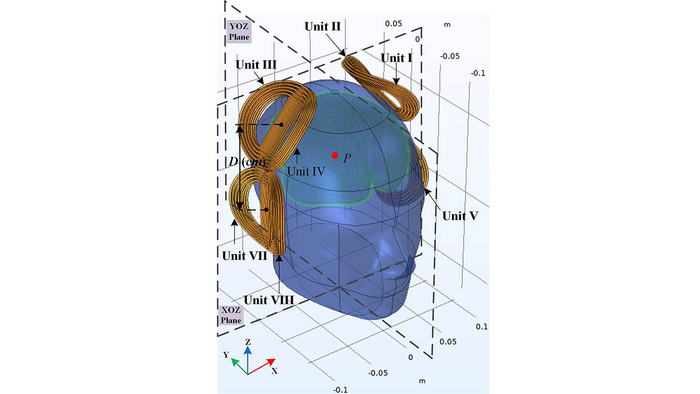
A new transcranial magnetic stimulation array with a special geometrical-shaped magnet structure reaches deeper brain tissue than conventional methods.

Credit: Xiao Fang

WASHINGTON, Nov. 29, 2022 – As a noninvasive neuromodulation method, transcranial magnetic stimulation (TMS) shows great potential to treat a range of mental and psychiatric diseases, including major depression.

Stimulating the deep brain helps researchers explore the causes of and possible treatments for psychiatric diseases, but current methods don’t go quite deep enough and are largely restricted to superficial targets within the brain.

In AIP Advances, from AIP Publishing, a group of researchers in China from Chengdu University of Technology and Huazhong University of Science and Technology present a new TMS array with a special geometrical-shaped magnet structure to help stimulate deeper tissue within the brain.

“Considering the approximate spherical structure of the human head, I wondered if special-shaped coils could be more advantageous than flat coils,” said Xiao Fang, a co-author who has worked on TMS for nearly eight years. “When I was studying at Wuhan National High Magnetic Field Center in 2016, we had a magnet design department in our lab, and they did some research regarding special-shaped magnets for electromagnetic shaping. After seeing their research posters, it inspired us to try to use shaped magnets in bioelectromagnetic stimulation.” 

Inside the brain, external stimuli transmit information through neurons with electrical and chemical signals.

“Deep brain stimulation taps into the penetrating ability of an electromagnetic field or signal to target the membrane potential of deep brain neurons and change the polarization or depolarization effect to achieve neuromodulation,” said Fang.

The group’s new spatially symmetric array, based on a curved type of coil, offers advantages over traditional TMS coils in deep brain stimulation performance.

“It enables focalized stimulation within the deep brain so fewer untargeted tissues are exposed to strong stimulation,” said Fang. “And the location of the stimulation target generated by the array can be flexibly and continuously adjusted.”

This array’s special geometric design enables deep brain focused stimulation 11 centimeters below the scalp.

“That is 1.67 times deeper than conventional planar stimulation arrays when producing the same focusing area, which effectively improves the stimulation effect,” Fang said.

The group’s design is mainly intended for deep brain stimulation, such as the treatment of major depression, and its target area is the ventromedial prefrontal cortex region located 7 centimeters beneath the human scalp.

###

The article, “Noninvasive focalized stimulation in deep brain using the spatially symmetric array,” is authored by Xiao Fang, Chen Yun, Chaoxu Zeng, Hongfa Ding, Yongheng Huang, Wi Liu, and Yaoyao Luo. It will appear in AIP Advances on Nov. 29, 2022 (DOI: 10.1063/5.0121692). After that date, it can be accessed at https://aip.scitation.org/doi/10.1063/5.0121692.

ABOUT THE JOURNAL

AIP Advances is an open access journal publishing in all areas of physical sciences—applied, theoretical, and experimental. The inclusive scope of AIP Advances makes it an essential outlet for scientists across the physical sciences.  See https://aip.scitation.org/journal/adv.

###


Journal

AIP Advances

DOI

10.1063/5.0121692

Method of Research

Experimental study

Article Title

Noninvasive focalized stimulation in deep brain using the spatially symmetric array

Article Publication Date

29-Nov-2022

Share12Tweet8Share2ShareShareShare2

Related Posts

Here are a few rewritten headlines for a science magazine post, each with a slightly different tone: Intriguing & poetic: How do organs sculpt themselves? Sea stars hold the secret Direct & research-focused: Sea stars reveal the hidden rules of organ formation Metaphorical & inviting: Tiny architects beneath the waves: What sea stars teach us about building organs Short & punchy: Star-shaped clues to how our organs take shape Question-led: Could a sea star show us how organs form? Elegant & feature-style: The body’s blueprint, glimpsed in a sea star’s arm

July 6, 2026
Bacteria evolve faster with unconventional gene copies — Biology

Bacteria evolve faster with unconventional gene copies

July 6, 2026

Neighbours rewire soil feedback via root microbiome shifts

July 6, 2026

Evolution-Inspired Biosensors Revolutionize Lipid Tracking in Real Time

July 2, 2026

POPULAR NEWS

  • Detection of EDCs in Breast Milk and Infant Urine Up to Six Months Highlights Early Exposure Risks

    77 shares
    Share 31 Tweet 19
  • New Drug Candidate Developed at McMaster Shows Potential for Treating Brain Cancer

    58 shares
    Share 23 Tweet 15
  • Saying Goodbye to PGY-6: Pediatric Fellowship Realities

    103 shares
    Share 41 Tweet 26
  • KTU Researchers Explore Ultrasound’s Role in Enhancing Blood Flow Beyond Diagnostics

    53 shares
    Share 21 Tweet 13

About

We bring you the latest biotechnology news from best research centers and universities around the world. Check our website.

Follow us

Recent News

Flame retardant BDE-209 targets molecularly linked to ulcerative colitis

Ultra-high frequency particle impacts mimic rockbursts to shatter hard rock

Kidney transplant outcomes in older adults studied by German researchers

Subscribe to Blog via Email

Success! An email was just sent to confirm your subscription. Please find the email now and click 'Confirm' to start subscribing.

Join 83 other subscribers
  • Contact Us

Bioengineer.org © Copyright 2023 All Rights Reserved.

Welcome Back!

Login to your account below

Forgotten Password?

Retrieve your password

Please enter your username or email address to reset your password.

Log In
No Result
View All Result
  • Homepages
    • Home Page 1
    • Home Page 2
  • News
  • National
  • Business
  • Health
  • Lifestyle
  • Science

Bioengineer.org © Copyright 2023 All Rights Reserved.