The idea that climate change and geological events can shape evolution isn’t a new one: anyone who’s heard of dinosaurs knows that a big change in the environment (like, say, a meteor hitting the Earth 66 million years ago and causing a chain reaction of storms, earthquakes, cold, and darkness) can dictate how animals live, die, and evolve. But while it’s a generally agreed-upon concept, scientists rely on painstakingly precise data to map how these sorts of changes affect the course of evolution for even one species. A new study in PNAS compiles data on more than 3,000 species to show how climate and geologic changes across Asia over the last 66 million years have shaped the evolution of the continent’s mammals.
Credit: Photo by Danping Mu.
The idea that climate change and geological events can shape evolution isn’t a new one: anyone who’s heard of dinosaurs knows that a big change in the environment (like, say, a meteor hitting the Earth 66 million years ago and causing a chain reaction of storms, earthquakes, cold, and darkness) can dictate how animals live, die, and evolve. But while it’s a generally agreed-upon concept, scientists rely on painstakingly precise data to map how these sorts of changes affect the course of evolution for even one species. A new study in PNAS compiles data on more than 3,000 species to show how climate and geologic changes across Asia over the last 66 million years have shaped the evolution of the continent’s mammals.
Asia is the world’s largest continent, and it’s home to just about every type of biome. “Asia has desert up north, tropical forests in the south, temperate forests in the east,” says Anderson Feijó, the study’s lead author, a researcher at the Institute of Zoology, Chinese Academy of Sciences and a former research fellow at Chicago’s Field Museum. “My idea was to understand how all these regions were connected and how we ended up with different species of mammals in different areas.”
“To understand historical events, scientists look for associations with their timing and location– when and where did species appear, and what else was happening then and there? This paper does that for the entire Asian mammal fauna,” says Bruce Patterson, a curator emeritus at the Field Museum and co-author of the paper.
Asia doesn’t have the most mammal species in the world, or the most different kinds of habitats, but “what makes it special is its connections,” says Patterson. “It’s a crossroads for connections to North America, Africa, Europe, and Australasia.” The researchers wanted to see how different mammals came to Asia and left from there over time, as well as how new species evolved, and determine whether they could link these changes in Asia’s mammal diversity with changes in the region’s geology (like shifting tectonic plates forming mountains) and climate.
“One big step of this project was building a very good understanding of the distribution of mammal species. And this took quite a while because I needed to go through the literature, public databases, and museum collections,” says Feijó. Museums like the Field and the National Zoological Museum of China house collections that include preserved animal specimens and fossils coupled with info about where the animal was found and when. They also used family trees showing how different species are related to shed light on the bigger picture of mammalian evolution. Combining both info, Feijó and his colleagues were able to map where different species have been found over time.
Overall, the researchers found clear links between changes in the Earth’s climate over the past 66 million years and the mammals found in different regions of Asia. As the climate slowly warmed and cooled, some species were driven extinct or moved to new habitats, while others thrived. Similarly, tectonic plate activity, like when the Indian subcontinent inched towards the rest of Asia and eventually crashed into it, buckling the land and forming the Himalayas, played a big role in the movement, extinction, and evolution of mammals.
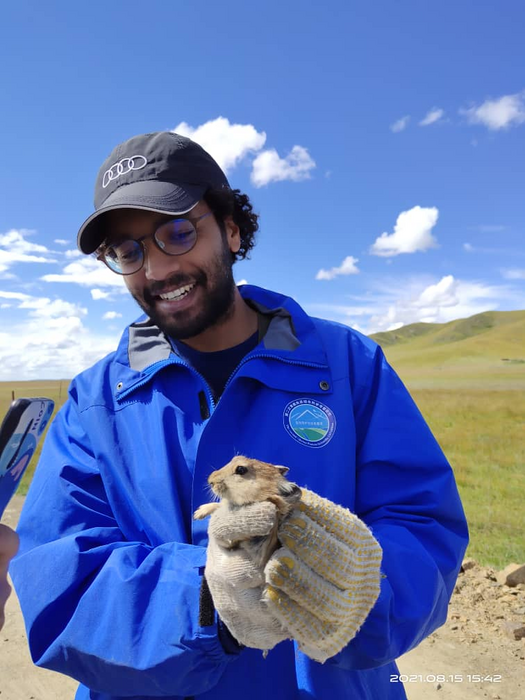
The researchers were even able to explore the effects of climate and geology on the evolution of individual species; Feijó gives the example of the pikas. Pikas look like their close relatives, rabbits, but have small rounded ears, and they’re adapted to live in high altitudes with low oxygen levels. “Pikas originated around 15 million years ago on the Tibetan Plateau, and we believe that the formation of this plateau was a big driver of the evolution of this group,” says Feijó. “Then from there, they colonized the lowlands of northern Asia and then invaded North America, where they’re still found today.”
Overall, “this paper made very clear that everything is connected.”says Feijó. “We are seeing a lot of climate change happen today, and this paper shows that every geological climate change event has led to either diversification or extinction or migration, and we can expect the same thing to happen in the future.”
###
Journal
Proceedings of the National Academy of Sciences
Article Title
Mammalian diversification bursts and biotic turnovers are synchronous with Cenozoic geoclimatic events in Asia
Article Publication Date
28-Nov-2022