For sharks living in the open ocean, longline fishing is the number-one threat, with an estimated 20 million pelagic sharks caught annually by fishers looking for tuna and other desired species. Now, a new study reported in Current Biology on November 21 shows that a new technology, known as “SharkGuard,” could allow longline fishing to continue while reversing the dramatic decline of endangered sharks around the world.
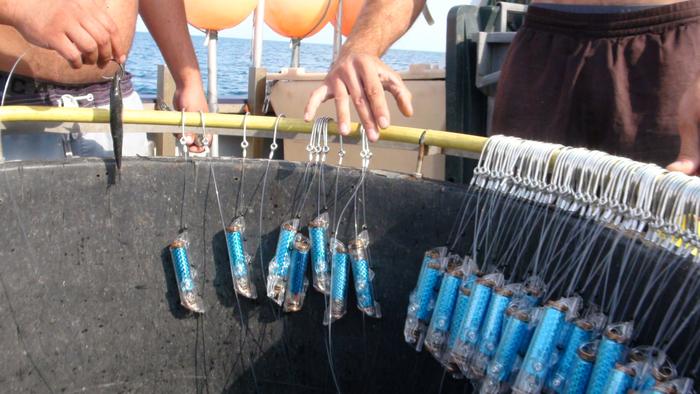
Credit: Robert Enever
For sharks living in the open ocean, longline fishing is the number-one threat, with an estimated 20 million pelagic sharks caught annually by fishers looking for tuna and other desired species. Now, a new study reported in Current Biology on November 21 shows that a new technology, known as “SharkGuard,” could allow longline fishing to continue while reversing the dramatic decline of endangered sharks around the world.
“The main implication is that commercial longline fishing may continue, but it won’t always necessarily result in the mass bycatch of sharks and rays,” said Robert Enever of Fishtek Marine, Dartington, Devon, United Kingdom. “This is important in balancing the needs of the fishers with the needs of the environment and contributes to national and international biodiversity commitments for long-term sustainability.”
Enever and his colleagues saw the tremendous need to slow or even reverse the decline in global shark populations based on evidence that more than 100 million sharks, skates, and rays are caught each year by the world’s commercial fisheries. A quarter of sharks and rays also are now classified as threatened. They thought that shark deterrents that showed promise for protecting scuba divers and surfers from sharks would also have application in tuna fisheries to protect sharks from bycatch.
How does it work? SharkGuard emits a small, localized, pulsing electric field. When attached to the fishing line, it creates an electric field around a baited hook. The goal is to discourage sharks and rays, which detect the electric signals via their electroreceptors, from biting without getting in the way of hooking other fish.
To find out how well it worked, the researchers ran sea trials in July and August 2021 in southern France. Two fishing vessels fished 22 longlines on 11 separate trips, deploying a total of more than 18,000 hooks. Their findings showed that SharkGuard hooks significantly reduced the number of blue sharks and pelagic stingrays caught in comparison to standard control hooks. The catch rate of these species per unit effort dropped by 91% and 71% for sharks and rays, respectively. Catch rates of bluefin tuna were not significantly influenced by the presence of SharkGuard on the hook.
“The sharks do not take the bait and do not get (by)caught on the hooks,” Enever said.
The researchers note that, in comparison to catching and releasing bycaught species including sharks, SharkGuard offers a more comprehensive solution. If its use were scaled up to the level of whole fisheries, it would mean much reduced interaction between sharks and fishing gear.
For now, however, the device does have limitations, including the need for frequent battery changes. They’re now working to overcome this barrier, so fishers could “fit and forget” it, while still protecting sharks and other bycatch species. It’s expected that a full set of induction-charged SharkGuard devices for 2,000 hooks would cost around $20,000 and would last 3 to 5 years (~$4-7K per annum), which they note is a modest annual cost for most commercial tuna fishing operations.
They now encourage fishers who experience high shark and ray bycatch, as well as retail corporates who are intent on improving the sustainability of their supply chain, to seek contact with Fishtek Marine early as sea trials and engineering developments are planned for commercialization.
“There is hope!” Enever said. “Against the relentless backdrop of stories of dramatic declines occurring across all species, it is important to remember that there are people working hard to find solutions. SharkGuard is an example of where, given the appropriate backing, it would be possible to roll the solution out on a sufficient scale to reverse the current decline in global shark populations.”
###
This work was funded by Innovate UK and supported Sa.Tho.An (French Producer Organisation) and France Filière Pêche. Fishtek Marine Ltd. designed and manufactured the SharkGuard prototypes used in this study.
Current Biology, Doherty et al.: “Efficacy of a novel shark bycatch mitigation device in a tuna longline fishery” https://www.cell.com/current-biology/fulltext/S0960-9822(22)01427-0
Current Biology (@CurrentBiology), published by Cell Press, is a bimonthly journal that features papers across all areas of biology. Current Biology strives to foster communication across fields of biology, both by publishing important findings of general interest and through highly accessible front matter for non-specialists. Visit http://www.cell.com/current-biology. To receive Cell Press media alerts, contact [email protected].
Journal
Current Biology
DOI
10.1016/j.cub.2022.09.003
Method of Research
Experimental study
Subject of Research
Animals
Article Title
Efficacy of a novel shark bycatch mitigation device in a tuna longline fishery
Article Publication Date
21-Nov-2022