Obesity is one of the most serious global health problems. Obesity increases the risk of diabetes, cardiovascular diseases, fatty liver diseases, and certain cancers, which affects billions of people around the world. Obesity results from an imbalance between energy intake and energy expenditure, and increasing energy expenditure is an efficient way to treat obesity. Brown adipose tissue (BAT) dissipates the mitochondrial electrochemical gradient to generate heat through uncoupling protein1 (UCP1). It has been shown that adult humans also have functional UCP1-positive brown adipocytes, and activation of BAT by cold stimuli leads to a decrease in fat mass. Thus, identification of targetable factors that promote development and function of BAT is an attractive strategy for treating obesity.
Credit: Yuqin Wang, Xinzhi Li, Cenxi Liu, Liying Zhou, Lei Shi, Zhiguo Zhang, Long Chen, Ming Gao, Lanyue Gao, Yuanyuan Xu, He Huang, Jin Li, Zheng Chen
Obesity is one of the most serious global health problems. Obesity increases the risk of diabetes, cardiovascular diseases, fatty liver diseases, and certain cancers, which affects billions of people around the world. Obesity results from an imbalance between energy intake and energy expenditure, and increasing energy expenditure is an efficient way to treat obesity. Brown adipose tissue (BAT) dissipates the mitochondrial electrochemical gradient to generate heat through uncoupling protein1 (UCP1). It has been shown that adult humans also have functional UCP1-positive brown adipocytes, and activation of BAT by cold stimuli leads to a decrease in fat mass. Thus, identification of targetable factors that promote development and function of BAT is an attractive strategy for treating obesity.
Earlier studies in the last century showed that brown adipocytes undergo postnatal development to mature and gain function in rodents. Environmental temperature plays a key role in this process. Relative low environmental temperature (22℃−24℃ compared to 37℃ in uterus) dramatically promotes Ucp1 expression and BAT growth in neonatal pups. Thermoneutral environment (36℃) significantly impairs the postnatal development of BAT. Conversely, the growth of BAT is faster and the mitochondria content is greater in cold (16℃) reared neonatal rats. These results indicate that the relative low temperature is essential for postnatal development of BAT. However, the molecular mechanisms are largely unknown.
Recently, Dr. Zheng Chen and his team at Harbin Institute of Technology published a paper in Life Metabolism entitled“WTAP regulates postnatal development of brown adipose tissue by stabilizing METTL3 in mice”. This study demonstrates that Wilms’tumor 1-associating protein (WTAP) plays an essential role in the postnatal development and maturation of BAT.
WTAP is an RNA binding protein, which interacts with METTL3, serving as a regulatory subunit of m6A writer machine, and regulates m6A modification and alternative splicing of mRNAs. Researchers found in this study that WTAP expression is significantly increased in BAT after birth. The UCP1 protein levels are also showed the similar expression pattern with WTAP (this study) and METTL3. In adult BAT, WTAP protein levels are significantly higher compared with that in inguinal white adipose tissue (iWAT) and epididymal white adipose tissue (eWAT). These data indicate that WTAP may play an important role in the postnatal development of interscapular BAT (iBAT).
To further determine whether WTAP regulates iBAT postnatal development, researchers generated BAT-specific Wtap knockout (Wtap-BKO) mice by crossing Wtap-floxed mice with Ucp1-iCre transgenic mice, in which IRES-Cre was inserted between exon 6 and the 3’UTR to allow UCP1 and iCRE expression at the same time with lower levels. Ucp1-iCre has been shown to delete genes specifically in iBAT at 5 days of age. The morphology of iBAT in Wtap-BKO mice appears abnormal, enlarged and “whitening” roughly after 10 days of age. Adult mice with WTAP deficiency in BAT display hypothermic and succumb to acute cold challenge. These results demonstrate that WTAP plays an essential role in the postnatal development of iBAT and deletion of WTAP seriously impairs this process and leads to cold intolerance and reduced energy expenditure.
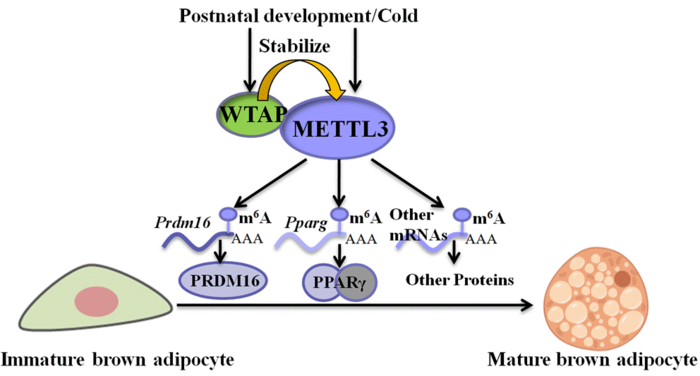
Researchers’previous study shows that METTL3, a key m6A RNA methyltransferase, also plays an essential role in the postnatal development of iBAT, and Mettl3-BKO mice show abnormal, enlarged and“whitening” BAT, which is very similar to those observed in Wtap-BKO mice. WTAP also interacts with METTL3 in BAT, indicating that WTAP may regulate the postnatal development of BAT by modulating METTL3. Further study shows that BAT-specific knockout of Wtap decreases protein stability of METTL3, which further causes the decreased m6A modification and expression of Prdm16 and Pparg. BAT-specific overexpression of Mettl3 in Wtap-BKO mice rescues the impaired energy expenditure and thermogenesis in Wtap-BKO mice by rescuing the decreased expression of PRDM16, PPARγ and UCP1. In conclusion, these results demonstrate that WTAP plays an essential role in iBAT postnatal development and thermogenesis by regulating the protein stability of METTL3.
###
Reference: Yuqin Wang et al. (2022). WTAP regulates postnatal development of brown adipose tissue by stabilizing METTL3 in mice. Life Metabolism. https://doi.org/10.1093/lifemeta/loac028.
About Higher Education Press
Founded in May 1954, Higher Education Press Limited Company (HEP), affiliated with the Ministry of Education, is one of the earliest institutions committed to educational publishing after the establishment of P. R. China in 1949. After striving for six decades, HEP has developed into a major comprehensive publisher, with products in various forms and at different levels. Both for import and export, HEP has been striving to fill in the gap of domestic and foreign markets and meet the demand of global customers by collaborating with more than 200 partners throughout the world and selling products and services in 32 languages globally. Now, HEP ranks among China’s top publishers in terms of copyright export volume and the world’s top 50 largest publishing enterprises in terms of comprehensive strength.
About Life Metabolism
Life Metabolism is a fully open access, peer-reviewed journal that publishes one volume per year online, providing a platform for the publication of works of high significance and broad interest in all areas of metabolism. Life Metabolism welcomes several different article types, including original article, review article, research highlight, letter, editorial, perspective, and so on. Once a paper is accepted, Life Metabolism can publish a precopyedited, preproofed version of the paper online within 48 hours of receiving a signed licence, and this will be replaced by a copyedited, proofed version of the paper as soon as it is ready. The Editors-in-Chief are professors Peng Li at Tsinghua University and John R Speakman at University of Aberdeen, UK. In the first three years, there will be no publication costs for publishing in Life Metabolism, and Open Access fees will be waived.
Journal
Life Metabolism
DOI
10.1093/lifemeta/loac028
Method of Research
Experimental study
Subject of Research
Animal tissue samples
Article Title
WTAP Regulates Postnatal Development of Brown Adipose Tissue by stabilizing METTL3 in mice
Article Publication Date
10-Oct-2022