Malaria is a devastating disease caused by the Plasmodium parasite. After an infected mosquitos’ bite, the parasites travel to the liver and infect liver cells. This phase of the infection is asymptomatic. Now, a new study led by Maria M. Mota, group leader at the Instituto de Medicina Molecular João Lobo Antunes (iMM; Portugal), and Shalev Itzkovitz, group leader at the Weizmann Institute of Science, in Israel, and published today in the scientific journal Nature, found for the first time that the outcome of the malaria infection is linked to the spatial location of the infected cells in the liver. This atlas of the liver stage of the malaria infection is crucial because solving the infection at this stage would prevent the development of the disease.
Credit: Helena Pinheiro, iMM
Malaria is a devastating disease caused by the Plasmodium parasite. After an infected mosquitos’ bite, the parasites travel to the liver and infect liver cells. This phase of the infection is asymptomatic. Now, a new study led by Maria M. Mota, group leader at the Instituto de Medicina Molecular João Lobo Antunes (iMM; Portugal), and Shalev Itzkovitz, group leader at the Weizmann Institute of Science, in Israel, and published today in the scientific journal Nature, found for the first time that the outcome of the malaria infection is linked to the spatial location of the infected cells in the liver. This atlas of the liver stage of the malaria infection is crucial because solving the infection at this stage would prevent the development of the disease.
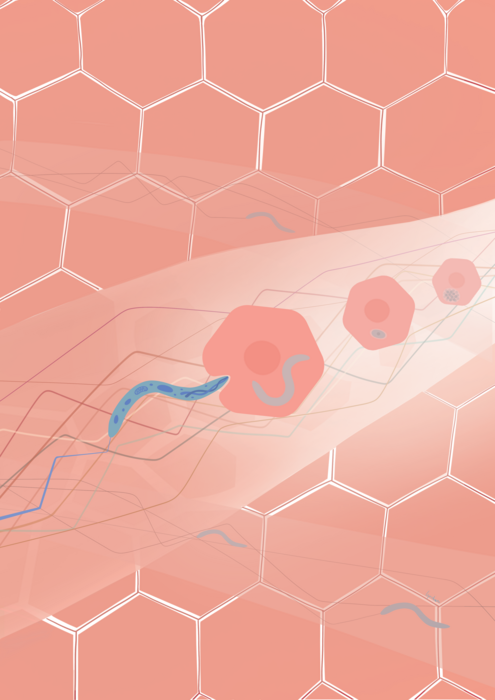
Scientists working in Portugal and Israel tracked the infection by Plasmodium parasites in the liver by looking at the localization of the parasites over time and were able to create an atlas of the liver infection by applying an innovative approach. “The liver is formed by thousands of lobules. The lobules are groups of liver cells that are organized in the shape of hexagons. We found that the outcome of the infection is different depending on the zone of the lobules infected by the malaria parasites. The parasites develop faster and survive better in the regions closer to the center of these hexagon-shaped lobules”, says Shalev Itzkovitz, group leader at the Weizmann Institute of Science, on the main findings of this work.
The research team analyzed the active genes of the liver cells and the parasites at different times after infection, using mice as a model. Since the genes that are active in the liver cells depend on their localization, the researchers were able to pair each parasite to its localization in the liver and reconstruct their paths by checking over the time of the infection. “We found a group of parasites located in the edge of the lobules that are not able to develop an infection”, continues Shalev Itzkovitz.
“We called these cells in the liver where the parasites are not able to develop an infection ‘abortive liver cells’”, says Maria Manuel Mota, group leader at the iMM and co-leader of the study. “It’s almost as if these cells are hostile to the parasites and the parasites have to “abort the mission”. We found that the immune response that these cells are able to promote in response to the parasites is different”, explains Maria Manuel Mota.
The liver stage of the malaria infection is hard to study due to the heterogeneity of the liver. “I have been studying the liver stage of malaria for 20 years, and this study is a turning point. We now have information on how both the liver cells and the Plasmodium parasites behave during infection, in time and space. This information will pave the way for our future research. We can use the vulnerabilities of the Plasmodium that we found in this study to try to develop ways to clear the infection in the liver stage, that is asymptomatic”, says Maria Manuel Mota.
The researchers created a detailed atlas of the infection by the parasites that cause malaria in the liver. Deciphering the dynamics of the infection at this asymptomatic stage is important because it will feed the research on how to stop the infection in the liver and eliminate the disease before the symptoms.
This work was funded by the Wolfson Family Charitable Trust, the Edmond de Rothschild Foundations, the Fannie Sherr Fund, the Dr. Beth Rom-Rymer Stem Cell Research Fund, the Helen and Martin Kimmel Institute for stem cell research, the Minerva Stiftung grant, the Israel Science Foundation, the Broad Institute‐Israel Science Foundation, the European Research Council under the European Union’s Horizon 2020 research and innovation program grant, the Chan Zuckerberg Initiative, the Bert L. and N. Kuggie Vallee Foundation, the Howard Hughes Medical Institute, the European Molecular Biology Organization, “laCaixa” Foundation and Fundação para a Ciência e Tecnologia.
*Amichay Afriat, Vanessa Zuzarte-Luís, Keren Bahar Halpern, Lisa Buchauer, Sofia Marques, Ângelo Ferreira Chora, Aparajita Lahree, Ido Amit, Maria M. Mota, Shalev Itzkovitz. 2022. A spatiotemporally resolved single cell atlas of the Plasmodiumliver stage. Nature. DOI: 10.1038/s41586-022-05406-5
Journal
Nature
DOI
10.1038/s41586-022-05406-5
Method of Research
Experimental study
Subject of Research
Animals
Article Title
A spatiotemporally resolved single cell atlas of the Plasmodium liver stage.
Article Publication Date
9-Nov-2022