• HOME
  • NEWS
  • EXPLORE
    • CAREER
      • Companies
      • Jobs
    • EVENTS
    • iGEM
      • News
      • Team
    • PHOTOS
    • VIDEO
    • WIKI
  • BLOG
  • COMMUNITY
    • FACEBOOK
    • INSTAGRAM
    • TWITTER
Sunday, February 8, 2026
BIOENGINEER.ORG
No Result
View All Result
  • Login
  • HOME
  • NEWS
  • EXPLORE
    • CAREER
      • Companies
      • Jobs
        • Lecturer
        • PhD Studentship
        • Postdoc
        • Research Assistant
    • EVENTS
    • iGEM
      • News
      • Team
    • PHOTOS
    • VIDEO
    • WIKI
  • BLOG
  • COMMUNITY
    • FACEBOOK
    • INSTAGRAM
    • TWITTER
  • HOME
  • NEWS
  • EXPLORE
    • CAREER
      • Companies
      • Jobs
        • Lecturer
        • PhD Studentship
        • Postdoc
        • Research Assistant
    • EVENTS
    • iGEM
      • News
      • Team
    • PHOTOS
    • VIDEO
    • WIKI
  • BLOG
  • COMMUNITY
    • FACEBOOK
    • INSTAGRAM
    • TWITTER
No Result
View All Result
Bioengineer.org
No Result
View All Result
Home NEWS Science News Chemistry

Chang’E-5 samples reveal how young volcanism occurred on the Moon

Bioengineer by Bioengineer
October 21, 2022
in Chemistry
Reading Time: 3 mins read
0
Dr. YUAN Jiangyan analyzes Chang’E-5 lunar samples with a scanning electron microscope at IGGCAS
Share on FacebookShare on TwitterShare on LinkedinShare on RedditShare on Telegram

A new study led by Prof. CHEN Yi from the Institute of Geology and Geophysics of the Chinese Academy of Sciences (IGGCAS) provides an answer to the question of how young volcanism occurred on the Moon.
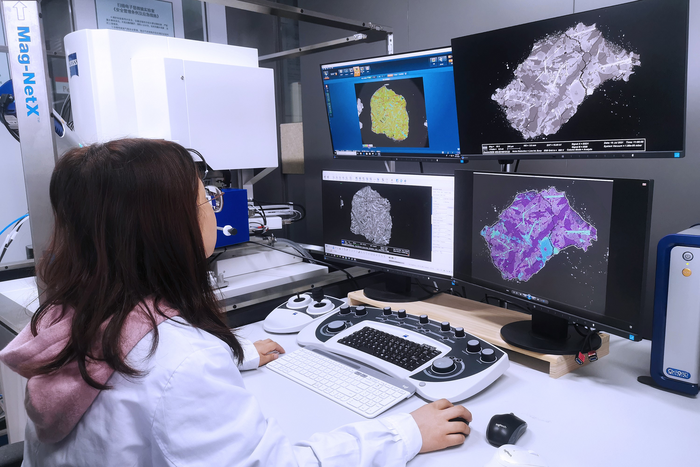
Dr. YUAN Jiangyan analyzes Chang’E-5 lunar samples with a scanning electron microscope at IGGCAS

Credit: SU Bin

A new study led by Prof. CHEN Yi from the Institute of Geology and Geophysics of the Chinese Academy of Sciences (IGGCAS) provides an answer to the question of how young volcanism occurred on the Moon.

The researchers found that mantle melting-point depression due to the presence of fusible, easily melted components could generate young lunar volcanism.

Their findings were published in Science Advances on Oct. 21.

Lunar samples returned by the Apollo and Luna missions are all older than about 3 billion years, leading scientists to suppose that the Moon has been geologically dead since then. However, the new lunar samples returned by China’s Chang’E-5 mission in 2020 revealed surprisingly young volcanic activity only 2 billion years old.

For the small rocky Moon, the heat fueling volcanic activity should have been lost long before these eruptions 2 billion years ago.

So what’s going on? Scientists previously speculated that either elevated water content or heat-producing elements in the lunar interior might have driven volcanism in the late stage of the Moon’s life. But the Chang’E-5 data recently published in Nature have ruled out these once-leading hypotheses.

“Recent melting of the lunar mantle can be achieved by either raising the temperature or lowering the melting point. To better understand this problem, we should estimate the temperature and pressure in which the young volcanism was created,” said Prof. CHEN.

The researchers conducted a series of fractional crystallization and lunar mantle melting simulations to compare 27 precious Chang’E-5 basalt clasts with Apollo basalts. They found that the young Chang’E-5-source magma had higher calcium oxide and titanium dioxide contents than older Apollo magmas.

“This is a fascinating result, indicating a significant contribution of late-stage lunar magma ocean cumulates to the Chang’E-5 volcanic formation,” said Dr. SU Bin, first author of the study.

Because the late-stage lunar magma ocean cumulates are calcium-titanium-rich and more easily melted than early cumulates, adding these fusible components to the lunar interior through gravitationally driven mantle overturn could have efficiently reduced the mantle melting temperature and thus triggered the young lunar volcanism.

“We discovered that the Chang’E-5 magma was produced at similar depths but 80 degrees Celsius cooler than older Apollo magmas. That means the lunar mantle experienced a sustained, slow cooling of 80 degrees Celsius from some 3 billion years to 2 billion years ago,” said Dr. SU.

This work presents evidence for the first viable mechanism to account for young volcanism on the Moon that is compatible with the newly returned Chang’E-5 samples. This study can help planetary scientists better understand the Moon’s thermal and magmatic evolution.


Journal

Science Advances

DOI

10.1126/sciadv.abn2103

Article Title

Fusible mantle cumulates trigger young mare volcanism on the cooling Moon

Article Publication Date

21-Oct-2022

Share12Tweet8Share2ShareShareShare2

Related Posts

blank

Breakthrough in Environmental Cleanup: Scientists Develop Solar-Activated Biochar for Faster Remediation

February 7, 2026
blank

Cutting Costs: Making Hydrogen Fuel Cells More Affordable

February 6, 2026

Scientists Develop Hand-Held “Levitating” Time Crystals

February 6, 2026

Observing a Key Green-Energy Catalyst Dissolve Atom by Atom

February 6, 2026

POPULAR NEWS

  • Robotic Ureteral Reconstruction: A Novel Approach

    Robotic Ureteral Reconstruction: A Novel Approach

    82 shares
    Share 33 Tweet 21
  • Digital Privacy: Health Data Control in Incarceration

    63 shares
    Share 25 Tweet 16
  • Breakthrough in RNA Research Accelerates Medical Innovations Timeline

    53 shares
    Share 21 Tweet 13
  • Mapping Tertiary Lymphoid Structures for Kidney Cancer Biomarkers

    50 shares
    Share 20 Tweet 13

About

We bring you the latest biotechnology news from best research centers and universities around the world. Check our website.

Follow us

Recent News

Evaluating a Self-Care App for Chest Trauma Patients

Anesthesia Method’s Impact on Elderly Hip Fracture Recovery

Menopause Care: Insights from Workforce Review and Consultation

Subscribe to Blog via Email

Enter your email address to subscribe to this blog and receive notifications of new posts by email.

Join 73 other subscribers
  • Contact Us

Bioengineer.org © Copyright 2023 All Rights Reserved.

Welcome Back!

Login to your account below

Forgotten Password?

Retrieve your password

Please enter your username or email address to reset your password.

Log In
No Result
View All Result
  • Homepages
    • Home Page 1
    • Home Page 2
  • News
  • National
  • Business
  • Health
  • Lifestyle
  • Science

Bioengineer.org © Copyright 2023 All Rights Reserved.