BUFFALO, NY- July 26, 2022 – A new research paper was published in Oncotarget on July 19, 2022, entitled, “CUDC907, a dual phosphoinositide-3 kinase/histone deacetylase inhibitor, promotes apoptosis of NF2 Schwannoma cells.”
Credit: Huegel et al.
BUFFALO, NY- July 26, 2022 – A new research paper was published in Oncotarget on July 19, 2022, entitled, “CUDC907, a dual phosphoinositide-3 kinase/histone deacetylase inhibitor, promotes apoptosis of NF2 Schwannoma cells.”
Neurofibromatosis Type 2 (NF2) is a rare tumor disorder caused by pathogenic variants of the merlin tumor suppressor encoded by NF2. Patients develop vestibular schwannomas (VS), peripheral schwannomas, meningiomas, and ependymomas. There are no approved drug therapies for NF2. Previous work identified phosphoinositide-3 kinase (PI3K) as a druggable target.
Researchers Julianne Huegel, Christine T. Dinh, Maria Martinelli, Olena Bracho, Rosa Rosario, Haley Hardin, Michael Estivill, Anthony Griswold, Sakir Gultekin, Xue-Zhong Liu, and Cristina Fernandez-Valle, from the University of Central Florida and the University of Miami Miller School of Medicine, conducted an unbiased chemical compound screen of the Library of Pharmacologically Active Compounds (LOPAC) as a pilot high-throughput screen to identify NF2 schwannoma targets for inhibition.
“Here we screened PI3K pathway inhibitors for efficacy in reducing viability of human schwannoma cells.”
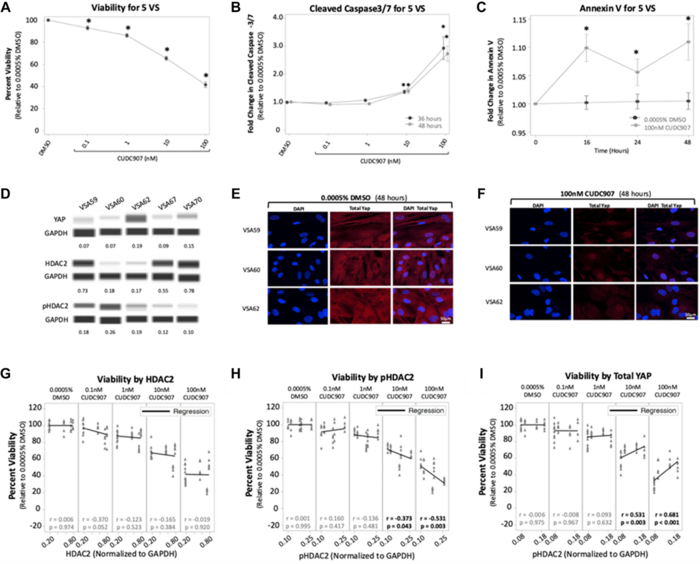
The lead compound, CUDC907, a dual histone deacetylase (HDAC)/PI3K inhibitor, was further evaluated for its effects on isolated and nerve-grafted schwannoma model cells, and primary VS cells. CUDC907 (3 nM IG50) reduced human merlin deficient Schwann cell (MD-SC) viability and was 5–100 fold selective for MD over WT-SCs. CUDC907 (10 nM) promoted cell cycle arrest and caspase-3/7 activation within 24 hours in human MD-SCs. Western blots confirmed a dose-dependent increase in acetylated lysine and decreases in pAKT and YAP.
In a 14-day treatment regimen, CUDC907 decreased tumor growth rate by 44%, modulated phospho-target levels, and decreased YAP levels. In five primary VS, CUDC907 decreased viability, induced caspase-3/7 cleavage, and reduced YAP levels. Its efficacy correlated with basal phospho-HDAC2 levels. CUDC907 has cytotoxic activity in NF2 schwannoma models and primary VS cells and is a candidate for clinical trials.
“In summary, we demonstrated that CUDC907 reduced the activity of three major signaling pathways in NF2 schwannomas (HDAC, PI3K, and YAP) and consistently reduced viability and induced apoptosis in several schwannoma cell models and in all five genetically unique primary VS studied. These consistent results offer the possibility that CUDC907 will promote schwannoma regression in patients with diverse NF2 mutations and support clinical evaluation of CUDC907 for NF2-associated schwannomas and potentially other cancers driven by NF2 pathogenic variants [45]. Current use of this drug in clinical trials for other indications reveals clinical interest in multi-modal drugs over monotherapies.”
DOI: https://doi.org/10.18632/oncotarget.28254
Correspondence to: Cristina Fernandez-Valle – Email: [email protected]
Keywords: fimepinostat, Schwann cell, vestibular schwanomma, merlin, nerve allograft
About Oncotarget: Oncotarget (a primarily oncology-focused, peer-reviewed, open access journal) aims to maximize research impact through insightful peer-review; eliminate borders between specialties by linking different fields of oncology, cancer research and biomedical sciences; and foster application of basic and clinical science.
To learn more about Oncotarget, visit Oncotarget.com and connect with us on social media:
- Twitter – https://twitter.com/Oncotarget
- Facebook – https://www.facebook.com/Oncotarget
- YouTube – www.youtube.com/c/OncotargetYouTube
- Instagram – https://www.instagram.com/oncotargetjrnl/
- LinkedIn – https://www.linkedin.com/company/oncotarget/
- Pinterest – https://www.pinterest.com/oncotarget/
- LabTube – https://www.labtube.tv/channel/MTY5OA
- SoundCloud – https://soundcloud.com/oncotarget
For media inquiries, please contact: [email protected].
Oncotarget Journal Office
6666 East Quaker Str., Suite 1A
Orchard Park, NY 14127
Phone: 1-800-922-0957 (option 2)
###
Journal
Oncotarget
DOI
10.18632/oncotarget.28254
Method of Research
Experimental study
Subject of Research
Cells
Article Title
CUDC907, a dual phosphoinositide-3 kinase/histone deacetylase inhibitor, promotes apoptosis of NF2 Schwannoma cells
Article Publication Date
19-Jul-2022