• HOME
  • NEWS
  • EXPLORE
    • CAREER
      • Companies
      • Jobs
    • EVENTS
    • iGEM
      • News
      • Team
    • PHOTOS
    • VIDEO
    • WIKI
  • BLOG
  • COMMUNITY
    • FACEBOOK
    • INSTAGRAM
    • TWITTER
Saturday, February 7, 2026
BIOENGINEER.ORG
No Result
View All Result
  • Login
  • HOME
  • NEWS
  • EXPLORE
    • CAREER
      • Companies
      • Jobs
        • Lecturer
        • PhD Studentship
        • Postdoc
        • Research Assistant
    • EVENTS
    • iGEM
      • News
      • Team
    • PHOTOS
    • VIDEO
    • WIKI
  • BLOG
  • COMMUNITY
    • FACEBOOK
    • INSTAGRAM
    • TWITTER
  • HOME
  • NEWS
  • EXPLORE
    • CAREER
      • Companies
      • Jobs
        • Lecturer
        • PhD Studentship
        • Postdoc
        • Research Assistant
    • EVENTS
    • iGEM
      • News
      • Team
    • PHOTOS
    • VIDEO
    • WIKI
  • BLOG
  • COMMUNITY
    • FACEBOOK
    • INSTAGRAM
    • TWITTER
No Result
View All Result
Bioengineer.org
No Result
View All Result
Home NEWS Science News Chemistry

Designing roots to penetrate hard soils could help climate proof crops

Bioengineer by Bioengineer
July 18, 2022
in Chemistry
Reading Time: 2 mins read
0
Root image
Share on FacebookShare on TwitterShare on LinkedinShare on RedditShare on Telegram

Scientists have discovered how to design cereal roots able to continue growing in hard soils by altering their ability to penetrate, enabling roots to access sources of water deeper in soil, and helping ‘climate-proof’ vital crops in response to changing UK rain fall patterns.
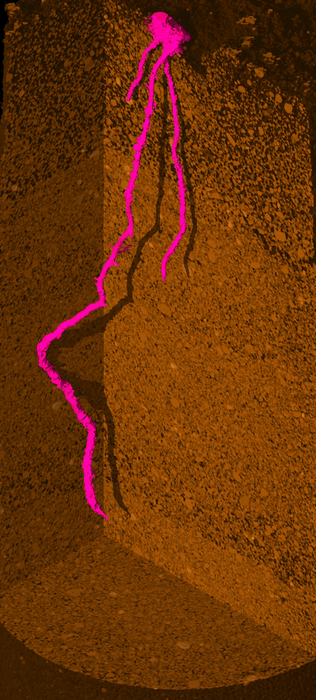
Root image

Credit: Dr Bipin Pandey, University of Nottingham

Scientists have discovered how to design cereal roots able to continue growing in hard soils by altering their ability to penetrate, enabling roots to access sources of water deeper in soil, and helping ‘climate-proof’ vital crops in response to changing UK rain fall patterns.

Climate change is altering rain fall patterns, resulting in drier, harder soils which threaten yields in rain fed crops like cereals.  An international team of researchers led by the University of Nottingham and Shanghai University have discovered key genes, hormone signals and processes in rice roots that control their ability to penetrate hard soils. Their findings have been published today in the scientific journal Proceedings of the National Academy of Sciences.

Hard soils cause crop roots to grow shorter and swell. Root swelling was originally thought to help penetrate hard soils. However, X-ray imaging of plants growing in soil at Nottingham revealed that roots which remained narrow penetrate hard soils more easily. The team went on to identify a hormone signal that promoted this root swelling response which, when its levels were reduced, helped roots remain narrow and penetrate hard soil more effectively.

Dr. Bipin Pandey, BBSRC Discovery Fellow and the lead researcher from the University of Nottingham says “Our research overturns decades of scientific thinking, revealing that root swelling does not help penetrate hard soils. These results can potentially safeguard or boost agricultural yields worldwide, particularly considering that climate change can exacerbate the strength of soil by less rainfall. This new understanding of how roots grow in hard soils promises to help develop novel soil-compaction-resistant crops.”

The international team includes researchers from the UK, USA, Netherlands, Germany, Czech Republic and China. The Nottingham team was funded by BBSRC Discovery Fellowship, European Research Council, Royal Society and University of Nottingham Future Food Beacon awards.


Journal

Proceedings of the National Academy of Sciences

DOI

10.1073/pnas.2201072119

Method of Research

Experimental study

Subject of Research

Not applicable

Article Title

Ethylene inhibits rice root growth in compacted soil via ABA and auxin mediated mechanisms

Article Publication Date

18-Jul-2022

Share12Tweet8Share2ShareShareShare2

Related Posts

blank

Breakthrough in Environmental Cleanup: Scientists Develop Solar-Activated Biochar for Faster Remediation

February 7, 2026
blank

Cutting Costs: Making Hydrogen Fuel Cells More Affordable

February 6, 2026

Scientists Develop Hand-Held “Levitating” Time Crystals

February 6, 2026

Observing a Key Green-Energy Catalyst Dissolve Atom by Atom

February 6, 2026

POPULAR NEWS

  • Robotic Ureteral Reconstruction: A Novel Approach

    Robotic Ureteral Reconstruction: A Novel Approach

    82 shares
    Share 33 Tweet 21
  • Digital Privacy: Health Data Control in Incarceration

    63 shares
    Share 25 Tweet 16
  • Study Reveals Lipid Accumulation in ME/CFS Cells

    57 shares
    Share 23 Tweet 14
  • Breakthrough in RNA Research Accelerates Medical Innovations Timeline

    53 shares
    Share 21 Tweet 13

About

We bring you the latest biotechnology news from best research centers and universities around the world. Check our website.

Follow us

Recent News

Barriers and Boosters of Seniors’ Physical Activity in Karachi

Evaluating Pediatric Emergency Care Quality in Ethiopia

TPMT Expression Predictions Linked to Azathioprine Side Effects

Subscribe to Blog via Email

Enter your email address to subscribe to this blog and receive notifications of new posts by email.

Join 73 other subscribers
  • Contact Us

Bioengineer.org © Copyright 2023 All Rights Reserved.

Welcome Back!

Login to your account below

Forgotten Password?

Retrieve your password

Please enter your username or email address to reset your password.

Log In
No Result
View All Result
  • Homepages
    • Home Page 1
    • Home Page 2
  • News
  • National
  • Business
  • Health
  • Lifestyle
  • Science

Bioengineer.org © Copyright 2023 All Rights Reserved.