A new study describes the formation of the body axis in the immortal freshwater polyp Hydra. It is controlled by the so-called hippo signaling pathway, a molecular biological process that, among other functions, ensures that our organs do not continue to grow indefinitely. The study was led by the Lunenfeld-Tanenbaum Research Institute in Toronto and the Washington University School of Medicine. The Department of Zoology of the University of Innsbruck, Austria, was significantly involved in the research and provided important data.
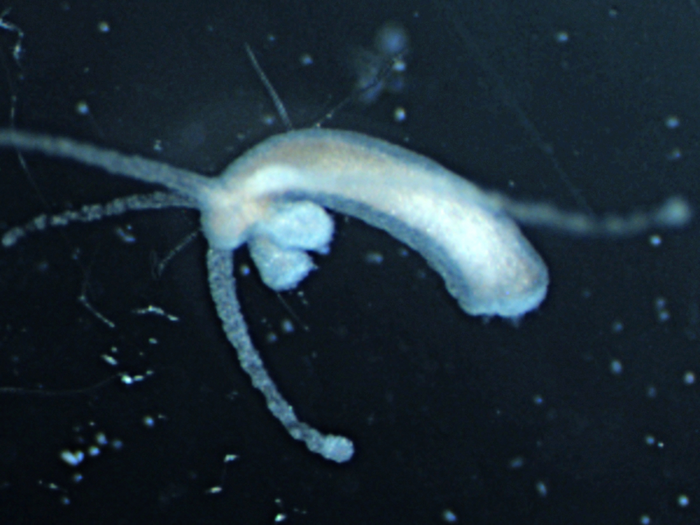
Credit: Maria Brooun
A new study describes the formation of the body axis in the immortal freshwater polyp Hydra. It is controlled by the so-called hippo signaling pathway, a molecular biological process that, among other functions, ensures that our organs do not continue to grow indefinitely. The study was led by the Lunenfeld-Tanenbaum Research Institute in Toronto and the Washington University School of Medicine. The Department of Zoology of the University of Innsbruck, Austria, was significantly involved in the research and provided important data.
The body structure of most animals is based on an axis that runs from the head to the tail. A big question in developmental biology is how the cells of the first multicellular animals were organized and how this body axis was formed. A new study published in the journal “Proceedings of the National Academy of Sciences” (PNAS) found that the evolutionary origins of the body axis lie in the so-called Hippo signaling pathway.
A signaling pathway shapes the organs
Signaling pathways are molecular biological processes that serve the communication between cells. Through the production and exchange of certain molecules, cells can recieve, process, and react to information from the environment or the body.
The hippo signaling pathway has an important function in higher animals, such as mammals and birds. It controls the cell division in the forming organs and ensures that they take on their correct size and three-dimensional shape. If the hippo signaling pathway is faulty, tissue thickening can occur, similar to the skin of a hippopotamus – hence the name.
Electron microscopy shows complex mechanism
A Canadian-US research cooperation, supported by the Department of Zoology at the University of Innsbruck, has described the function of this signaling pathway for the first time in evolutionary ancient organisms. The freshwater polyp hydra served as the model organism for the researchers. It is probable that the Hippo signaling pathway originated in ancient animals such as the hydra.
The working group led by Bert Hobmayer at the Department of Zoology has been intensively studying this model organism for years. Using electron microscopy, it provided important data on the internal organization of cells which are controlled by the Hippo signaling pathway.
“Hippo is a complex mechanism that is not yet fully understood in developmental biology,” says Hobmayer. “We have now found similar principles of action in the simply built hydras. However, these seem to affect the entire animals.”
The Immortal Polyp
The Hydra is a simply built animal, which is considered practically immortal. It permanently renews its tissue, can completely replace entire parts of the body, and form an entire organism from individual cells. The Hydra reproduces asexually by forming a bud from its body, which then grows into a new clone. With each new bud, a new body axis is created.
The study shows that the Hippo signaling pathway affects the rate of cell division throughout the Hydra. This way, it also controls the emergence of new specimens. In addition to controlling tissue growth and asexual reproduction, the Hippo signaling pathway also produces signaling molecules that are necessary for the formation of a normally shaped body axis.
Thus, the researchers have not only come a big step closer to the development of an important signaling pathway. The new knowledge gained on the simply built Hydra also opens up further studies with this model organism.
Journal
Proceedings of the National Academy of Sciences
DOI
10.1073/pnas.2203257119
Method of Research
Experimental study
Subject of Research
Animals
Article Title
The Hippo pathway regulates axis formation and morphogenesis in Hydra
Article Publication Date
12-Jul-2022
COI Statement
The authors declare no competing interest.