• HOME
  • NEWS
  • EXPLORE
    • CAREER
      • Companies
      • Jobs
    • EVENTS
    • iGEM
      • News
      • Team
    • PHOTOS
    • VIDEO
    • WIKI
  • BLOG
  • COMMUNITY
    • FACEBOOK
    • INSTAGRAM
    • TWITTER
Saturday, February 7, 2026
BIOENGINEER.ORG
No Result
View All Result
  • Login
  • HOME
  • NEWS
  • EXPLORE
    • CAREER
      • Companies
      • Jobs
        • Lecturer
        • PhD Studentship
        • Postdoc
        • Research Assistant
    • EVENTS
    • iGEM
      • News
      • Team
    • PHOTOS
    • VIDEO
    • WIKI
  • BLOG
  • COMMUNITY
    • FACEBOOK
    • INSTAGRAM
    • TWITTER
  • HOME
  • NEWS
  • EXPLORE
    • CAREER
      • Companies
      • Jobs
        • Lecturer
        • PhD Studentship
        • Postdoc
        • Research Assistant
    • EVENTS
    • iGEM
      • News
      • Team
    • PHOTOS
    • VIDEO
    • WIKI
  • BLOG
  • COMMUNITY
    • FACEBOOK
    • INSTAGRAM
    • TWITTER
No Result
View All Result
Bioengineer.org
No Result
View All Result
Home NEWS Science News Chemistry

Researchers extend quantum amplification to floquet systems

Bioengineer by Bioengineer
June 27, 2022
in Chemistry
Reading Time: 2 mins read
0
Researchers Extend Quantum Amplification to Floquet Systems
Share on FacebookShare on TwitterShare on LinkedinShare on RedditShare on Telegram

Detection of weak signals is a crucial step in the verification of physics hypothesis and making breakthroughs in cutting-edge and fundamental physics research. However, the signals are too weak to measure, and thus need enhancement. One attractive way to amplify the signals is quantum amplification. The state-of-the-art quantum amplification techniques still have some limitations because they rely on the inherent discrete state transitions of atoms and molecules and therefore lacks tunability, usually enhancing only one signal within a narrow range of frequencies.
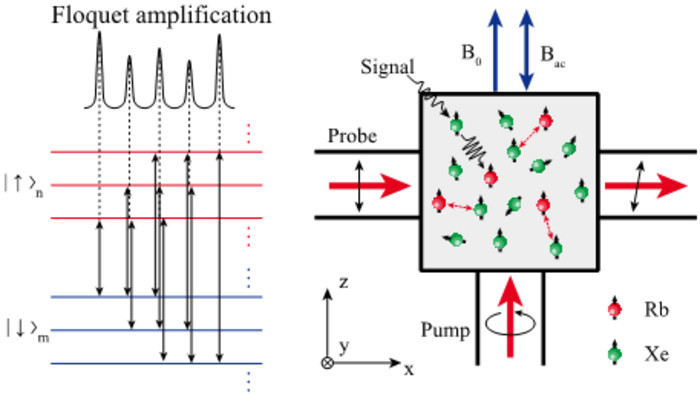
Researchers Extend Quantum Amplification to Floquet Systems

Credit: Image by the group of Prof. PENG Xinhua

Detection of weak signals is a crucial step in the verification of physics hypothesis and making breakthroughs in cutting-edge and fundamental physics research. However, the signals are too weak to measure, and thus need enhancement. One attractive way to amplify the signals is quantum amplification. The state-of-the-art quantum amplification techniques still have some limitations because they rely on the inherent discrete state transitions of atoms and molecules and therefore lacks tunability, usually enhancing only one signal within a narrow range of frequencies.

To solve this problem, the research team led by Prof. PENG Xinhua from University of Science and Technology of China (USTC) of the Chinese Academy of Sciences, collaborating with Prof. Dmitry Budker from the Helmholtz Institution in Mainz, extended quantum amplification to periodically driven spins. The result was published on Physical Review Letters.

Periodically driven systems, or Floquet systems, are described by time-dependent, periodic Hamiltonians. A Floquet system possesses energy levels with equal energy gaps, and the system’s state can jump between different energy levels via resonance transitions. The combination of quantum amplification and the Floquet system is promising in overcoming the limitations of conventional quantum amplification methods.

The researchers periodically drove 129Xe noble gas with an oscillating field. The Hamiltonians of 129Xe spins then became time-periodic, and the system obtained extra synthetic dimensions, which allows resonance transitions in a broader frequency range. With this 129Xe Floquet spin system, researchers demonstrated the amplification of multiple weak electromagnetic waves simultaneously, both in theory and experiment.

This work extends quantum amplification to Floquet systems and observes a new type of amplification phenomenon——“Floquet spin amplification”. It largely overcomes the limitations of conventional amplifiers, increases the operation bandwidth in femtotesla-level measurements, and allows amplifying more than one signal at different frequencies in the meantime. This “Floquet amplifier” enables a wide range of applications in precision measurements and in the study of fundamental physics.


Journal

Physical Review Letters

DOI

10.1103/PhysRevLett.128.233201

Article Title

Floquet Spin Amplification

Article Publication Date

9-Jun-2022

Share12Tweet8Share2ShareShareShare2

Related Posts

blank

Breakthrough in Environmental Cleanup: Scientists Develop Solar-Activated Biochar for Faster Remediation

February 7, 2026
blank

Cutting Costs: Making Hydrogen Fuel Cells More Affordable

February 6, 2026

Scientists Develop Hand-Held “Levitating” Time Crystals

February 6, 2026

Observing a Key Green-Energy Catalyst Dissolve Atom by Atom

February 6, 2026

POPULAR NEWS

  • Robotic Ureteral Reconstruction: A Novel Approach

    Robotic Ureteral Reconstruction: A Novel Approach

    82 shares
    Share 33 Tweet 21
  • Digital Privacy: Health Data Control in Incarceration

    63 shares
    Share 25 Tweet 16
  • Study Reveals Lipid Accumulation in ME/CFS Cells

    57 shares
    Share 23 Tweet 14
  • Breakthrough in RNA Research Accelerates Medical Innovations Timeline

    53 shares
    Share 21 Tweet 13

About

We bring you the latest biotechnology news from best research centers and universities around the world. Check our website.

Follow us

Recent News

Evaluating Pediatric Emergency Care Quality in Ethiopia

TPMT Expression Predictions Linked to Azathioprine Side Effects

Improving Dementia Care with Enhanced Activity Kits

Subscribe to Blog via Email

Success! An email was just sent to confirm your subscription. Please find the email now and click 'Confirm' to start subscribing.

Join 73 other subscribers
  • Contact Us

Bioengineer.org © Copyright 2023 All Rights Reserved.

Welcome Back!

Login to your account below

Forgotten Password?

Retrieve your password

Please enter your username or email address to reset your password.

Log In
No Result
View All Result
  • Homepages
    • Home Page 1
    • Home Page 2
  • News
  • National
  • Business
  • Health
  • Lifestyle
  • Science

Bioengineer.org © Copyright 2023 All Rights Reserved.