From a zoomed out, distant view, star-forming cloud L483 appears normal. But when a Northwestern University-led team of astrophysicists zoomed in closer and closer, things became weirder and weirder.
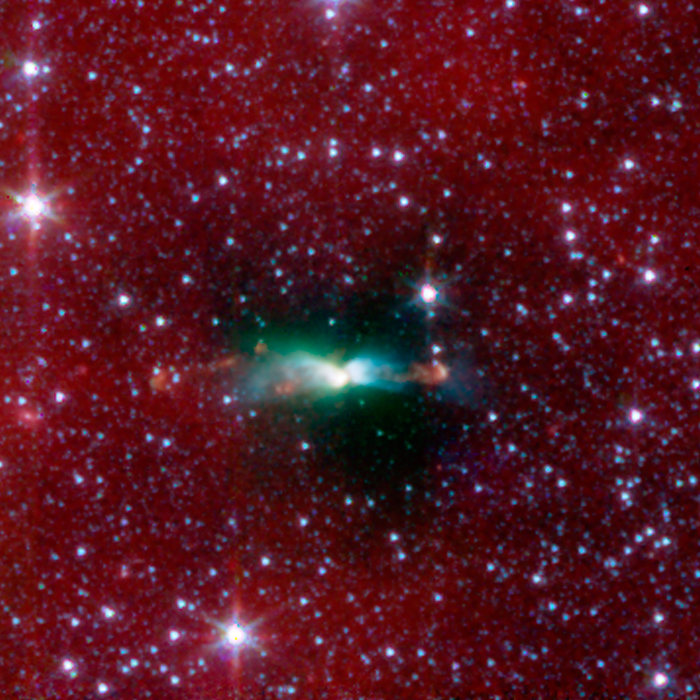
Credit: NASA/JPL-Caltech/J.Tobin (University of Michigan)
From a zoomed out, distant view, star-forming cloud L483 appears normal. But when a Northwestern University-led team of astrophysicists zoomed in closer and closer, things became weirder and weirder.
As the researchers peered closer into the cloud, they noticed that its magnetic field was curiously twisted. And then — as they examined a newborn star within the cloud — they spotted a hidden star, tucked behind it.
“It’s the star’s sibling, basically,” said Northwestern’s Erin Cox, who led the new study. “We think these stars formed far apart, and one moved closer to the other to form a binary. When the star traveled closer to its sibling, it shifted the dynamics of the cloud to twist its magnetic field.”
The new findings provide insight into binary star formation and how magnetic fields influence the earliest stages of developing stars.
Cox will present this research at the 240th meeting of the American Astronomical Society (AAS) in Pasadena, California. “The Twisted Magnetic Field of L483” will take place on Tuesday, June 14, as a part of a session on “Magnetic Fields and Galaxies.” The Astrophysical Journal also will publish the study next week.
Cox will be available to answer questions about the study during a press conference at AAS, which will be held both in-person and virtually at 2:15 p.m. PDT on Monday, June 13. Members of the press can register for the event here.
Cox is a postdoctoral associate at Northwestern’s Center for Interdisciplinary Exploration and Research in Astrophysics (CIERA).
Twisted mystery
Stellar nurseries are wild and wondrous places. As dense clouds of gas and dust collapse to form stars, they launch outflows of stellar material at hypersonic speeds. A magnetic field surrounding a star-forming cloud is typically parallel to these outflows. When Cox and her collaborators observed the large-scale L483 cloud, they discovered just that. The magnetic field matched this typical profile.
But then the astrophysicists decided to take a closer look with NASA’s Stratospheric Observatory for Infrared Astronomy (SOFIA), and this is when things became strange. The magnetic field was not, in fact, parallel to the newborn stars’ outflows. Instead, the field was twisted at a 45-degree angle, with respect to the outflows.
“At first, it matched what theory predicts,” Cox said. “If you have a magnetized collapse, then the magnetic field is controlling how the star is forming. We expect to see this parallelism. But theory can say one thing, and observations can say another.”
Unusual binary formation
Although more observations are needed, Cox believes a previously hidden sibling star may be responsible for the twisted field. Using SOFIA, the astrophysics team spotted one newborn star forming inside an envelope of material. But upon closer examination with radio telescopes at the Atacama Large Millimeter/submillimeter Array (ALMA) in Chile, the researchers spotted the second star, sharing the same stellar envelope.
“These stars are still young and still forming,” Cox said. “The stellar envelope is what supplies the material to form the stars. It’s similar to rolling a snowball in snow to make it bigger and bigger. The young stars are ‘rolling’ in material to build up mass.”
About the same distance apart as our sun to Pluto, the two young stars form a binary system. Currently, astrophysicists agree that binaries can be formed when star-forming clouds are large enough to produce two stars or when the disc rotating around a young star partially collapses to make a second star.
But for the twin stars in L483, Cox suspects something unusual is at play.
“There is newer work that suggests it’s possible to have two stars form faraway from each other, and then one star moves in closer to form a binary,” Cox said. “We think that’s what is happening here. We don’t know why one star would move toward another one, but we think the moving star shifted the dynamics of the system to twist the magnetic field.”
Cox believes this new work ultimately could provide new insights into how binary stars — and the planets that orbit them — form. Most people are familiar with the iconic scene from “Star Wars,” in which Luke Skywalker wistfully gazes up at the binary stars that his home planet Tatooine orbits. Now, scientists know this scenario is not merely science fiction; planets orbiting binary stars potentially could be habitable worlds.
“Learning how binary stars form is exciting because planet and star formation take place at the same time, and binary stars dynamically interact with each other,” Cox said. “In our census of exoplanets, we know planets exist around these double stars, but we don’t know much about how these planets differ from the ones that live around isolated stars. With new instruments coming online to discover and probe new binary systems, we will be able to test these results with a statistical sample.”
The study, “The twisted magnetic field of the protobinary L483,” was supported by NASA and the National Science Foundation.
Journal
The Astrophysical Journal
Method of Research
Observational study
Subject of Research
Not applicable
Article Title
The twisted magnetic field of the protobinary L483
Article Publication Date
13-Jun-2022