The go-to materials for building home furniture, décor and floors are composite wood products that come in large sheets. But the glues and resins holding together particleboard, fiberboard and plywood usually contain formaldehyde and could release this probable carcinogen into the air. To develop a nontoxic adhesive, researchers reporting in ACS Applied Materials & Interfaces have combined glucose and citric acid — sugar and an orange juice ingredient — into a strong, water-resistant wood glue for plywood.
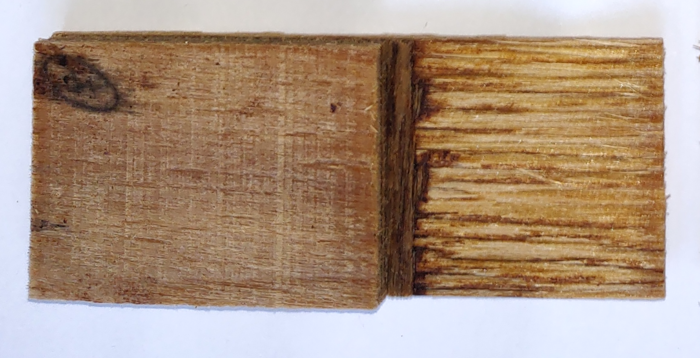
Credit: Adapted from ACS Applied Materials & Interfaces 2022, DOI: 10.1021/acsami.2c02859
The go-to materials for building home furniture, décor and floors are composite wood products that come in large sheets. But the glues and resins holding together particleboard, fiberboard and plywood usually contain formaldehyde and could release this probable carcinogen into the air. To develop a nontoxic adhesive, researchers reporting in ACS Applied Materials & Interfaces have combined glucose and citric acid — sugar and an orange juice ingredient — into a strong, water-resistant wood glue for plywood.
To make plywood, manufacturers glue together thin layers of wood and then cure the material under pressure and heat, creating large, flexible panels. One of the most common adhesives is a urea-formaldehyde resin because it’s inexpensive and bonds strongly to wood. However, formaldehyde emissions from plywood with this type of resin have raised health and environmental concerns. Previous studies have shown that solutions of sucrose, a two-unit sugar made of glucose and fructose, and citric acid form a natural and water-resistant wood glue. But a zinc chloride catalyst is required to decrease the energy consumption for the plywood curing, which also reduces the adhesive’s strength. So, Hong Lei and colleagues wanted to see if pure glucose and citric acid could produce a strong adhesive with a less energy-intensive curing process.
The researchers heated solutions of glucose and varying amounts of citric acid into a sticky liquid that they applied onto poplar veneers. Then they stacked three veneers and pressed them into a single sheet at 392 F for six minutes. The team cut the sheets into smaller pieces for strength tests and found that under pressures greater than 101 psi, the plywood samples all broke along the wood fibers and not at the glued seams. These results satisfy the standard requirement for plywood in China. When the plywood samples were soaked in hot or boiling water, only the ones made with citric acid to glucose ratios above 0.6 had adhesive strengths that satisfied the standard requirement. The researchers attribute these results to the increase in ester links between citric acid and wood, which increased the wood-binding strength and water-resistance. Citric acid-glucose adhesives hold promise for the wood products industry, the researchers say.
The authors acknowledge funding from the National Natural Science Foundation of China, the Yunnan Provincial Natural Science Foundation, the 111 project and the French National Research Agency (ANR).
The paper’s abstract will be available on May 11 at 8 a.m. Eastern time here: http://pubs.acs.org/doi/abs/10.1021/acsami.2c02859.
The American Chemical Society (ACS) is a nonprofit organization chartered by the U.S. Congress. ACS’ mission is to advance the broader chemistry enterprise and its practitioners for the benefit of Earth and all its people. The Society is a global leader in promoting excellence in science education and providing access to chemistry-related information and research through its multiple research solutions, peer-reviewed journals, scientific conferences, eBooks and weekly news periodical Chemical & Engineering News. ACS journals are among the most cited, most trusted and most read within the scientific literature; however, ACS itself does not conduct chemical research. As a leader in scientific information solutions, its CAS division partners with global innovators to accelerate breakthroughs by curating, connecting and analyzing the world’s scientific knowledge. ACS’ main offices are in Washington, D.C., and Columbus, Ohio.
To automatically receive news releases from the American Chemical Society, contact [email protected].
Follow us: Twitter | Facebook | LinkedIn | Instagram
Journal
ACS Applied Materials & Interfaces
DOI
10.1021/acsami.2c02859
Article Title
Fully biobased adhesive from glucose and citric acid for plywood with high performance
Article Publication Date
11-May-2022