Southeast Asia’s most productive agricultural region and home to 17 million people could be mostly underwater within a lifetime. Saving the Mekong River Delta requires urgent, concerted action among countries in the region to lessen the impact of upstream dams and better manage water and sediments within the delta, according to an international team of researchers. Their commentary, published May 5 in Science, outlines solutions to the region’s dramatic loss of sediment essential to nourishing delta land.
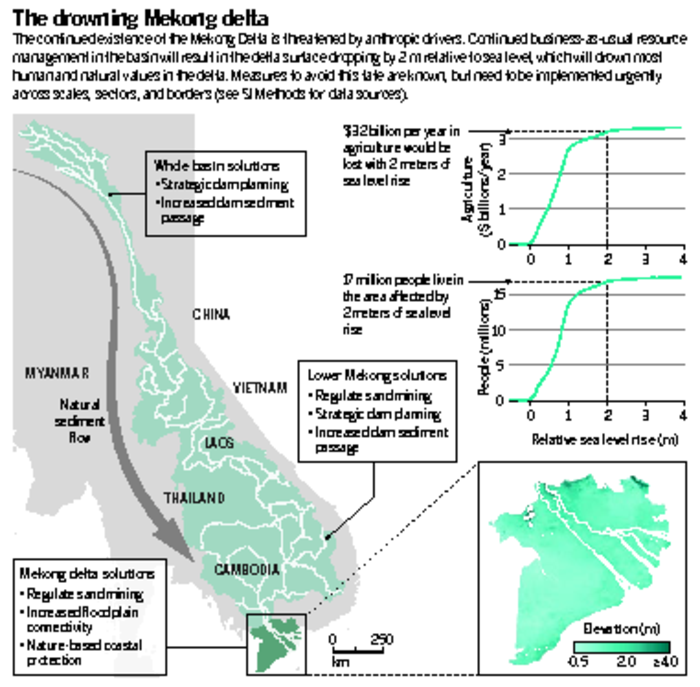
Credit: Credit Kondolf, Schmitt, et al. / Nature
Southeast Asia’s most productive agricultural region and home to 17 million people could be mostly underwater within a lifetime. Saving the Mekong River Delta requires urgent, concerted action among countries in the region to lessen the impact of upstream dams and better manage water and sediments within the delta, according to an international team of researchers. Their commentary, published May 5 in Science, outlines solutions to the region’s dramatic loss of sediment essential to nourishing delta land.
“It’s hard to fathom that a landform the size of the Netherlands and with a comparable population might disappear by the end of the century”, said study co-lead author Matt Kondolf, a Professor of Landscape Architecture & Environmental Planning at the University of California, Berkeley.
“The Mekong Delta is truly outstanding in terms of agro-economic value and regional importance for food security and livelihoods,” said study co-lead author Rafael Schmitt, a senior scientist at the Stanford Natural Capital Project. “Without rapid action, the delta and its livelihoods could become victims of global and regional environmental change.”
On its journey from skyscraping Tibetan peaks to the sea, the Mekong River picks up sediment from eroding uplands in China, Myanmar, Laos Cambodia, Thailand and Vietnam. The nutrient-rich sediment has accumulated in the Mekong Delta and enabled the lower Mekong region to produce up to 10% of all rice traded internationally. It has also fed fisheries that feed tens of millions of people. Like any river delta, the Mekong Delta can only exist if it receives a constant sediment supply from its upstream basin, and if water flows can spread that sediment across the low-lying delta surface to build land at a rate that is equal to or greater than global sea level rise.
Hungry for renewable energy, countries in the basin have built numerous hydropower dams that block fish migrations, trap sediment and reduce downstream flows. If all planned dams are built, they will trap 96% of the sediment formerly reaching the delta. Additionally, sediment supply from tropical cyclones, which deliver about 32% of the suspended sediment load reaching the delta, is decreasing as cyclone tracks shift north.
Sediment that manages to reach the lower Mekong is mined for sand used in construction and land reclamation. Over pumping of groundwater and high dikes built to control floods and enable high intensity agriculture exacerbate the problem.
To slow and reverse damages, the researchers recommend that policymakers:
- Design dams to enable better sediment sediment passage, place them strategically to reduce their downstream impacts, or replace them with wind and solar farms, where possible.
- Strictly regulate sediment mining and reduce use of Mekong sand through sustainable building materials and recycling.
- Allow floodwaters to spread out over the Delta and deposit their sediments
- Limit groundwater pumping in the Mekong Delta
- Reevaluate intensive agriculture in the Mekong Delta for sustainability.
- Implement natural solutions for coastal protections on a large scale along the delta’s coast
Most efforts to rehabilitate the delta have involved individual countries approaching isolated engineering challenges, and proposing solutions on local scales, according to the researchers. Making meaningful progress will require coordination among countries, development banks development agencies and other private and civil society stakeholders, the researchers write.
“We are seeing signs that governments and nongovernmental actors are beginning to work together on these issues,” said Schmitt. “We hope our commentary will elevate the topic on the regional policy agenda, empower conservation in the basin, and act as a wake-up call to address key drivers for land loss on a system scale.”
Journal
Science
DOI
10.1126/science.abm5176
Article Title
Save the Mekong Delta from drowning
Article Publication Date
5-May-2022