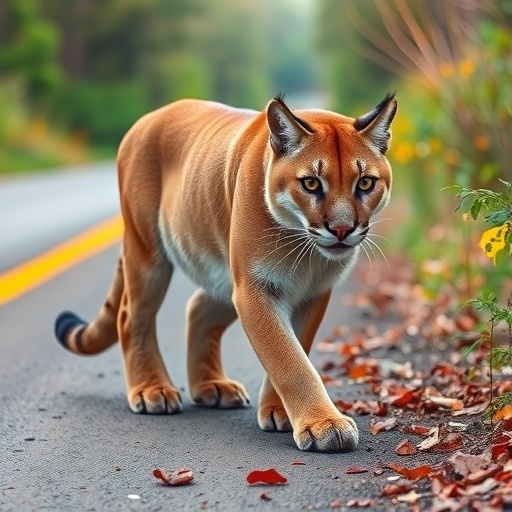
Living alongside pumas may seem like a dangerous bargain, but new research suggests that the presence of these large predators can make roads safer for people. A study published in Current Biology reports that pumas influence deer behavior in ways that sharply reduce the likelihood of deer–vehicle collisions. Across Washington’s Olympic Peninsula, areas with high puma occupancy were associated with fewer deer near roads, less nighttime deer activity, and an estimated 76% reduction in the expected number of collisions over a five-year period.
The findings highlight an often-overlooked ecological service provided by large carnivores. Pumas, also called mountain lions, cougars, or panthers, do not need to attack deer frequently to influence their behavior. Their presence creates what ecologists describe as a “landscape of fear,” in which prey modify when and where they move to reduce the risk of encountering a predator. Those changes can affect human infrastructure, transportation safety, and even the economic costs associated with wildlife collisions.
Justin Suraci of Conservation Science Partners and colleagues investigated these effects using a large camera-trap dataset combined with spatial records of collisions between vehicles and wildlife. Their study area, the Olympic Peninsula of Washington, contains extensive forests, rural roads, and established puma populations. By comparing deer activity and habitat use in locations with different levels of puma occupancy, the researchers were able to examine how predator presence altered the conditions under which collisions occur.
The analysis showed that deer behaved differently in areas where pumas were present. Rather than moving primarily at night, deer shifted more of their activity into daylight hours. They were also 15% less likely to occupy locations with dense road networks, spending more time in remote habitats away from vehicles. This behavioral response is important because roads are not distributed randomly across the landscape: they often pass through valleys, forest edges, and other habitats that deer may otherwise use for feeding or movement.
The researchers calculated that these changes were associated with a 67% reduction in the likelihood of a deer–vehicle collision. The effect was not limited to the total number of incidents. Tracking-collar data indicated that collisions became more concentrated during the day rather than at night. Nighttime crashes are often more dangerous because drivers have reduced visibility and less time to react, meaning that a shift toward daylight collisions could reduce the severity of accidents as well as their frequency.
The study does not suggest that pumas directly protect motorists or that every landscape with predators will experience the same result. Instead, the researchers describe a chain of ecological effects. Pumas alter deer risk perception; deer adjust their movements and daily schedules; those adjustments reduce overlap between deer and roads; and reduced overlap lowers the probability of a vehicle encounter. In technical terms, the predators change prey space use and temporal activity patterns, modifying the conditions that determine collision risk.
Although predators have long been suspected of influencing road safety, the relationship has rarely been quantified in places where large carnivores remain established. Wildlife–vehicle collisions are a global problem, causing human injuries, vehicle damage, and the deaths of millions of animals each year. Conventional responses include fencing, wildlife crossings, warning signs, and roadside vegetation management. The new findings suggest that predator–prey interactions may function as an additional, naturally occurring layer of protection, although they cannot replace engineered safety measures.
The implications extend beyond Washington. Pumas are slowly recolonizing parts of the eastern United States and Canada, and proposals to reintroduce them have generated intense public debate. Concerns about livestock, pets, and human safety often dominate those discussions. Suraci and Mark Elbroch of Panthera argue that a fuller assessment should also consider benefits that are less visible but potentially substantial, including changes in deer behavior that may reduce collisions. Such benefits could influence how communities evaluate coexistence with large carnivores.
The researchers emphasize that pumas retain value independent of any advantage they provide to people. Nevertheless, demonstrating measurable benefits may help build public tolerance for predators and encourage more informed conservation policies. The study presents coexistence not as a simple choice between human safety and wildlife protection, but as a complex ecological relationship in which predator presence can produce unexpected advantages. On roads across landscapes where pumas still roam, the animals may be quietly changing the behavior of deer—and helping drivers avoid them.
Subject of Research: Animals
Article Title: Large carnivores shape road safety through effects on prey space use
News Publication Date: 5-Aug-2026
Web References: https://doi.org/10.1016/j.cub.2026.06.072; https://www.cell.com/current-biology
References: Suraci et al., “Large carnivores shape road safety through effects on prey space use,” Current Biology, DOI: 10.1016/j.cub.2026.06.072
Image Credits: Nicolás Lagos, Panthera
Keywords: Pumas, mountain lions, deer, wildlife–vehicle collisions, road safety, predator–prey interactions, behavioral ecology, conservation, Olympic Peninsula, landscape of fear
Tags: camera-trap studies of predator effectsconservation benefits of pumas in rural areasecological impact of mountain lions on transportation safetyecological services of large carnivoresimpact of predators on road safetylandscape of fear created by predatorspredator-driven changes in prey movementPuma influence on deer behavior and wildlife collision reductionpuma presence and deer activity patternspuma-human coexistence safety benefitsrole of pumas in reducing economic costs of collisionswildlife–vehicle collision statistics in Washington