How do we perceive music and sounds? This question is the basis of the research by the Language and Comparative Cognition Group (LCC) of the UPF Center for Brain and Cognition (CBC) published recently in the journal Animal Cognition.
Credit: UPF
How do we perceive music and sounds? This question is the basis of the research by the Language and Comparative Cognition Group (LCC) of the UPF Center for Brain and Cognition (CBC) published recently in the journal Animal Cognition.
Humans share characteristics that for the time being appear to be unique in the animal kingdom: language and music. “Our group is dedicated to understanding how these skills have evolved in humans and to what extent some of their components are shared with other species”, explains Juan Manuel Toro, director of the LCC and one of the authors of the study, together with Paola Crespo Bojorque and Alexandre Celma Miralles.
When we hear a song that we already know, we can identify it even if it is not an exact version of the original. If it sounds higher or lower, faster or slower, or if the instruments are different from the known version, humans can identify it even if there are these superficial changes to the melody. The study by the LLC explores the extent to which this skill is based on skills that are also present in other animals, i.e., not unique to humans.
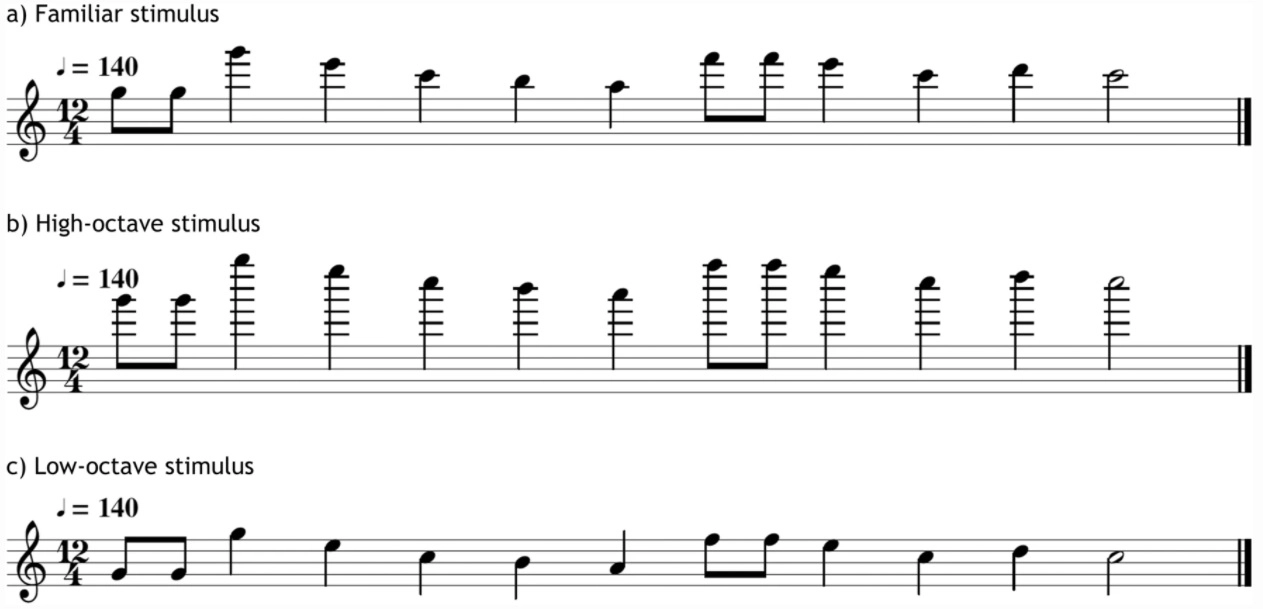
Hence, they studied 40 laboratory rats (Rattus norvegicus, commonly known as Long-Evans rats), trained to identify a melody, in this case using the second half of the song “Happy Birthday”. “It is a thirteen-tone melody that includes all the entire range of pitches of the Western major scales”, they explain in the article.
The experiment began with a familiarization phase followed by three test sessions. Twenty familiarization sessions were held, each session lasting 10 minutes per day. At each session, the rats were placed individually in a response box and presented with 40 repetitions of the familiarization melody while being given a sucrose pill as food.
The results suggest that the ability to recognize patterns over changes in pitch and tempo present in humans might emerge from pre-existing abilities in other species
After the familiarization phase, three sessions were held in which modified versions of the song were used. Responses to the following physical changes in the melody were analysed:
- Fundamental frequency (pitch): the song was played one eighth above or below the original.
- Speed (tempo)
- Timbre. The original song was played on a piano and the variant on a violin.
“Our results show that the rats recognized the song even when there were changes in frequency and tempo”, Toro explains, “but when we changed the timbre they were no longer able to recognize the song. The results suggest that the ability to recognize patterns over changes in pitch and tempo present in humans might emerge from pre-existing abilities in other species”.
Some mammalian and bird species can perceive changes in fundamental frequency (rhesus monkeys -Macaca mulatta), tempo (California sea lion -Zalophus californianus- or cockatoo -Cacatua galerita eleonora) and timbre (chimpanzees – Pa troglodytes). However, Toro explains that humans process music perceiving musical structures in a relative rather than an absolute way; that is, independently of surface changes along features such as pitch, tempo and timbre. It is thus important to understand the extent to which this ability is based on sensitivities already present in other species”.
The research was conducted with the support of the Barcelona Biomedical Research Park (PRBB), the BIAL Foundation and the Catalan Government.
Reference work:
Paola Crespo-Bojorque, Alexandre Celma-Miralles, Juan M. Toro (February 2022). “Detecting surface changes in a familiar tune: exploring pitch, tempo and timbre”. Animal Cognition
Journal
Animal Cognition
DOI
10.1007/s10071-022-01604-w
Method of Research
Observational study
Subject of Research
Animals
Article Title
Detecting surface changes in a familiar tune: exploring pitch, tempo and timbre
Article Publication Date
9-Feb-2022