• HOME
  • NEWS
  • EXPLORE
    • CAREER
      • Companies
      • Jobs
    • EVENTS
    • iGEM
      • News
      • Team
    • PHOTOS
    • VIDEO
    • WIKI
  • BLOG
  • COMMUNITY
    • FACEBOOK
    • INSTAGRAM
    • TWITTER
Wednesday, June 24, 2026
BIOENGINEER.ORG
No Result
View All Result
  • Login
  • HOME
  • NEWS
  • EXPLORE
    • CAREER
      • Companies
      • Jobs
        • Lecturer
        • PhD Studentship
        • Postdoc
        • Research Assistant
    • EVENTS
    • iGEM
      • News
      • Team
    • PHOTOS
    • VIDEO
    • WIKI
  • BLOG
  • COMMUNITY
    • FACEBOOK
    • INSTAGRAM
    • TWITTER
  • HOME
  • NEWS
  • EXPLORE
    • CAREER
      • Companies
      • Jobs
        • Lecturer
        • PhD Studentship
        • Postdoc
        • Research Assistant
    • EVENTS
    • iGEM
      • News
      • Team
    • PHOTOS
    • VIDEO
    • WIKI
  • BLOG
  • COMMUNITY
    • FACEBOOK
    • INSTAGRAM
    • TWITTER
No Result
View All Result
Bioengineer.org
No Result
View All Result
Home NEWS Science News Biology

Injured dinosaur left behind unusual footprints

Bioengineer by Bioengineer
April 6, 2022
in Biology
Reading Time: 3 mins read
0
Plausible reconstruction of the theropod foot deformity.
Share on FacebookShare on TwitterShare on LinkedinShare on RedditShare on Telegram

A set of dinosaur footprints in Spain has unusual features because the dinosaur that made the tracks had an injured foot, according to a study published April 6, 2022 in the open-access journal PLOS ONE by Carlos M. Herrera-Castillo of the Autonomous University of Madrid and colleagues.
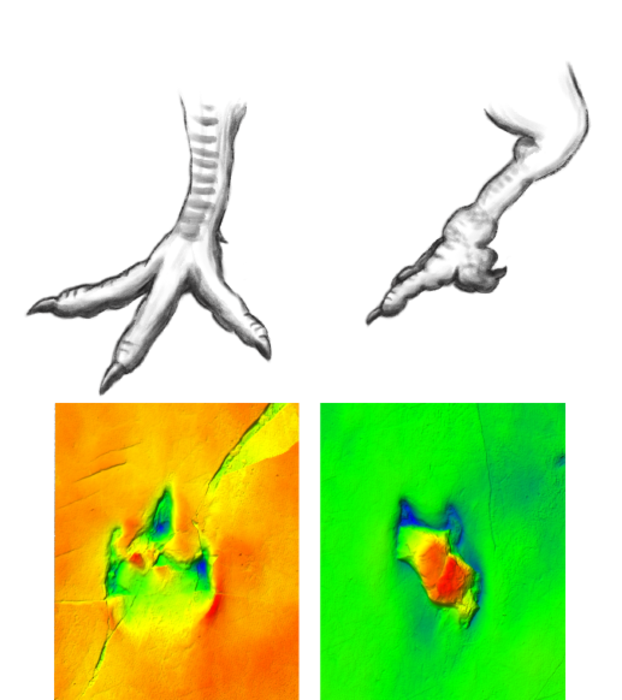
Plausible reconstruction of the theropod foot deformity.

Credit: Artwork by Lara de la Cita, and photographs by Las Hoyas
research team, Universidad Autónoma de Madrid, Spain, CC-BY 4.0 (https://creativecommons.org/licenses/by/4.0/)

A set of dinosaur footprints in Spain has unusual features because the dinosaur that made the tracks had an injured foot, according to a study published April 6, 2022 in the open-access journal PLOS ONE by Carlos M. Herrera-Castillo of the Autonomous University of Madrid and colleagues.

Fossil trackways are an excellent source of information on the behavior of extinct animals. In this study, researchers examine an abnormal trackway comprising six footprints from an unidentified theropod dinosaur preserved at the Las Hoyas Locality in Spain, dating to around 129 million years ago.

The authors used a variety of techniques to describe and model the tracks and to compare them to other trackways. They observed that the tracks made by the right foot display all three toes, but that the innermost toe on the left foot is represented only by extremely short and irregularly shaped markings in the sediment, indicating an injury or deformity in that toe. Furthermore, the footprints are spaced more widely than typical theropod tracks, indicating that this dinosaur adjusted its gait to compensate for its injured foot. This is further supported by certain deformations in the right footprints which suggest the animal was putting more weight on that side.

The authors note that similar toe deformities and similar compensating behaviors are also seen in modern birds, and that fossil theropod feet are often found with injuries on the innermost toes. Taken altogether, this evidence sheds light on how this dinosaur, and perhaps many others, found ways to survive despite pathological setbacks.

The authors add: “We studied one of the best theropod trackway with a foot deformity, printed in a microbial mat that grew in a 129 Ma pond, when hundreds of fish were swimming around.”

#####

In your coverage please use this URL to provide access to the freely available article in PLOS ONE: https://journals.plos.org/plosone/article?id=10.1371/journal.pone.0264406   

Citation: Herrera-Castillo CM, Moratalla JJ, Belaústegui Z, Marugán-Lobón J, Martín-Abad H, Nebreda SM, et al. (2022) A theropod trackway providing evidence of a pathological foot from the exceptional locality of Las Hoyas (upper Barremian, Serranía de Cuenca, Spain). PLoS ONE 17(4): e0264406. https://doi.org/10.1371/journal.pone.0264406

Author Countries: Spain

Funding: This study forms part of the project reference, PID-2019-105546GB-I00 of the Spanish Ministerio de Ciencia e Innovación, and SIFA161418 Junta de Comunidades de Castilla-La Mancha.


Journal

PLoS ONE

DOI

10.1371/journal.pone.0264406

Method of Research

Observational study

Subject of Research

Animals

Article Title

A theropod trackway providing evidence of a pathological foot from the exceptional locality of Las Hoyas (upper Barremian, Serranía de Cuenca, Spain)

Article Publication Date

30-Mar-2022

COI Statement

The authors have declared that no competing interest exist.

Share12Tweet8Share2ShareShareShare2

Related Posts

Unraveling the Genetic Buzz: Insights into Worker Honeybee Metamorphosis — Biology

Unraveling the Genetic Buzz: Insights into Worker Honeybee Metamorphosis

June 24, 2026
Why Birds Lay Surprisingly Large Eggs: New Study Reveals the Link to Bigger Brains — Biology

Why Birds Lay Surprisingly Large Eggs: New Study Reveals the Link to Bigger Brains

June 24, 2026

Unraveling m6A RNA Modification in Colorectal Cancer: Key Regulatory Mechanisms, Oncogenic Signals, and Metabolic Pathways

June 24, 2026

Rice Bioengineer Receives Federal Award for Advancements in Ewing Sarcoma Research

June 23, 2026

POPULAR NEWS

  • Saying Goodbye to PGY-6: Pediatric Fellowship Realities

    103 shares
    Share 41 Tweet 26
  • Multi-Hospital Study Reveals Long Covid Burden Is Twice as High as Current Estimates

    92 shares
    Share 36 Tweet 23
  • Detection of EDCs in Breast Milk and Infant Urine Up to Six Months Highlights Early Exposure Risks

    77 shares
    Share 31 Tweet 19
  • New Drug Candidate Developed at McMaster Shows Potential for Treating Brain Cancer

    58 shares
    Share 23 Tweet 15

About

BIOENGINEER.ORG

We bring you the latest biotechnology news from best research centers and universities around the world. Check our website.

Follow us

Recent News

Germline Mutations in Young Women’s Breast Cancer Genes

Breakthrough Chip Enhances Tiny Robots’ Ability to Navigate Complex Terrains

Caution for Consumers: How “Green” Are Your Sustainable Shopping Choices Really?

Subscribe to Blog via Email

Enter your email address to subscribe to this blog and receive notifications of new posts by email.

Join 82 other subscribers
  • Contact Us

Bioengineer.org © Copyright 2023 All Rights Reserved.

Welcome Back!

Login to your account below

Forgotten Password?

Retrieve your password

Please enter your username or email address to reset your password.

Log In
No Result
View All Result
  • Homepages
    • Home Page 1
    • Home Page 2
  • News
  • National
  • Business
  • Health
  • Lifestyle
  • Science

Bioengineer.org © Copyright 2023 All Rights Reserved.