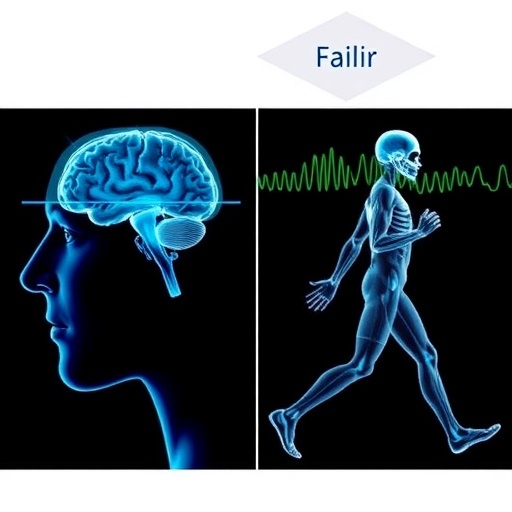
In a groundbreaking study published in BMC Geriatrics, researchers have unveiled critical insights into the intricate neural and muscular dynamics occurring in older adults with mild cognitive impairment (MCI) when they undertake dual-task walking activities. This research not only deepens our understanding of the neurological underpinnings of cognitive decline but also highlights the complex interplay between brain activation patterns, gait performance, and muscle engagement in a population vulnerable to mobility issues and cognitive deterioration. The findings herald a new frontier in geriatric neuroscience and rehabilitation strategies, promising to transform how clinicians approach mobility and fall risk in cognitively impaired seniors.
Walking, one of the most fundamental human motor activities, becomes notably more complex when compounded by simultaneous cognitive demands. In older adults, particularly those with MCI, the challenge of managing a dual-task—such as walking while performing a mental arithmetic task or recalling words—can reveal subtle but significant impairments in motor control and cognition. Prior studies have shown deterioration in gait stability and increased fall risk during such dual-task situations, but the neurophysiological basis remained elusive until now. This latest study integrates advanced cortical imaging and electromyography (EMG) to dissect these mechanisms in unprecedented detail.
At the core of the investigation lies the examination of cortical activation patterns during single and dual-task walking. Utilizing non-invasive neuroimaging techniques—likely functional near-infrared spectroscopy (fNIRS) or electroencephalography (EEG)—the researchers monitored brain regions implicated in motor planning, execution, and cognitive control. The prefrontal cortex (PFC), known for its role in executive function and attentional control, emerged as a key area exhibiting altered activation profiles in MCI participants under dual-task conditions. This enhanced cortical effort suggests a compensatory mechanism whereby the brain recruits additional resources to maintain walking performance amidst cognitive challenges.
The study’s multidisciplinary approach extended beyond cortical observation to include rigorous gait analysis. Using pressure-sensitive walkways and motion capture systems, the researchers quantified gait parameters such as stride length, cadence, and variability. Older adults with MCI demonstrated significant instability marked by decreased stride length and increased stride-to-stride variability when engaged in dual tasks compared to healthy controls. These gait perturbations inherently signify a compromised ability to allocate cognitive resources efficiently, reflecting the cognitive-motor interference framework extensively discussed in scientific literature.
Complementing cortical and gait metrics, the investigation incorporated detailed EMG recordings of lower limb muscle groups. The activation patterns of muscles critical for gait—such as the tibialis anterior, gastrocnemius, and quadriceps—were meticulously recorded during single and dual-task walking. The researchers observed that, in MCI participants, muscle activation became less coordinated and more variable during dual-task engagements. This phenomenon likely arises from the direct impact of reduced cortical efficiency on descending motor commands, leading to impaired muscle timing and force modulation, which in turn exacerbates fall risk.
Crucially, the interplay between increased prefrontal activation and disrupted muscle activation patterns paints a holistic picture of the compensatory yet insufficient strategies employed by the aging brain under cognitive-motor load. The heightened cortical recruitment, although indicative of the brain’s plasticity, may not fully counterbalance the degradation in peripheral motor execution. The resultant gait disturbances highlight systems-level vulnerabilities unique to the intersection of cognitive decline and motor function.
Implications of this research are profound for clinical neurorehabilitation. The identification of specific cortical and muscular signatures associated with dual-task gait deficits provides potential biomarkers for early detection of functional decline in MCI. Such biomarkers could inform personalized intervention protocols aiming to restore or augment cognitive-motor integration via targeted physical and cognitive training regimes. For instance, programs focusing on executive function enhancement or neuromuscular coordination could leverage these insights for better rehabilitative outcomes.
Furthermore, the study sheds light on the potential for wearable technology integration in everyday monitoring of at-risk populations. Advanced EMG sensors paired with cortical activity monitors could enable continuous, real-time assessment of dual-task performance outside laboratory settings, facilitating proactive management of fall risk. Such technological synergy would embody precision medicine principles, tailoring preventive strategies to individual neural and muscular profiles.
From a neuroscientific perspective, the findings expand our understanding of neural plasticity in aging. The compensatory activation observed in the PFC during dual-task walking underscores the brain’s adaptive capacity but also signals the limits of such adaptation in MCI. Future research could explore whether pharmacological or non-invasive brain stimulation techniques might amplify beneficial cortical responses or reduce inefficient overactivation, thus optimizing dual-task walking dynamics.
Another fascinating dimension emerges in the context of disease progression monitoring. Given that gait disturbances and cognitive impairment often co-occur in the prodromal stages of dementia, longitudinal studies based on these findings might clarify whether alterations in dual-task cortical and muscular activation serve as prognostic indicators for conversion to Alzheimer’s disease or other dementias. This potential could revolutionize early diagnosis paradigms and intervention timing.
The meticulous experimental design of this study—combining behavioral tasks, neuroimaging, and electrophysiological measurements—sets a benchmark for future investigations into the intertwined nature of motor and cognitive aging. It also raises new questions about the underlying mechanisms of attentional resource allocation, neural redundancy, and how systemic aging affects integrated neural circuits governing complex tasks such as ambulation.
Notably, the participants’ variability in MCI severity and functional status suggests that personalized assessments are crucial. Individual differences in compensatory cortical activity and muscle recruitment patterns may unveil subtypes within the MCI population, each requiring distinct therapeutic approaches. Personalized medicine in geriatrics could thus greatly benefit from the nuanced data emerging from such dual-task paradigms.
The societal implications are equally compelling. As global populations age, the burden of cognitive impairments and mobility loss escalates dramatically, leading to increased healthcare costs and diminished quality of life. Interventions derived from an intricate understanding of cognitive-motor interplay promise to reduce fall incidences, prolong independent living, and ultimately alleviate this looming public health challenge.
In summary, this pioneering research elucidates the sophisticated neural and muscular substrates underlying the challenges faced by older adults with mild cognitive impairment during cognitively demanding walking tasks. By bridging cognitive neuroscience, motor physiology, and clinical geriatrics, it opens new pathways for early detection, targeted rehabilitation, and continuous monitoring—advancing both scientific knowledge and practical healthcare solutions in aging populations.
As investigative efforts continue, the integration of multimodal neuroimaging, biomechanical analysis, and novel rehabilitation technologies holds the promise of transforming care paradigms for the elderly at risk. The dialogue between brain and body, as revealed through studies like this, ultimately informs how we might preserve mobility, cognitive function, and autonomy in later life with greater efficacy and compassion.
Subject of Research:
Older adults with mild cognitive impairment and the relationship between cortical activation, gait performance, and muscle activation during dual-task walking.
Article Title:
Cortical activation, gait performance, and muscle activation during dual-task walking in older adults with mild cognitive impairment.
Article References:
Li, X., Zhang, Y., Xue, S. et al. Cortical activation, gait performance, and muscle activation during dual-task walking in older adults with mild cognitive impairment. BMC Geriatr (2026). https://doi.org/10.1186/s12877-026-07598-1
Image Credits: AI Generated
Tags: brain activation during gaitcognitive decline and motor controlcortical imaging in geriatric neurosciencedual-task walking in older adultselectromyography in movement analysisfall risk assessment in seniorsgait performance in elderly with MCIinterplay of cognition and locomotionmild cognitive impairment and mobilitymuscle activity in dual-task scenariosneural dynamics of walkingrehabilitation strategies for cognitive impairment