When dieting and exercise aren’t enough, weight-loss surgery can be an effective obesity treatment. But people who don’t want surgery have other options, including insertion of an appetite-suppressing balloon or other implant in the stomach. Now, researchers report in ACS Applied Materials & Interfaces that they have augmented that procedure in laboratory animals by coating an implant with a laser-activated dye that kills cells producing ghrelin, the “hunger hormone.”
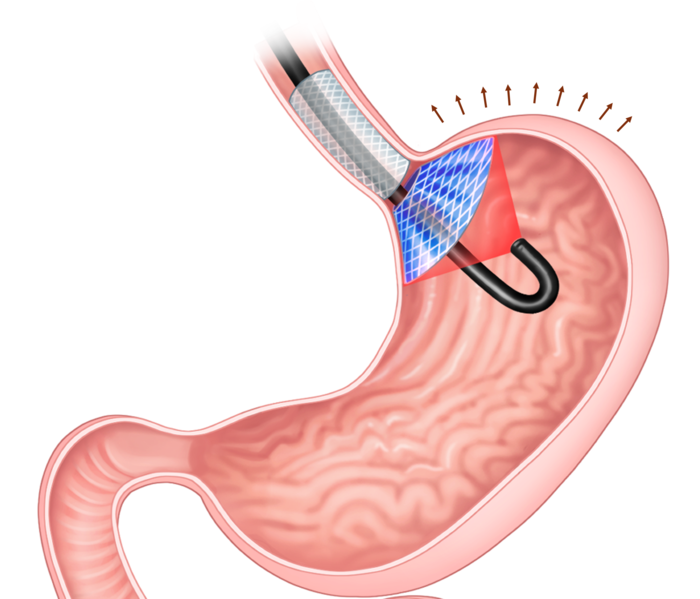
Credit: Adapted from ACS Applied Materials & Interfaces 2022, DOI: 10.1021/acsami.2c00532
When dieting and exercise aren’t enough, weight-loss surgery can be an effective obesity treatment. But people who don’t want surgery have other options, including insertion of an appetite-suppressing balloon or other implant in the stomach. Now, researchers report in ACS Applied Materials & Interfaces that they have augmented that procedure in laboratory animals by coating an implant with a laser-activated dye that kills cells producing ghrelin, the “hunger hormone.”
Implants can be inserted in the stomach through the mouth after local anesthesia. In 2019, Hwoon-Yong Jung, Jung-Hoon Park and colleagues designed a new type of implant. The “intragastric satiety-inducing device” (ISD) consists of a stent — which lodges in the lower esophagus — attached to a disk that rests in the opening to the stomach. The disk has a hole in the center to let food through. Tests in pigs showed that the ISD lowered food intake and weight gain by enhancing the feeling of fullness and reducing levels of ghrelin, which is produced by cells near the top of stomach. But the device caused complications, including acid reflux and migration into the stomach. In their latest project, Jung, Park, Kun Na and colleagues wanted to find out if they could suppress ghrelin even more by coating the ISD’s disk with a compound that, with a shot of laser light, could kill some of the ghrelin-producing cells. The implant could then be removed to avoid the side effects associated with the initial design.
In this preliminary study, the team coated ISDs with methylene blue — an FDA-approved drug — and then placed them in the stomachs of young pigs. When exposed to laser light, the coating released singlet oxygen, an energized form of oxygen that killed nearby ghrelin-producing cells in the pigs’ stomachs and then rapidly disappeared. After one week, the treatment reduced ghrelin levels and body weight gain by half compared with an untreated pig, though these differences declined in the following weeks unless the light treatment was repeated. With further development, the simple procedure could become a new type of minimally invasive treatment to help obese patients lose weight, the researchers say.
The authors acknowledge support from the Korea Medical Device Development Fund grant funded by the Korean government (Project number: KMDF_PR_20200901_0036).
The paper’s abstract will be available on April 6 at 8 a.m. Eastern time here: http://pubs.acs.org/doi/abs/10.1021/acsami.2c00532
The American Chemical Society (ACS) is a nonprofit organization chartered by the U.S. Congress. ACS’ mission is to advance the broader chemistry enterprise and its practitioners for the benefit of Earth and all its people. The Society is a global leader in promoting excellence in science education and providing access to chemistry-related information and research through its multiple research solutions, peer-reviewed journals, scientific conferences, eBooks and weekly news periodical Chemical & Engineering News. ACS journals are among the most cited, most trusted and most read within the scientific literature; however, ACS itself does not conduct chemical research. As a leader in scientific information solutions, its CAS division partners with global innovators to accelerate breakthroughs by curating, connecting and analyzing the world’s scientific knowledge. ACS’ main offices are in Washington, D.C., and Columbus, Ohio.
To automatically receive news releases from the American Chemical Society, contact [email protected].
Follow us: Twitter | Facebook | LinkedIn | Instagram
Journal
ACS Applied Materials & Interfaces
DOI
10.1021/acsami.2c00532
Article Title
Photodynamic methylene blue-embedded intragastric satiety-inducing device to treat obesity
Article Publication Date
6-Apr-2022