Skoltech researchers and their colleagues from ESPCI Paris, Chiba University, and Japan Agency for Marine-Earth Science and Technology have used a 3D simulation to show that small fish swimming in a school can sense the position and tail beat of their neighbors as water pressure variation on the side of their bodies. This mechanism is thought to enable fish to maximize swimming efficiency in a group even in complete darkness, when no visual cues are available. Understanding group motion of fish is useful for predicting their migration and designing aquatic research robots that mimic fish behavior either for the energy-saving benefits of moving in a group or to blend in with the ocean creatures they are studying. The paper came out in Frontiers in Robotics and AI.
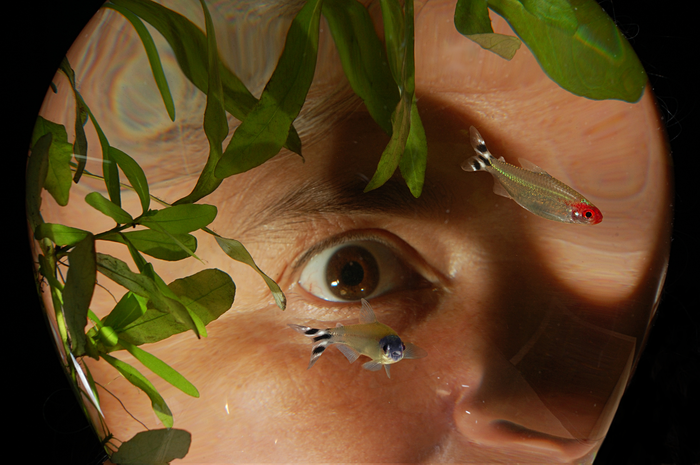
Credit: flickr.com/Apionid (CC BY-NC-ND 2.0)
Skoltech researchers and their colleagues from ESPCI Paris, Chiba University, and Japan Agency for Marine-Earth Science and Technology have used a 3D simulation to show that small fish swimming in a school can sense the position and tail beat of their neighbors as water pressure variation on the side of their bodies. This mechanism is thought to enable fish to maximize swimming efficiency in a group even in complete darkness, when no visual cues are available. Understanding group motion of fish is useful for predicting their migration and designing aquatic research robots that mimic fish behavior either for the energy-saving benefits of moving in a group or to blend in with the ocean creatures they are studying. The paper came out in Frontiers in Robotics and AI.
Prior research suggests fish swimming in groups may benefit from adopting optimal relative positions and synchronizing their movements. To keep track of neighbors even in dark or turbid environments, fish must clearly rely on more than just vision. “In this study, we simulate two rummy nose tetra fish swimming adjacently in various configurations in calm waters. We investigate the pressure signals propagating through water from one fish’s body to the other’s. While we don’t know how the animals process them, the simulation shows that signals reaching the tactile sense organs are intelligible against the background noise and carry information about the neighbor’s position and tail movement,” commented study co-author Dmitry Kolomenskiy, an assistant professor at the Skoltech Center for Materials Technologies.
According to Kolomenskiy, further research might consider noisier environments, expand to larger groups of fish, and enlist artificial intelligence to look at how fish might process such signals. A prior study on ant swirling and bird flocks, also carried out at Skoltech, demonstrated the potential of AI for understanding the neural processes underlying the collective motion of animals.
In fact, there is an emerging trend in robotics that will increasingly see modular designs of smaller robots working in groups, or swarms. For example, a study in the upcoming May issue of Acta Astronautica will consider an eight-wheel Mars rover that can operate as a constellation of two-wheeled machines, maximizing exploration time.
Similarly, swarms of robotic fish equipped with pressure sensors might exploit the hydrodynamic advantages of moving in a group to replace larger underwater drones that explore historic shipwrecks — such as that of the recently discovered Ernest Shackleton’s Endurance — or observe fish behavior. In the latter case, the added bonus is that studies have shown fish to be much less disturbed by sea probes that look and feel more fishlike.
Knowledge of how much energy ingested as food fish conserve by optimizing their movement in groups is also important for predicting their migration patterns, which is of use to the fishing industry.
*****
Skoltech is a private international university located in Russia. Established in 2011 in collaboration with the Massachusetts Institute of Technology (MIT), Skoltech is cultivating a new generation of leaders in the fields of science, technology, and business, conducting research in breakthrough fields, and promoting technological innovation with the goal of solving critical problems that face Russia and the world. Skoltech is focusing on six priority areas: artificial intelligence and communications, life sciences and health, cutting-edge engineering and advanced materials, energy efficiency and ESG, quantum technologies, advanced studies. Website: https://www.skoltech.ru/.
Journal
Frontiers in Robotics and AI
DOI
10.3389/frobt.2022.825889
Article Title
Hydrodynamical Fingerprint of a Neighbour in a Fish Lateral Line
Article Publication Date
11-Feb-2022