Halide perovskites have long been viewed as a promising route to electrically driven microlasers, but turning optical gain into reliable direct-current lasing in solution-processed devices has remained stubbornly difficult. Their story so far is impressive: optically excited single-crystal cavities and solution-assembled microstructures have repeatedly achieved low thresholds. Yet, translating that performance into true charge-carrier injection—where electrons and holes are directly injected into the perovskite—has proved far more challenging.
Recent work has shown indirect or hybrid approaches that mimic electrical pumping. In one strategy, a high-luminosity LED supplies optical energy to a high-gain medium, enabling a dual-cavity perovskite laser. Another line of experiments uses a perovskite light-emitting diode driven by short optical pulses: charge carriers are injected electrically into the diode, and the resulting amplified spontaneous emission (ASE) demonstrates gain inside the electrical device environment. Additional engineering efforts—including hybrid perovskite light-emitting diodes designed for intense excitation—have pushed carrier densities higher. Still, fully electrically induced lasing from perovskites remained elusive.
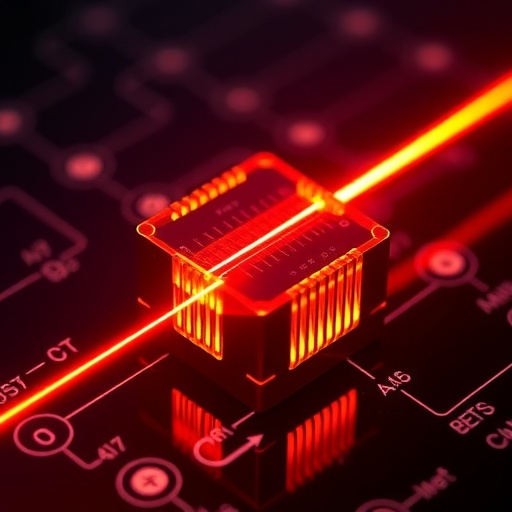
Now, researchers report a direct-current perovskite laser diode that is designed to solve the bottleneck: getting balanced, high-density injection into a perovskite microcavity without damaging it or upsetting its electronic structure. The key advance is a carefully engineered p–i–n diode architecture formed during operation. Instead of relying on epitaxial growth, the team integrates a solution-grown CsPbBr3 microplate with chemically inert single-walled carbon nanotube (SWCNT) electrodes, then embeds this assembly into an optical microcavity.
The device is cooled to 8 K while maintaining a constant current. At this temperature, the microplate–electrode configuration enables formation of a perovskite p–i–n diode that supports balanced carrier injection, even at high current densities. This is crucial: unbalanced injection typically wastes carriers or promotes nonradiative pathways, preventing coherent emission.
Beyond achieving injection, the researchers exploit the optical cavity to enter a strongly coupled regime. In that regime, light and matter hybridize into polaritons—quasiparticles that can lase when gain overcomes losses. By driving the integrated microcavity diode, the system reaches polariton lasing rather than conventional weak-coupling emission.
The headline result is strikingly specific: polariton lasing occurs under a direct current of 65 μA. Such low drive currents for electrically pumped, non-epitaxial perovskite devices point toward practical, chip-compatible routes to coherent light sources.
If the approach scales, it could reshape perovskite photonics from “optically impressive” to “electrically usable,” narrowing the gap between laboratory cavity physics and device-level performance. More broadly, it highlights a path forward: engineer injection through non-traditional contacts, then let strong coupling do the heavy lifting for coherent emission.
This work demonstrates that direct electrical pumping of a perovskite microcavity diode can achieve polariton lasing, turning a conceptual challenge into a measurable device outcome. With perovskites already valued for tunable optical properties, the next steps will likely focus on stability, higher-temperature operation, and integration with scalable photonic circuitry.
Subject of Research: Direct-current electrically pumped perovskite polariton laser diode
Article Title: Non-epitaxial perovskite polariton laser diode operating under direct current.
Article References: Pushkarev, A.P., Khmelevskaia, D., Matchenya, I.A. et al. Non-epitaxial perovskite polariton laser diode operating under direct current. Nature (2026). https://doi.org/10.1038/s41586-026-10824-w
DOI: https://doi.org/10.1038/s41586-026-10824-w
Keywords: Perovskite, polariton lasing, strong coupling, microcavity diode, SWCNT electrodes, direct current injection, CsPbBr3
Tags: balanced high-density carrier injectioncharge-carrier injection in perovskitescontinuous operation of perovskite laser diodesdirect-current perovskite lasingelectrically driven microlasershigh-gain perovskite microstructureshybrid approaches to electrically pumped lasersnovel design forovercoming charge injection challenges in perovskitesp–i–n diode architecture in perovskitesperovskite polariton laser diodesolution-processed laser devices