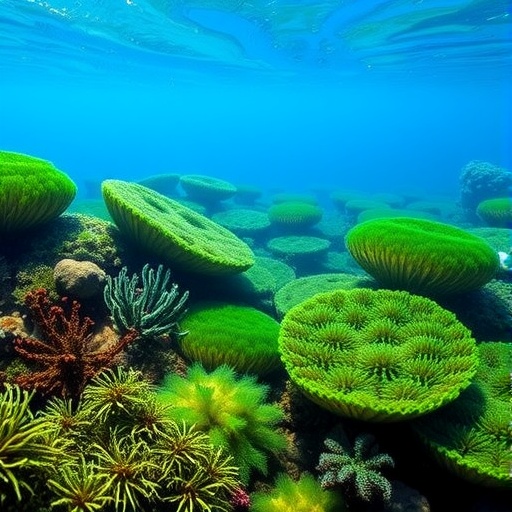
Marine speciation is notoriously difficult to unravel, especially in dynamic ocean habitats where dispersal can blur species boundaries. A new genomic study in Heredity examines how reproductive isolation emerges in the red alga Amansia glomerata around Oʻahu, Hawaiʻi, where multiple lineages coexist. The researchers test whether lineage boundaries are maintained by strong, genome-wide barriers to gene flow.
To do this, they generated fine-scale population data using ddRAD sequencing, mapping genetic divergence across spatial transects. Rather than finding a simple geographic replacement of lineages, the team observed that lineages form extensive sympatric populations, meaning distinct genetic groups occur together across the same coastal regions. This sets the stage for asking whether coexistence is compatible with reproductive isolation.
Despite this close spatial overlap, the lineages remained strongly differentiated across the genome. The authors report differentiation at many loci, consistent with barriers that limit effective interbreeding even when individuals occur at fine scales. In other words, spatial proximity did not automatically translate into genetic mixing.
Demographic modeling further supported an evolutionary history shaped by sea-level change. The data fit a scenario of allopatric divergence—lineages diverged in isolation—followed by secondary contact when previously separated populations reconnected. The proposed timing aligns with Pleistocene sea-level fluctuations within the Hawaiian Archipelago.
The strength of reproductive barriers is reinforced by the absence of backcrosses and second-generation hybrids. The genomic pattern indicates little to no contemporary admixture, suggesting that barriers to reproduction remain functional where lineages overlap today. This is consistent with a lack of ongoing hybrid formation and subsequent gene flow.
At the same time, the study does not portray the system as completely closed. Even though present-day mixing appears limited, genomic footprints of introgression were detected. Importantly, the spatial structure of these signals around Oʻahu suggests that past gene flow was geographically restricted rather than uniform.
The introgression appears asymmetric, implying that one lineage likely contributed more allelic material than the other during earlier secondary contact. The authors interpret this as a transient phase of limited connectivity before reproductive isolation became stronger or more effective.
While the paper establishes allopatric divergence as a major driver of speciation in this algal system, ecological differentiation remains an open question. If habitat-linked selection or microenvironmental differences also contribute, future work could clarify how ecological forces interact with genomic barriers to shape speciation.
Overall, the results provide a genomic roadmap for how reproductive isolation can persist in sympatry and how limited, structured introgression can leave lasting traces. By leveraging ddRAD and spatially explicit inference, the study highlights the Hawaiian seaweed system as a powerful natural laboratory for the mechanisms of speciation in the marine realm.
Subject of Research: Marine speciation; reproductive isolation and genomic introgression in the red alga Amansia glomerata.
Article Title: Reproductive isolation and differential introgression shape the genomic landscape of the red alga Amansia glomerata in the Hawaiian Archipelago.
Article References: Reyn es, L., Fumo, J.T. & Sherwood, A.R. Reproductive isolation and differential introgression shape the genomic landscape of the red alga Amansia glomerata in the Hawaiian Archipelago. Heredity (2026). https://doi.org/10.1038/s41437-026-00869-y
Image Credits: AI Generated
DOI: https://doi.org/10.1038/s41437-026-00869-y
Keywords: Reproductive isolation; Genomic divergence; Introgression; Seaweed; Hawaiʻi; ddRAD; secondary contact; sympatry.
Tags: ddRAD sequencingdemographic modelinggene flow barriersgene introgressiongenomic divergenceHawaiian algae evolutionMarine speciationPleistocene sea-level changespopulation structurereproductive isolationspeciation mechanismssympatric populations