• HOME
  • NEWS
  • EXPLORE
    • CAREER
      • Companies
      • Jobs
    • EVENTS
    • iGEM
      • News
      • Team
    • PHOTOS
    • VIDEO
    • WIKI
  • BLOG
  • COMMUNITY
    • FACEBOOK
    • INSTAGRAM
    • TWITTER
Saturday, February 7, 2026
BIOENGINEER.ORG
No Result
View All Result
  • Login
  • HOME
  • NEWS
  • EXPLORE
    • CAREER
      • Companies
      • Jobs
        • Lecturer
        • PhD Studentship
        • Postdoc
        • Research Assistant
    • EVENTS
    • iGEM
      • News
      • Team
    • PHOTOS
    • VIDEO
    • WIKI
  • BLOG
  • COMMUNITY
    • FACEBOOK
    • INSTAGRAM
    • TWITTER
  • HOME
  • NEWS
  • EXPLORE
    • CAREER
      • Companies
      • Jobs
        • Lecturer
        • PhD Studentship
        • Postdoc
        • Research Assistant
    • EVENTS
    • iGEM
      • News
      • Team
    • PHOTOS
    • VIDEO
    • WIKI
  • BLOG
  • COMMUNITY
    • FACEBOOK
    • INSTAGRAM
    • TWITTER
No Result
View All Result
Bioengineer.org
No Result
View All Result
Home NEWS Science News Biology

Uncovering how immune cells nurture brain connections

Bioengineer by Bioengineer
March 7, 2022
in Biology
Reading Time: 2 mins read
0
Microglia and Chandelier Cells
Share on FacebookShare on TwitterShare on LinkedinShare on RedditShare on Telegram

Microglia, the immune cells of the brain, are known for eating up unwanted items like germs and debris, much as their counterparts do in the rest of the body. In early childhood, certain microglia remove unneeded connections, or synapses, to shape the adult brain’s organized circuitry. Now, Cold Spring Harbor Laboratory (CSHL) Professor Linda Van Aelst has found that in mice, microglia also help neurons grow synapses critical to cognitive functioning.
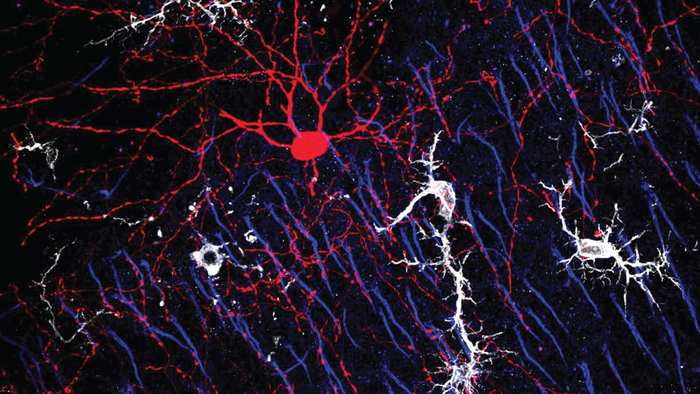
Microglia and Chandelier Cells

Credit: Nicholas Gallo/Van Aelst lab/CSHL, 2022

Microglia, the immune cells of the brain, are known for eating up unwanted items like germs and debris, much as their counterparts do in the rest of the body. In early childhood, certain microglia remove unneeded connections, or synapses, to shape the adult brain’s organized circuitry. Now, Cold Spring Harbor Laboratory (CSHL) Professor Linda Van Aelst has found that in mice, microglia also help neurons grow synapses critical to cognitive functioning.

“Most immune cells are known to target and eat—let’s call it garbage,” says Van Aelst. “But what we saw is the opposite. During a particular developmental time point, under normal physiological conditions, they did not eat any synapses that we saw, but helped the synapses form. That was quite a nice surprise.”

It was Van Aelst’s obsession with a rare type of inhibitory neuron called a chandelier cell that sparked her interest in microglia. Chandelier cells are named for the ornate branching shape of their nerve fibers. These structures make direct contact with the section of a target neuron that sets off its firing: the axonal initial segment (AIS). This unique synapse gives chandelier cells powerful control over the signaling of hundreds of neighboring neurons at once.

“These synapses are critical for chandelier cells to silence the excitatory neurons. Too much excitation can contribute to disorders like epilepsy, schizophrenia, and autism,” Van Aelst explains. She wondered what other cell types regulate the formation of such synapses.

Together with graduate students Nicholas Gallo and research assistant Artan Berisha, Van Aelst studied how microglia interact with chandelier cells. They found that microglia wrap their armlike processes around the synapse-forming structures of a chandelier cell and its target neuron, increasing proper synapse formation. These special embraces were more common in pups and young mice than in adults.

“And that was really cool,” she says. “This is the first time that microglia have been implicated in these unique synapses as a growth-promoting function.”

The team then tested what happens when microglia are impaired. “We saw that there were less microglia going to where chandelier cells make contact on the AIS,” Van Aelst says. “And we saw that fewer of these synapses formed.”

Microglia “are only one of the players that control synaptogenesis, but key players that people didn’t think of or expect,” she says. Ultimately, the researchers want to see if microglia could be recruited to help treat neurological disorders.


Journal

Proceedings of the National Academy of Sciences

DOI

10.1073/pnas.2114476119

Article Title

Microglia regulate chandelier cell axo-axonic synaptogenesis

Article Publication Date

11-Mar-2022

Share12Tweet8Share2ShareShareShare2

Related Posts

Florida Cane Toad: Complex Spread and Selective Evolution

Florida Cane Toad: Complex Spread and Selective Evolution

February 7, 2026
New Study Uncovers Mechanism Behind Burn Pit Particulate Matter–Induced Lung Inflammation

New Study Uncovers Mechanism Behind Burn Pit Particulate Matter–Induced Lung Inflammation

February 6, 2026

DeepBlastoid: Advancing Automated and Efficient Evaluation of Human Blastoids with Deep Learning

February 6, 2026

Navigating the Gut: The Role of Formic Acid in the Microbiome

February 6, 2026

POPULAR NEWS

  • Robotic Ureteral Reconstruction: A Novel Approach

    Robotic Ureteral Reconstruction: A Novel Approach

    82 shares
    Share 33 Tweet 21
  • Digital Privacy: Health Data Control in Incarceration

    63 shares
    Share 25 Tweet 16
  • Study Reveals Lipid Accumulation in ME/CFS Cells

    57 shares
    Share 23 Tweet 14
  • Breakthrough in RNA Research Accelerates Medical Innovations Timeline

    53 shares
    Share 21 Tweet 13

About

We bring you the latest biotechnology news from best research centers and universities around the world. Check our website.

Follow us

Recent News

Evaluating Pediatric Emergency Care Quality in Ethiopia

TPMT Expression Predictions Linked to Azathioprine Side Effects

Improving Dementia Care with Enhanced Activity Kits

Subscribe to Blog via Email

Enter your email address to subscribe to this blog and receive notifications of new posts by email.

Join 73 other subscribers
  • Contact Us

Bioengineer.org © Copyright 2023 All Rights Reserved.

Welcome Back!

Login to your account below

Forgotten Password?

Retrieve your password

Please enter your username or email address to reset your password.

Log In
No Result
View All Result
  • Homepages
    • Home Page 1
    • Home Page 2
  • News
  • National
  • Business
  • Health
  • Lifestyle
  • Science

Bioengineer.org © Copyright 2023 All Rights Reserved.