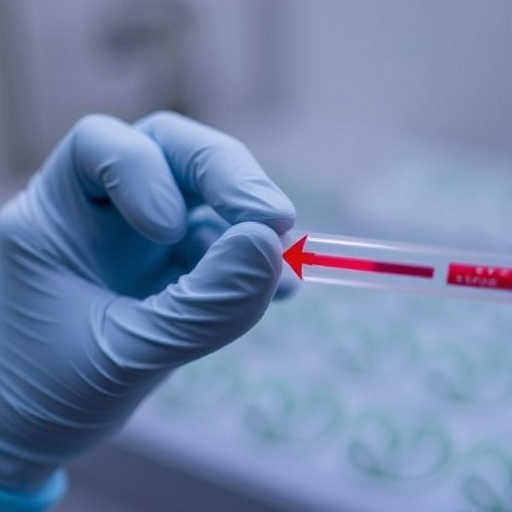
In a groundbreaking study recently published in the Journal of Exposure Science and Environmental Epidemiology, researchers have unveiled a novel approach to monitor environmental contamination through an innovative capillary blood collection device. This cutting-edge technology was applied in a cohort of Veterans residing near potential sources of per- and polyfluoroalkyl substances (PFAS), substances notorious for their persistence in the environment and suspected health implications. The study represents a significant advance in biomonitoring techniques, addressing the critical need for minimally invasive, accurate, and field-deployable tools to assess human exposure to these hazardous compounds.
PFAS, often termed “forever chemicals” due to their extraordinary resistance to degradation, are widely utilized in various industrial applications, from firefighting foams to non-stick cookware. Their ubiquity has led to widespread environmental dissemination, contaminating water supplies and creating exposure pathways for nearby populations. Veterans residing adjacent to military installations or industrial sites are disproportionately impacted, given the historical use of PFAS-containing materials. However, traditional methods of exposure assessment, relying on venous blood draws, are invasive, logistically challenging, and limit large-scale surveillance efforts.
The study’s authors, led by Havens et al., capitalized on a minimally invasive capillary blood collection technique to surmount these limitations. This method uses a small, user-friendly device to collect finger-prick blood samples, dramatically simplifying the process of obtaining biological specimens for chemical analysis. The innovation promises to facilitate broader surveillance efforts, enabling researchers to monitor PFAS exposure in vulnerable communities with unprecedented efficiency and scalability.
To validate the capillary device’s efficacy, the team conducted a comparative analysis against conventional venous blood sampling in a cohort of Veterans living in proximity to known environmental PFAS sources. The results demonstrated strong concordance between the two sampling modalities, affirming that capillary blood collection can reliably capture the internal burden of PFAS. This breakthrough holds immense promise for epidemiological investigations, reducing participant burden while maintaining data integrity.
Importantly, the study also delved into spatial exposure gradients, illustrating how PFAS serum concentrations correlated with residential proximity to contamination hotspots. Veterans closer to such sites exhibited significantly elevated PFAS levels, reinforcing concerns about localized environmental exposure risks. This spatial analysis underscores the critical need for targeted public health interventions and ongoing biomonitoring of at-risk populations.
Moreover, by employing advanced analytical chemistry techniques capable of detecting minute PFAS concentrations, the researchers revealed diverse exposure profiles among individuals, reflecting complex contamination patterns and lifestyle factors. Such granularity enables refined risk assessment and personalized exposure mitigation strategies, aligning with modern precision public health paradigms.
Beyond its immediate implications, this research opens avenues for integrating capillary blood collection in routine environmental health surveillance. The portability and minimal invasiveness of the device could catalyze community-based monitoring programs, empowering affected populations to actively participate in exposure assessment. This democratization of environmental health research could transform public engagement and policy advocacy surrounding chemical contaminants.
The investigation also acknowledged limitations inherent in capillary sampling, such as potential variability in sample volume and matrix effects. Nonetheless, careful methodological standardization and quality control measures implemented by the researchers mitigated these concerns, paving the way for robust application in diverse settings. Future research is warranted to further optimize device performance and expand analyte panels.
Crucially, the study’s timing aligns with growing scientific and regulatory attention on PFAS contamination worldwide. Regulatory agencies are enacting stricter limits on PFAS levels in drinking water, and heightened public awareness is driving demand for better exposure data. The capillary blood collection approach could serve as a vital tool in these efforts, providing actionable insights to shape policy and remedial actions.
Veterans’ health advocacy groups have welcomed these findings, highlighting the urgent need for accessible exposure monitoring tools that better capture the environmental realities faced by military communities. The potential to implement large-scale biomonitoring initiatives with minimal disruption holds promise for closing knowledge gaps and fostering equitable health protections.
Furthermore, the integration of this technology into longitudinal cohort studies could illuminate chronic health impacts linked to PFAS exposure. By enabling repeated measures, researchers can track biomarker dynamics over time, linking exposure trajectories with disease outcomes. This longitudinal perspective is essential for unraveling the complex toxicokinetics and pathophysiology of PFAS-related conditions.
As environmental contamination patterns evolve with industrial practices and remediation efforts, adaptable and responsive biomonitoring methodologies become indispensable. The capillary blood collection device exemplifies such adaptability, offering a scalable platform applicable not only to PFAS but potentially to broader classes of environmental pollutants of concern. This versatility positions the technology at the frontier of exposure science.
In conclusion, the advent of capillary blood collection for PFAS biomonitoring marks a pivotal advance in environmental health research. Havens and colleagues have demonstrated a practical, reliable, and innovative tool that could revolutionize exposure assessment, especially for vulnerable populations like Veterans residing near contamination sources. This research heralds new possibilities for surveillance, risk communication, and environmental justice, echoing across scientific, regulatory, and community domains.
As the global community confronts the challenges posed by persistent chemical contaminants, such pioneering approaches will be crucial. By empowering researchers and affected populations alike with accessible biomonitoring capabilities, science can forge pathways towards healthier environments and more resilient societies. The promise of capillary blood collection technology invites a new era of dynamic, precise, and participatory environmental health science.
The implications of this study extend well beyond the initial application, suggesting fertile ground for interdisciplinary collaboration. Toxicologists, epidemiologists, engineers, and policymakers stand to benefit from integrating this tool in concerted campaigns to tackle the pervasive legacy of “forever chemicals.” Continued innovation and dissemination will be vital to realize the full potential of this breakthrough.
Overall, the research underscores how technological ingenuity intertwined with environmental health imperatives can propel the field forward. By transforming how exposure data are collected and interpreted, this work sets a new gold standard for monitoring the invisible yet insidious chemical threats in our environment, raising the bar for future investigations.
Subject of Research: Use of capillary blood collection device for monitoring exposure to per- and polyfluoroalkyl substances (PFAS) in Veterans near potential environmental contamination sources.
Article Title: Use of a capillary blood collection device to monitor exposure to per- and polyfluoroalkyl substances (PFAS) in Veterans living in proximity to potential sources of environmental contamination.
Article References:
Havens, L.A., Heitz, E.R., Hartley, K.R. et al. Use of a capillary blood collection device to monitor exposure to per- and polyfluoroalkyl substances (PFAS) in Veterans living in proximity to potential sources of environmental contamination. J Expo Sci Environ Epidemiol (2026). https://doi.org/10.1038/s41370-026-00884-5
Image Credits: AI Generated
DOI: 30 April 2026
Tags: capillary blood collection device for PFAS monitoringenvironmental contamination tracking methodsfield-deployable PFAS testing technologyinnovative blood sampling for toxicologylarge-scale PFAS surveillance methodsminimally invasive biomonitoring techniquesnon-invasive PFAS exposure assessment toolsnovel environmental exposure biomarkersper- and polyfluoroalkyl substances health impactPFAS contamination in veteran populationsPFAS exposure near military installationsveterans PFAS exposure assessment