Roads have a negative impact on chimpanzee populations that can extend for more than 17 km, new research shows.
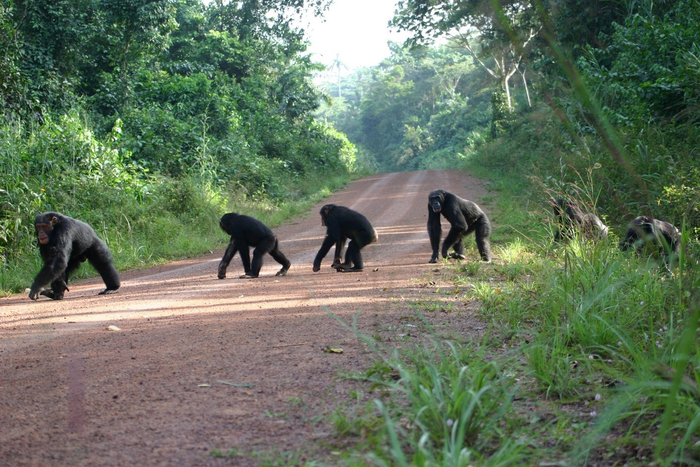
Credit: Dr Kimberley Hockings
Roads have a negative impact on chimpanzee populations that can extend for more than 17 km, new research shows.
A team led by the University of Exeter examined the impact of major and minor roads on wild western chimpanzee numbers in the eight African countries in which they live.
The impacts extended to an average of 17.2 km (10.7 miles) from major roads, and 5.4 km (3.4 miles) from minor roads.
Chimpanzee population density drops consistently from the edges of these areas to a lowest value at the roads.
The situation in untouched areas is hard to assess because less than five per cent of western chimpanzees’ range is outside the “road-effect zones” identified in the study.
The paper is published in the journal Conservation Letters, and the research team also included Concordia University in Montreal (Canada) and the Potsdam Institute for Climate Impact Research.
“Western chimpanzees were once widespread across West Africa, but the species has declined by 80% in the last 20 years and is currently classified as critically endangered,” said Balint Andrasi, who led the study as part of a masters in Conservation Science and Policy at Exeter.
“The human population in West Africa is growing rapidly, and chimpanzees face mounting pressure from the expansion of settlements and infrastructure.
“Previous research suggests that roads dramatically reduce western chimpanzee numbers, rather than simply displacing the animals.
“Just 4.3% of their range remains unaffected by roads, so they don’t have anywhere else to go, and in any case migration over long distances is uncommon.
“Western chimpanzees are highly territorial, so attempting to move could lead to conflict with neighbouring groups.”
The study did not directly investigate the reasons why roads affect chimpanzee numbers, but the researchers highlight several possible explanations.
As well as direct impacts like roadkill and noise, they say roads open up unexploited areas to industries such as mining and agriculture which often reduce or remove forest habitats.
Roads can also restrict chimpanzee movements, dividing populations and causing genetic isolation.
Hunting is a persistent threat to western chimpanzees, and roads provide easier access for hunters.
“When roads appear, so do all sorts of human activities,” Andrasi said.
Regulations in many countries require that wildlife should be considered before new roads are built, but until now the size of the impact area affecting chimpanzees had not been estimated.
The researchers hope their findings will help to bring about more effective guidelines to mitigate road impacts.
“This is the first time this analytical approach has been used to understand the impact of roads on nonhuman primates, and the results are shocking,” said Dr Kimberley Hockings, of the Centre for Ecology and Conservation on the University of Exeter’s Penryn Campus in Cornwall.
“We hope these findings will ensure the true costs of infrastructure development on the critically endangered western chimpanzee are fully considered by policy makers.
“Our great ape cousins face so many threats, from habitat change to hunting to disease.
“The impact of infrastructure development is much larger than I ever anticipated and is truly worrying.
“But we can’t give up. We must do everything we can to ensure their continued survival. I can’t imagine a world where humans are the only great apes left.”
The study combined data on western chimpanzee density with road routes across the range inhabited by the species, which spans Ghana, Guinea, Guinea Bissau, Ivory Coast, Liberia, Mali, Senegal and Sierra Leone.
The paper is entitled: “Quantifying the road-effect zone for a critically endangered primate.”
The University of Exeter has launched a ‘Green Futures’ campaign and website to drive action on the environment and climate emergency. To find out more please visit https://greenfutures.exeter.ac.uk
Journal
Conservation Letters
DOI
10.1111/conl.12839
Method of Research
Data/statistical analysis
Subject of Research
Animals
Article Title
Quantifying the road-effect zone for a critically endangered primate
Article Publication Date
15-Sep-2021