• HOME
  • NEWS
  • EXPLORE
    • CAREER
      • Companies
      • Jobs
    • EVENTS
    • iGEM
      • News
      • Team
    • PHOTOS
    • VIDEO
    • WIKI
  • BLOG
  • COMMUNITY
    • FACEBOOK
    • INSTAGRAM
    • TWITTER
Wednesday, June 24, 2026
BIOENGINEER.ORG
No Result
View All Result
  • Login
  • HOME
  • NEWS
  • EXPLORE
    • CAREER
      • Companies
      • Jobs
        • Lecturer
        • PhD Studentship
        • Postdoc
        • Research Assistant
    • EVENTS
    • iGEM
      • News
      • Team
    • PHOTOS
    • VIDEO
    • WIKI
  • BLOG
  • COMMUNITY
    • FACEBOOK
    • INSTAGRAM
    • TWITTER
  • HOME
  • NEWS
  • EXPLORE
    • CAREER
      • Companies
      • Jobs
        • Lecturer
        • PhD Studentship
        • Postdoc
        • Research Assistant
    • EVENTS
    • iGEM
      • News
      • Team
    • PHOTOS
    • VIDEO
    • WIKI
  • BLOG
  • COMMUNITY
    • FACEBOOK
    • INSTAGRAM
    • TWITTER
No Result
View All Result
Bioengineer.org
No Result
View All Result
Home NEWS Science News Biology

China’s carbon-monitoring satellite reports global carbon net of six gigatons

Bioengineer by Bioengineer
July 23, 2021
in Biology
Reading Time: 3 mins read
0
IMAGE
Share on FacebookShare on TwitterShare on LinkedinShare on RedditShare on Telegram

IMAGE

Credit: Dongxu Yang

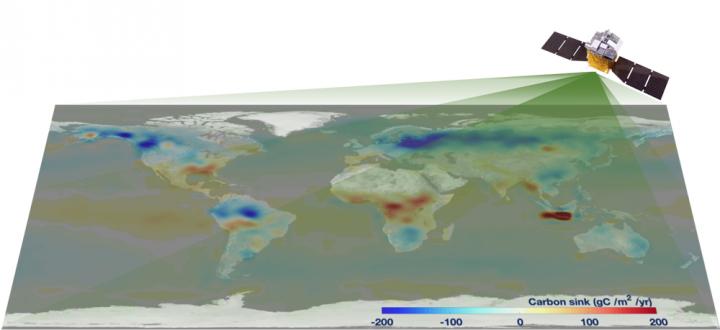
About six gigatons — roughly 12 times the mass of all living humans — of carbon appears to be emitted over land every year, according to data from the Chinese Global Carbon Dioxide Monitoring Scientific Experimental Satellite (TanSat).

Using data on how carbon mixes with dry air collected from May 2017 to April 2018, researchers developed the first global carbon flux dataset and map. They published their results in Advances in Atmospheric Sciences.

The map was developed by applying TanSat’s satellite observations to models of how greenhouse gasses are exchanged among Earth’s atmosphere, land, water and living organisms. During this process, more than a hundred of gigatons of carbon are exchanged, but the increase in carbon emissions has resulted in net carbon added to the atmosphere — now at about six gigatons a year — which is a serious issue that contributes to climate change, according to Dongxu Yang, first author and a researcher in the Institute of Atmospheric Physics at the Chinese Academy of Sciences (IAP CAS).

“In this paper, we introduce the first implementation of TanSat carbon dioxide data on carbon flux estimations,” Yang said. “We also demonstrate that China’s first carbon-monitoring satellite can investigate the distribution of carbon flux across the globe.”

While satellite measurements are not as accurate as ground-based measurements, said co-author Jing Wang, a researcher in IAP CAS, satellite measurements provide continuous global observation coverage that provides additional information not available from limited or varied surface monitoring stations. For example, a monitoring station in a city may report very different observations compared to a station in a remote village, especially if they are in drastically different climates.

“The sparseness and spatial inhomogeneity of the existing ground-based network limits our ability to infer consistent global- and regional-scale carbon sources and sinks,” said co-author Liang Feng, researcher with the National Centre for Earth Observation at the University of Edinburgh. “To improve observation coverage, tailor-made satellites, for example TanSat, have been developed to provide accurate atmospheric greenhouse gas measurements.”

The data from these satellites, which includes TanSat, Japan’s GOSAT and the United States’ OCO-2, and future missions, will be used to independently verify national emission inventories across the globe. According to the Yang, this process will be overseen by the United Nations Framework Convention on Climate Change and begin in 2023, in support of the Paris Agreement. TanSat’s measurements generally match with data from the other satellites.

“This verification method will be helpful to better understand carbon emissions in real time, and to help ensure transparency across the inventories,” said co-author Yi Liu, researcher in IAP CAS.

The process will be bolstered by the next generation of satellites, known as TanSat-2, which is currently in the design phase. The goal, Yang said, will be to obtain measurements that help elucidate the carbon budget from the global scale down to individual cities.

###

TanSat, funded by the Ministry of Science and Technology of China and the China Meteorological Administration, was launched in December 2016.

Media Contact
Ms. Zheng Lin
[email protected]

Original Source

http://english.iap.cas.cn/home/News/202107/t20210723_276226.html

Related Journal Article

http://dx.doi.org/10.1007/s00376-021-1179-7

Tags: Atmospheric ScienceClimate ChangeEarth ScienceMeteorologySatellite Missions/Shuttles
Share13Tweet8Share2ShareShareShare2

Related Posts

How Intestinal Mucus Influences Klebsiella pneumoniae Colonization and Antibiotic Effectiveness — Biology

How Intestinal Mucus Influences Klebsiella pneumoniae Colonization and Antibiotic Effectiveness

June 24, 2026
From Darkness to Light: How Blind Mexican Cavefish Reveal Brain Evolution — Biology

From Darkness to Light: How Blind Mexican Cavefish Reveal Brain Evolution

June 24, 2026

Reevaluating the Impact of ‘Yo-Yo Dieting’: Is It Less Harmful Than Commonly Thought?

June 24, 2026

Family Dogs: Science’s Unexpected Ally in Autism Research

June 24, 2026
Please login to join discussion

POPULAR NEWS

  • Saying Goodbye to PGY-6: Pediatric Fellowship Realities

    103 shares
    Share 41 Tweet 26
  • Multi-Hospital Study Reveals Long Covid Burden Is Twice as High as Current Estimates

    92 shares
    Share 36 Tweet 23
  • Detection of EDCs in Breast Milk and Infant Urine Up to Six Months Highlights Early Exposure Risks

    77 shares
    Share 31 Tweet 19
  • New Drug Candidate Developed at McMaster Shows Potential for Treating Brain Cancer

    58 shares
    Share 23 Tweet 15

About

We bring you the latest biotechnology news from best research centers and universities around the world. Check our website.

Follow us

Recent News

Antler Stem Cells Relieve Cerebral Ischemic Injury

Increase in Adolescent Suicidality Following State-Level Total Abortion Bans

Personalized Brain Imaging Offers New Hope for Treatment-Resistant Depression

Subscribe to Blog via Email

Enter your email address to subscribe to this blog and receive notifications of new posts by email.

Join 82 other subscribers
  • Contact Us

Bioengineer.org © Copyright 2023 All Rights Reserved.

Welcome Back!

Login to your account below

Forgotten Password?

Retrieve your password

Please enter your username or email address to reset your password.

Log In
No Result
View All Result
  • Homepages
    • Home Page 1
    • Home Page 2
  • News
  • National
  • Business
  • Health
  • Lifestyle
  • Science

Bioengineer.org © Copyright 2023 All Rights Reserved.