• HOME
  • NEWS
  • EXPLORE
    • CAREER
      • Companies
      • Jobs
    • EVENTS
    • iGEM
      • News
      • Team
    • PHOTOS
    • VIDEO
    • WIKI
  • BLOG
  • COMMUNITY
    • FACEBOOK
    • INSTAGRAM
    • TWITTER
Sunday, December 7, 2025
BIOENGINEER.ORG
No Result
View All Result
  • Login
  • HOME
  • NEWS
  • EXPLORE
    • CAREER
      • Companies
      • Jobs
        • Lecturer
        • PhD Studentship
        • Postdoc
        • Research Assistant
    • EVENTS
    • iGEM
      • News
      • Team
    • PHOTOS
    • VIDEO
    • WIKI
  • BLOG
  • COMMUNITY
    • FACEBOOK
    • INSTAGRAM
    • TWITTER
  • HOME
  • NEWS
  • EXPLORE
    • CAREER
      • Companies
      • Jobs
        • Lecturer
        • PhD Studentship
        • Postdoc
        • Research Assistant
    • EVENTS
    • iGEM
      • News
      • Team
    • PHOTOS
    • VIDEO
    • WIKI
  • BLOG
  • COMMUNITY
    • FACEBOOK
    • INSTAGRAM
    • TWITTER
No Result
View All Result
Bioengineer.org
No Result
View All Result
Home NEWS Science News Chemistry

Unravelling the knotty problem of the Sun’s activity

Bioengineer by Bioengineer
July 22, 2021
in Chemistry
Reading Time: 2 mins read
0
IMAGE
Share on FacebookShare on TwitterShare on LinkedinShare on RedditShare on Telegram

IMAGE

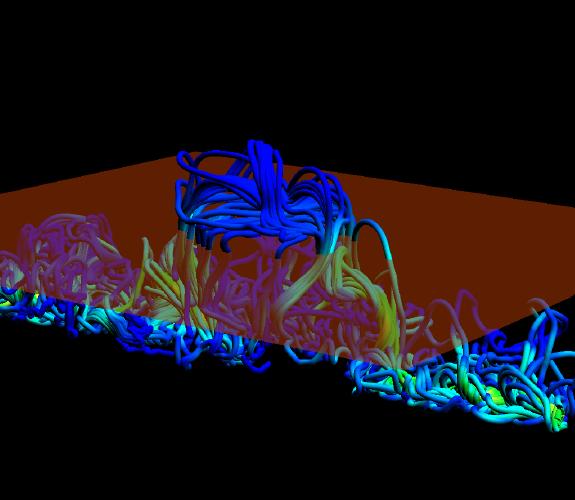
Credit: MacTaggart et al.

A new approach to analysing the development of magnetic tangles on the Sun has led to a breakthrough in a longstanding debate about how solar energy is injected into the solar atmosphere before being released into space, causing space weather events. The first direct evidence that field lines become knotted before they emerge at the visible surface of the Sun has implications for our ability to predict the behaviour of active regions and the nature of the solar interior. Dr Christopher Prior of the Department of Mathematical Sciences, Durham University, will present the work today at the virtual National Astronomy Meeting (NAM 2021).

Researchers are generally in agreement that solar activity is caused by instabilities in giant twists of magnetic ropes threading the visible surface of the Sun, known as the photosphere. However, there has been an ongoing debate about how these tangles form. The two dominant theories have suggested either that coils of field lines emerge through the photosphere from the convection zone below, or that the feet of arching field lines wrap around each other on the surface itself and create braids. Both mechanisms could theoretically produce effects like sunspot rotation and dramatic solar flares but, to date, no direct observational evidence had conclusively supported either scenario.

Prior and colleagues from the University of Glasgow and INAF-Osservatorio Astrofisico di Catania in Italy came up with a new direct measure of the entanglement of the magnetic field by tracking the rotation of field lines at the points where they intersect with the photosphere. This ‘magnetic winding’ should manifest in different ways for each of the two theories. Thus, applying magnetic winding to observations of the photosphere and examining the resulting patterns could enable a definitive answer to be reached for which theory was correct.

The researchers studied the magnetic winding for 10 active regions on the Sun in observations by solar missions. In every case, the results matched the emergence theory of pre-twisted magnetic field lines rising up from the convection zone.

Prior explains: “The pattern for pre-twisted field lines exactly matched the observational data we considered initially, and this has since been found to be true for all data sets of active regions we have looked at so far. We anticipate that magnetic winding will become a staple quantity in the interpretation of magnetic field structure from observational data.”

###

Media Contact
Robert Massey
[email protected]

Tags: AstronomyAstrophysicsSpace/Planetary ScienceStars/The Sun
Share13Tweet8Share2ShareShareShare2

Related Posts

blank

Iridium Catalysis Enables Piperidine Synthesis from Pyridines

December 3, 2025
Neighboring Groups Speed Up Polymer Self-Deconstruction

Neighboring Groups Speed Up Polymer Self-Deconstruction

November 28, 2025

Activating Alcohols as Sulfonium Salts for Photocatalysis

November 26, 2025

Carbonate Ions Drive Water Ordering in COâ‚‚ Reduction

November 25, 2025
Please login to join discussion

POPULAR NEWS

  • New Research Unveils the Pathway for CEOs to Achieve Social Media Stardom

    New Research Unveils the Pathway for CEOs to Achieve Social Media Stardom

    204 shares
    Share 82 Tweet 51
  • Scientists Uncover Chameleon’s Telephone-Cord-Like Optic Nerves, A Feature Missed by Aristotle and Newton

    121 shares
    Share 48 Tweet 30
  • Neurological Impacts of COVID and MIS-C in Children

    107 shares
    Share 43 Tweet 27
  • MoCK2 Kinase Shapes Mitochondrial Dynamics in Rice Fungal Pathogen

    70 shares
    Share 28 Tweet 18

About

We bring you the latest biotechnology news from best research centers and universities around the world. Check our website.

Follow us

Recent News

Boosting Cancer Immunotherapy by Targeting DNA Repair

Evaluating eGFR Equations in Chinese Children

Metformin-Alogliptin Combo vs. Monotherapy in Diabetes

Subscribe to Blog via Email

Success! An email was just sent to confirm your subscription. Please find the email now and click 'Confirm' to start subscribing.

Join 69 other subscribers
  • Contact Us

Bioengineer.org © Copyright 2023 All Rights Reserved.

Welcome Back!

Login to your account below

Forgotten Password?

Retrieve your password

Please enter your username or email address to reset your password.

Log In
No Result
View All Result
  • Homepages
    • Home Page 1
    • Home Page 2
  • News
  • National
  • Business
  • Health
  • Lifestyle
  • Science

Bioengineer.org © Copyright 2023 All Rights Reserved.