• HOME
  • NEWS
  • EXPLORE
    • CAREER
      • Companies
      • Jobs
    • EVENTS
    • iGEM
      • News
      • Team
    • PHOTOS
    • VIDEO
    • WIKI
  • BLOG
  • COMMUNITY
    • FACEBOOK
    • INSTAGRAM
    • TWITTER
Sunday, October 4, 2026
BIOENGINEER.ORG
No Result
View All Result
  • Login
  • HOME
  • NEWS
  • EXPLORE
    • CAREER
      • Companies
      • Jobs
        • Lecturer
        • PhD Studentship
        • Postdoc
        • Research Assistant
    • EVENTS
    • iGEM
      • News
      • Team
    • PHOTOS
    • VIDEO
    • WIKI
  • BLOG
  • COMMUNITY
    • FACEBOOK
    • INSTAGRAM
    • TWITTER
  • HOME
  • NEWS
  • EXPLORE
    • CAREER
      • Companies
      • Jobs
        • Lecturer
        • PhD Studentship
        • Postdoc
        • Research Assistant
    • EVENTS
    • iGEM
      • News
      • Team
    • PHOTOS
    • VIDEO
    • WIKI
  • BLOG
  • COMMUNITY
    • FACEBOOK
    • INSTAGRAM
    • TWITTER
No Result
View All Result
Bioengineer.org
No Result
View All Result
Home NEWS Science News

To die or not to die in response to stress, a decision regulated by MK2 protein levels

Bioengineer by Bioengineer
July 19, 2021
in Science News
Reading Time: 2 mins read
0
IMAGE
Share on FacebookShare on TwitterShare on LinkedinShare on RedditShare on Telegram

IMAGE

Credit: IRB Barcelona

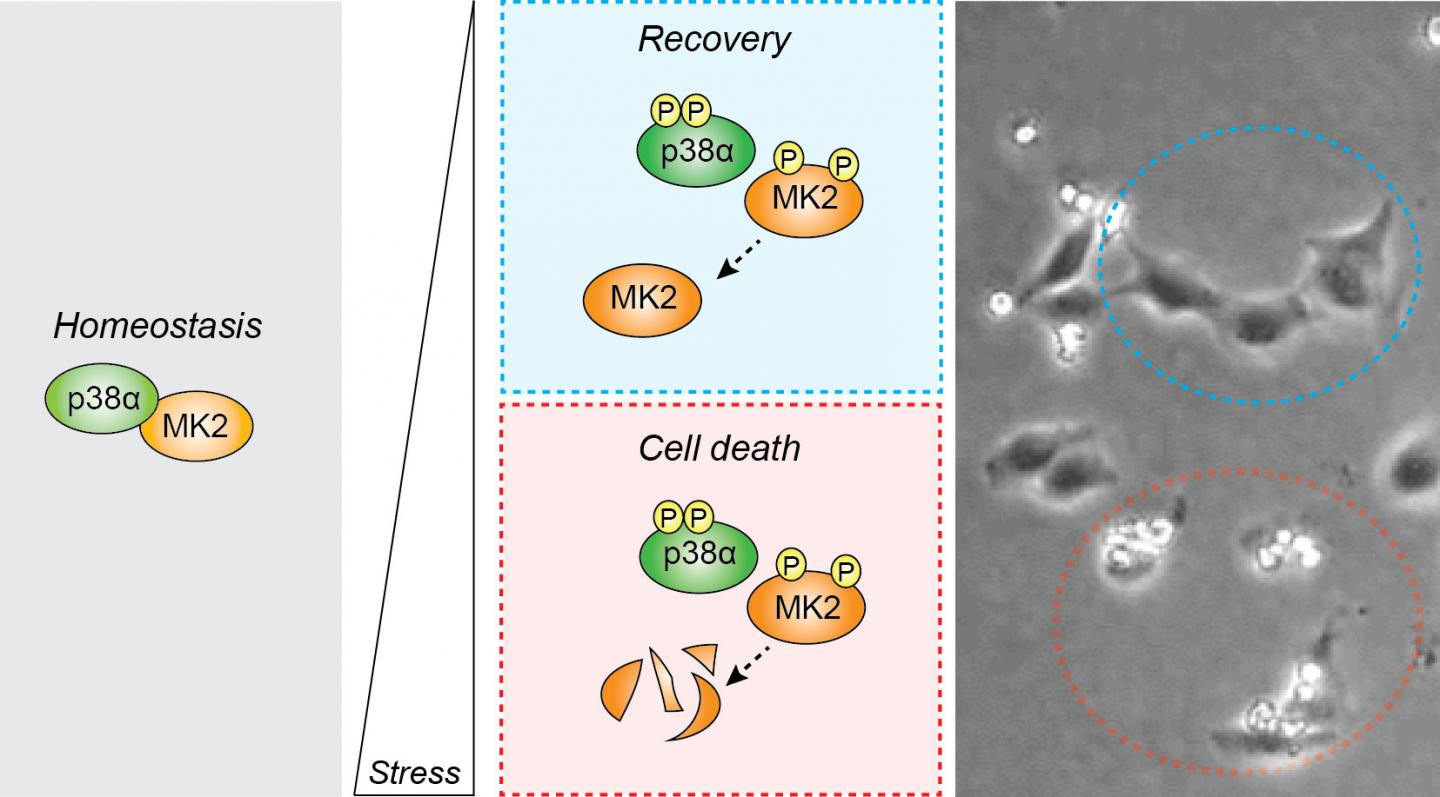
Living organisms are often exposed to stress stimuli generated either by external or internal factors, and they need to respond accordingly. At a cellular level, stress usually triggers the activation of survival pathways that contribute to the recovery of cell homeostasis. However, when stress is too high, a process of cell death is initiated that eliminates the damaged cell.

Scientists led by ICREA researcher Dr. Angel Nebreda, head of the Signalling and Cell Cycle laboratory at IRB Barcelona, have identified an important role of the p38-MK2 pathway in determining cell fate in response to stress.

“Our study describes a molecular mechanism that cells can use to translate the stress-induced activation of the p38a-MK2 pathway into an appropriate biological response,” says Dr. Nebreda.

When cells are exposed to high levels of stress, the p38-MK2 pathway is activated in a sustained manner, promoting the degradation of the MK2 protein, which correlates with cell death. However, moderate levels of stress trigger only a temporary activation of the p38-MK2 pathway, which allows the re-accumulation of MK2 and leads to cell survival. Thus, MK2 protein levels act as a molecular indicator that informs cells whether to stay alive or to initiate self-destruction.

“By using human and mouse cell lines treated with different stress stimuli, we showed that MK2 expression levels are regulated by stress intensity and that they are critical for the viability of stressed cells,” explains Dr. Núria Gutiérrez-Prat, who started the work and is the first co-author of the article, together with Dr. Mónica Cubillos-Rojas and Dr. Begoña Canovas.

p38, a protein related to stress and cancer

p38 is a central protein that regulates many cellular processes by modulating the activity of a number of other proteins. Diseases such as cancer show alterations in the p38 pathway, and high p38 activity levels are sometimes linked to poor prognosis, for example in lung tumours. Moreover, the dysregulation of this p38-MK2 pathway has been linked to several human diseases, such as inflammatory disorders and cancer.

Further studies will investigate whether the regulation of the p38-MK2 pathway in response to strong or sustained stress functions as a common sensor of irreversible damage among cell types. Researchers will also study the possible relevance of these stress response mechanisms in causing diseases, and whether the stress response differs under pathological situations.

###

The study has been supported by the European Research Council (ERC), the Spanish Ministry of Science and Innovation (MICINN) and the Catalan Agency for Management of University and Research Grants (AGAUR).

Media Contact
Nahia Barberia
[email protected]

Related Journal Article

http://dx.doi.org/10.1073/pnas.2024562118

Tags: BiologyBiotechnologycancerCell BiologyGeneticsMedicine/HealthMolecular Biology
Share13Tweet8Share2ShareShareShare2

Related Posts

Forskolin Extract Boosts Gut Hormone GLP-1 and Strengthens Intestinal Barrier in Cell Study

Forskolin Extract Boosts Gut Hormone GLP-1 and Strengthens Intestinal Barrier in Cell Study

October 4, 2026
Empathy, Not Mood, Drives Helping in Autistic Children, Study Finds

Empathy, Not Mood, Drives Helping in Autistic Children, Study Finds

October 4, 2026

Simple Sugar Dextrose Emerges as Best Carbon Source for Zero-Exchange Shrimp Hatcheries

October 4, 2026

Nose-to-Brain Protein Delivery Shows Promise for Protecting Dopamine Neurons in Parkinson’s Models

October 4, 2026
Please login to join discussion

POPULAR NEWS

  • Alloys That Shrink Their Own Grains: New PIX Mechanism Refines Metals With Heat Alone

    Alloys That Shrink Their Own Grains: New PIX Mechanism Refines Metals With Heat Alone

    29 shares
    Share 12 Tweet 7
  • Endurance Exercise Reshapes the Liver in Males and Females Through Distinct Molecular Routes

    29 shares
    Share 12 Tweet 7
  • Single Transcription Factor PU.1 Rapidly Converts Fibroblasts into Macrophage-Lineage Cells

    29 shares
    Share 12 Tweet 7
  • New Scale Measures How Ready Nurse Educators Really Are for the AI Era

    29 shares
    Share 12 Tweet 7

About

We bring you the latest biotechnology news from best research centers and universities around the world. Check our website.

Follow us

Recent News

Alloys That Shrink Their Own Grains: New PIX Mechanism Refines Metals With Heat Alone

Endurance Exercise Reshapes the Liver in Males and Females Through Distinct Molecular Routes

Single Transcription Factor PU.1 Rapidly Converts Fibroblasts into Macrophage-Lineage Cells

Subscribe to Blog via Email

Enter your email address to subscribe to this blog and receive notifications of new posts by email.

Join 85 other subscribers
  • Contact Us

Bioengineer.org © Copyright 2023 All Rights Reserved.

Welcome Back!

Login to your account below

Forgotten Password?

Retrieve your password

Please enter your username or email address to reset your password.

Log In
No Result
View All Result
  • Homepages
    • Home Page 1
    • Home Page 2
  • News
  • National
  • Business
  • Health
  • Lifestyle
  • Science

Bioengineer.org © Copyright 2023 All Rights Reserved.