• HOME
  • NEWS
  • EXPLORE
    • CAREER
      • Companies
      • Jobs
    • EVENTS
    • iGEM
      • News
      • Team
    • PHOTOS
    • VIDEO
    • WIKI
  • BLOG
  • COMMUNITY
    • FACEBOOK
    • INSTAGRAM
    • TWITTER
Thursday, March 26, 2026
BIOENGINEER.ORG
No Result
View All Result
  • Login
  • HOME
  • NEWS
  • EXPLORE
    • CAREER
      • Companies
      • Jobs
        • Lecturer
        • PhD Studentship
        • Postdoc
        • Research Assistant
    • EVENTS
    • iGEM
      • News
      • Team
    • PHOTOS
    • VIDEO
    • WIKI
  • BLOG
  • COMMUNITY
    • FACEBOOK
    • INSTAGRAM
    • TWITTER
  • HOME
  • NEWS
  • EXPLORE
    • CAREER
      • Companies
      • Jobs
        • Lecturer
        • PhD Studentship
        • Postdoc
        • Research Assistant
    • EVENTS
    • iGEM
      • News
      • Team
    • PHOTOS
    • VIDEO
    • WIKI
  • BLOG
  • COMMUNITY
    • FACEBOOK
    • INSTAGRAM
    • TWITTER
No Result
View All Result
Bioengineer.org
No Result
View All Result
Home NEWS Science News Chemistry

New discoveries and insights into the glass transition

Bioengineer by Bioengineer
July 16, 2021
in Chemistry
Reading Time: 2 mins read
0
IMAGE
Share on FacebookShare on TwitterShare on LinkedinShare on RedditShare on Telegram

IMAGE

Credit: Kato laboratory, IMR, Tohoku University

A collaborative group from Tohoku University and Johns Hopkins University have provided valuable insights into the glass transition.

When a liquid is cooled rapidly, it gains viscosity and eventually becomes a rigid solid glass. The point at which it does so is known as the glass transition.

But the exact physics behind the glass transition, and the nature of glass in general, still pose many questions for scientists.

Metallic Glasses (MGs) are highly sought after since they combine the flexibility of plastic with the strength of steel. They are amorphous materials with a disordered atomic structure and exhibit unique and divergent thermodynamic and dynamic characteristics, especially when approaching the glass-transition temperature.

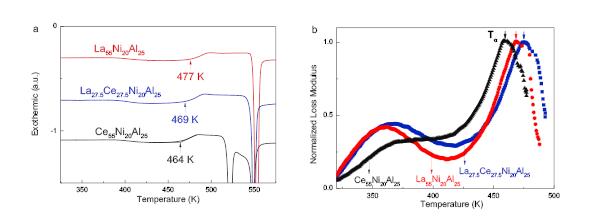
The glass transition in MGs is usually determined by calorimetric and dynamical measurements. The calorimetric glass transition detects the temperature at which specific heat has an abrupt jump, whereas dynamical transition looks at the diverse relaxation responses that emerge with increasing temperature forms.

Generally, the calorimetric glass-transition temperature follows the same trend as the dynamic α-relaxation temperature.

However, the collaborative group discovered that high configuration entropy significantly influences the glass transition of MGs and leads to the decoupling between calorimetric and dynamical glass transitions of high entropy metallic glasses.

The results of their research were published in the journal Nature Communication on June 22, 2021.

Their study presents a new glass-forming system that uses high configurational entropy, named high entropy metallic glasses (HEMGs).

The group featured Specially Appointed Professor Jing Jiang and Professor Hidemi Kato from the Institute for Materials Research at Tohoku University and Professor Mingwei Chen from Johns Hopkins University.

“We are excited about this discovery and believe this work furthers our understanding of the fundamental mechanism behind the glass transition,” said members of the research group.

###

Media Contact
Hidemi Kato
[email protected]

Original Source

https://www.tohoku.ac.jp/en/press/discoveries_and_insights_into_the_glass_transition.html

Related Journal Article

http://dx.doi.org/10.1038/s41467-021-24093-w

Tags: Chemistry/Physics/Materials SciencesMaterials
Share13Tweet8Share2ShareShareShare2

Related Posts

Isolated H2-Reduced Clusters Boost CO2-to-Methanol Catalysis

Isolated H2-Reduced Clusters Boost CO2-to-Methanol Catalysis

March 25, 2026
blank

Physicists Identify Electronic Drivers Behind Flat Band Quantum Materials

March 21, 2026

Würzburg Chemistry Professor Claudia Höbartner Receives Prestigious Honor

March 20, 2026

Scientists Reveal How Magnets Control Metamaterial Behavior

March 20, 2026
Please login to join discussion

POPULAR NEWS

  • blank

    Revolutionary AI Model Enhances Precision in Detecting Food Contamination

    96 shares
    Share 38 Tweet 24
  • Imagine a Social Media Feed That Challenges Your Views Instead of Reinforcing Them

    1003 shares
    Share 397 Tweet 248
  • Uncovering Functions of Cavernous Malformation Proteins in Organoids

    54 shares
    Share 22 Tweet 14
  • Promising Outcomes from First Clinical Trials of Gene Regulation in Epilepsy

    51 shares
    Share 20 Tweet 13

About

We bring you the latest biotechnology news from best research centers and universities around the world. Check our website.

Follow us

Recent News

In-Sensor Cryptography Links Physical Process to Digital Identity

Can Psychosocial Factors Influence Cancer Risk?

Depression Factors in Elderly: Pre vs. Post-COVID Analysis

Subscribe to Blog via Email

Success! An email was just sent to confirm your subscription. Please find the email now and click 'Confirm' to start subscribing.

Join 78 other subscribers
  • Contact Us

Bioengineer.org © Copyright 2023 All Rights Reserved.

Welcome Back!

Login to your account below

Forgotten Password?

Retrieve your password

Please enter your username or email address to reset your password.

Log In
No Result
View All Result
  • Homepages
    • Home Page 1
    • Home Page 2
  • News
  • National
  • Business
  • Health
  • Lifestyle
  • Science

Bioengineer.org © Copyright 2023 All Rights Reserved.